UNITED STATES
SECURITIES AND EXCHANGE COMMISSION
Washington, D.C. 20549
INFORMATION
Proxy Statement Pursuant to Section 14(a) of the
Securities Exchange Act of 1934
(Amendment No. )
Filed by the Registrant | ☒ |
Filed by a Party other than the Registrant | ☐ |
Check the appropriate box:
☒ | Preliminary Proxy Statement |
☐ | Confidential, for Use of the Commission Only (as permitted by Rule 14a-6(e)(2)) |
☐ | Definitive Proxy Statement |
☐ | Definitive Additional Materials |
☐ | Soliciting Material under Rule 14a-12 |
(Name of registrant as specified in its charter)
(Name of person(s) filing proxy statement, if other than the registrant)
Payment of Filing Fee (Check all boxes that apply):
☒ | No fee required. |
☐ | Fee paid previously with preliminary materials. |
☐ | Fee computed on table in exhibit required by Item 25(b) per Exchange Act Rules 14a-6(i)(1) and 0-11. |

PRELIMINARY PROXY STATEMENT SUBJECT TO COMPLETION
[March 25], 2026
Dear Fellow Shareholders:
You are cordially invited to attend the 2026 annual meeting of shareholders of Atlantic Union Bankshares Corporation to be held on Tuesday, May 5, 2026 at 10:00 a.m., Eastern Time. Our meeting will be held in a virtual-only format conducted via a live audio webcast at https://meetnow.global/MJ76S67. You will be able to participate in the virtual annual meeting online, vote your shares electronically during the meeting, and submit questions prior to and during the meeting. You will not be able to attend the meeting in person.
For more information on how to attend the annual meeting, please see the instructions in the accompanying proxy statement, beginning on page 4.
At the annual meeting, shareholders will be asked to:
| 1. | elect directors to serve until the 2027 annual meeting of shareholders; |
| 2. | approve an amendment to the Company’s Amended and Restated Articles of Incorporation (the “articles of incorporation”) to remove the supermajority voting requirement in Article V related to the removal of directors by shareholders; |
| 3. | approve an amendment to the Company’s articles of incorporation to remove the supermajority voting requirement in Article VII related to amendments to the articles of incorporation; |
| 4. | ratify the appointment of Ernst & Young LLP as our independent registered public accounting firm for the year ending December 31, 2026; |
| 5. | approve the compensation of our named executive officers (an advisory, non-binding “Say on Pay” resolution); and |
| 6. | transact any other business that may properly come before the meeting or any adjournments or postponements of the meeting. |
At the annual meeting, we will also report on our condition and performance in 2025, and you will have an opportunity to submit questions.
Your vote is very important. I encourage you to read our 2026 proxy statement, our 2025 annual report to shareholders, and the other proxy materials. Please submit your proxy as soon as possible by internet, telephone, or mail to ensure your vote is represented at the annual meeting, regardless of whether you plan to attend the meeting.
We value your continued support and loyalty. Thank you.
Very truly yours, | |
| |
John C. Asbury |
Atlantic Union Bankshares Corporation
4300 Cox Road
Glen Allen, Virginia 23060
NOTICE OF ANNUAL MEETING OF SHAREHOLDERS |
| | Date and Time: | |
| | Live Audio Webcast: |
Matters to be Voted on:
| 1. | Electing directors to serve until the 2027 annual meeting of shareholders; |
| 2. | A proposal to approve an amendment to the articles of incorporation to remove the supermajority voting requirement in Article V related to the removal of directors by shareholders; |
| 3. | A proposal to approve an amendment to the articles of incorporation to remove the supermajority voting requirement in Article VII related to amendments to the articles of incorporation; |
| 4. | A proposal to ratify the appointment of Ernst & Young LLP as our independent registered public accounting firm for the year ending December 31, 2026; |
| 5. | A proposal to approve the compensation of our named executive officers (an advisory, non-binding “Say on Pay” resolution); and |
| 6. | Any other business that may properly come before the meeting or any adjournments or postponements of the meeting. |
Record Date:
Our common shareholders, as of the close of business on March 11, 2026, are entitled to notice of and to vote at the annual meeting and any adjournments or postponements of the meeting.
Your Vote is Very Important:
Our annual meeting will be held solely by means of remote communication via a live audio webcast. You will be able to participate in the virtual annual meeting online, vote your shares electronically during the meeting, and submit questions prior to and during the meeting. You will not be able to attend the meeting in person.
Please submit your proxy as soon as possible by Internet, telephone, or mail to ensure your representation at the annual meeting, regardless of whether you plan to attend the meeting. Please refer to the discussion beginning on page 80 of the proxy statement for information on how to vote your shares and attend our annual meeting virtually.
By Order of the Board of Directors, | |
| |
Rachael R. Lape General Counsel/Corporate Secretary [March 25], 2026 | |
Important Notice Regarding the Availability of Proxy Materials for | |
PROXY STATEMENT |
Table of Contents
ATLANTIC UNION BANKSHARES | 2026 PROXY STATEMENT 2
GENERAL |
The Board of Directors (the “Board”) of Atlantic Union Bankshares Corporation is furnishing you with this proxy statement to solicit proxies on its behalf to be voted at our 2026 annual meeting of shareholders, or any adjournments or postponements of the meeting. As used in this proxy statement, the terms “the Company,” “we,” “us” and “our” refer to Atlantic Union Bankshares Corporation and its subsidiaries. Additionally, references to the “Bank” refer to Atlantic Union Bank.
Proxy Materials
We mailed to most of our shareholders a Notice of Internet Availability of our Proxy Materials (the “Notice of Internet Availability”) with instructions on how to access our proxy materials over the Internet and how to vote. The Notice of Internet Availability or, in some cases, this proxy statement, and the accompanying form of proxy, was first mailed to shareholders on or about [March 25], 2026. By furnishing proxy materials over the Internet, we are able to reduce the printing and mailing costs of this solicitation and help conserve natural resources. If you receive the Notice of Internet Availability but would still like to receive paper copies of the proxy materials, please follow the instructions on the Notice of Internet Availability.
Website
Website references throughout this proxy statement are provided for convenience only, and the content on the referenced websites is not incorporated by reference into this proxy statement.
ATLANTIC UNION BANKSHARES | 2026 PROXY STATEMENT 3
PROXY STATEMENT SUMMARY |
Voting Your Shares
You may vote at our 2026 annual meeting if you were a common shareholder as of the close of business on March 11, 2026.
| | Online Before the Meeting | |
| By Mail | |
| By Telephone |
| Online During the Meeting |
If you are a beneficial (or street name) holder and you would like to vote during the meeting, you must obtain a legal proxy from your bank, broker or other nominee and submit it to our transfer agent in advance of the meeting. See “Voting and Other Information” beginning on page 80 for more information.
Proposals For Your Vote | Board Voting | Page | ||||
1. | Election of directors | “FOR” each nominee | 5 | |||
2. | Approval of an amendment to the Company’s articles of incorporation to remove the supermajority voting requirement in Article V related to the removal of directors by shareholders | “FOR” | 18 | |||
3. | Approval of an amendment to the Company’s articles of incorporation to remove the supermajority voting requirement in Article VII related to approval of amendments to the articles of incorporation | “FOR” | 19 | |||
4. | Ratification of the appointment of our independent registered public accounting firm for 2026 | “FOR” | 20 | |||
5. | Approval of the compensation of our named executive officers (an advisory, non-binding “Say on Pay” resolution) | “FOR” | 21 | |||
Attending our Annual Meeting
To attend, vote, and submit questions during our annual meeting, visit https://meetnow.global/MJ76S67 and enter the control number found on your Notice of Internet Availability or on your proxy card. If you do not have a control number, you may still attend the meeting as a guest in listen-only mode, but you will not be able to vote your shares or otherwise participate in the meeting. If you hold your shares in street name through a bank, broker, or other nominee, you must register in advance of the meeting to vote and ask questions during the meeting. See “Attending Our Annual Meeting” beginning on page 83 for more information.
The live audio webcast of the meeting will begin promptly at 10:00 a.m., Eastern Time. We encourage you to access the meeting 15 minutes before the start time. If you experience technical difficulties in connecting to the meeting, you may call 1-888-724-2416 (Toll Free) or 1-781-575-2748 (International Toll). If we experience technical issues in convening or hosting the meeting, we will promptly post information on the Investor Relations > Company Info > Annual Reports & Proxy section of our website at www.atlanticunionbank.com, including when the meeting will be reconvened.
ATLANTIC UNION BANKSHARES | 2026 PROXY STATEMENT 4
PROPOSAL 1—ELECTION OF DIRECTORS |
Board Size
Our Amended and Restated Bylaws (the “bylaws”) provide that the number of directors on the Board will be fixed from time to time by the Board. As of the date of this proxy statement, the size of our Board is fixed at 17 directors. For information about anticipated changes in the size of our Board, please see the sections “Retiring Directors” beginning on page 5 and “Board Refreshment and Succession Planning” beginning on page 7.
Retirement Policy
Our bylaws and Corporate Governance Guidelines provide that no director may serve on the Board after the annual meeting following his or her 72nd birthday, other than those directors the Board has determined to be exempt from the mandatory retirement provision. Ms. Agee, who was appointed to the Board in connection with our acquisition of American National Bankshares Inc., turned 72 in 2024. Under the merger agreement with American National Bankshares Inc., following the closing of the merger, we agreed to nominate Ms. Agee for re-election to our Board at least until our 2027 annual meeting of shareholders, subject to certain exceptions. As a result, the Board has waived the mandatory retirement policy with respect to Ms. Agee and, pursuant to the merger agreement, intends to re-nominate Ms. Agee at least until our 2027 annual meeting of shareholders, subject to certain exceptions.
Retiring Directors
Patrick E. Corbin reached the mandatory retirement age applicable to directors as established by the Company’s bylaws. Accordingly, Mr. Corbin will retire from the Company’s Board effective at the 2026 annual meeting of shareholders, and the Board will reduce its size to 16 directors, effective as of the 2026 annual meeting date. Mr. Corbin has served as a director of the Company since 2018. The Company is grateful for Mr. Corbin’s leadership and contributions during his tenure on the Board.
Nominees for Election as Directors
Our directors are elected annually to a one-year term to expire at the next annual meeting of shareholders or until his or her successor is duly elected and qualified. All of our nominees are current directors standing for re-election.
Each director nominee has consented to being named in this proxy statement and to serving as a director if elected. If any nominee is unable to stand for election for any reason, the shares represented at our annual meeting may be voted for another candidate proposed by our Board, or our Board may choose to reduce its size.
ATLANTIC UNION BANKSHARES | 2026 PROXY STATEMENT 5
Nominee | Age+ | Principal Occupation | Director | Independent | Committee |
|---|---|---|---|---|---|
Mona Abutaleb Stephenson | 64 | Chief Executive Officer of Medical Technology Solutions | 2025 | Yes | Risk, Trust |
Nancy Howell Agee | 74 | Former President and Chief Executive Officer of Carilion Clinic | 2024 | Yes | Executive, Nominating and Corporate Governance, Risk |
John C. Asbury | 61 | President of the Company; Chief Executive Officer of the Company and Bank | 2016 | No | Executive |
Rilla S. Delorier | 59 | Former Executive Vice President and Chief Strategy and Digital Transformation Officer at Umpqua Bank | 2022 | Yes | Compensation, Risk |
Frank Russell Ellett | 59 | President of Excel Truck Group | 2019 | Yes | Audit, Compensation |
Paul Engola | 54 | Former Deputy Group President of the Dynetics Group of Leidos Holdings, Inc. (“Leidos”) and Executive Vice President, National Security Space, for Leidos | 2023 | Yes | Nominating and |
Donald R. Kimble | 66 | Former Chief Financial Officer, Vice Chair and Chief Administrative Officer of KeyCorp and President of KeyBank NA | 2023 | Yes | Audit, Risk |
Patrick J. McCann | 69 | Former Chief Financial Officer of University of Virginia Foundation | 2004 | Yes | Nominating and |
Mark C. Micklem | 67 | Former Managing Director and Head of Financial Services Investment Banking for Robert W. Baird & Co. Incorporated | 2025 | Yes | Audit, Trust |
Michelle A. O’Hara | 50 | Chief Human Resources Officer of Humana Inc. | 2023 | Yes | Compensation (C), Trust |
Linda V. Schreiner | 67 | Former Senior Vice President of Markel Corporation | 2012 | Yes | Compensation, |
Daniel J. Schrider | 61 | Former Chief Executive Officer for Sandy Spring Bancorp, Inc. | 2025 | Yes | — |
Joel R. Shepherd | 62 | President, Virginia Home Furnishings, Inc. and 220 Self Storage, Inc. | 2024 | Yes | Audit, Trust (C) |
Ronald L. Tillett | 70 | Managing Director and Head, Mid-Atlantic Public Finance at Raymond James & Associates, Inc. | 2003 | Yes | Executive (C) |
Keith L. Wampler | 68 | Former Partner at PBMares, LLP | 2014 | Yes | Risk (C) |
ATLANTIC UNION BANKSHARES | 2026 PROXY STATEMENT 6
Nominee | Age+ | Principal Occupation | Director | Independent | Committee |
|---|---|---|---|---|---|
F. Blair Wimbush | 70 | Former Chief Real Estate and Corporate Sustainability Officer | 2018 | Yes | Compensation, |
* Excludes director service with companies merged with the Company.
+ All ages are reflected as of the 2026 annual meeting date.
Identifying and Evaluating Director Candidates
Our Board regularly reviews and evaluates its size and composition. Our Nominating and Corporate Governance Committee is responsible for identifying and recommending director candidates to our Board for nomination. The Board, in coordination with the Nominating and Corporate Governance Committee, also considers Board succession planning and committee membership. See “Board Refreshment and Succession” below. Our Nominating and Corporate Governance Committee uses a variety of methods for identifying potential director candidates, including third-party search firms, and will also consider candidates proposed by directors, management and by our shareholders.
When considering a candidate for membership on the Board, the Nominating and Corporate Governance Committee evaluates the collective contribution of qualifications, skills, and experience of Board nominees. The goal of that evaluation is to ensure that the Board, as a whole, possesses the necessary qualifications, skills, and experience relevant to the Company for effective oversight.
Consistent with our Corporate Governance Guidelines, which includes provisions with respect to the selection, composition and performance of the Board, the Nominating and Corporate Governance Committee seeks directors who:
| ● | demonstrate integrity, accountability, informed judgment, financial literacy, and vision; |
| ● | encompass a range of talent, skill and expertise sufficient to provide sound and prudent guidance, which would be of assistance to management in operating our business; |
| ● | can devote the necessary time to discharge their duties; and |
| ● | are prepared to represent the interests of all of our shareholders and not just one particular constituency. |
The Nominating and Corporate Governance Committee and the Board also believe it is important to have directors from various backgrounds and professions to ensure that the Board has a wealth of experiences to inform its decisions. Consistent with this philosophy, the Nominating and Corporate Governance Committee and the Board believe that heterogeneity contributes to the overall effectiveness of the Board, which is generally conceptualized expansively to include a wide array of qualities and attributes.
Under the merger agreement with American National Bankshares Inc., following the closing of the merger, we agreed to nominate Ms. Agee and Mr. Shepherd for re-election to our Board at least until our 2027 annual meeting of shareholders, subject to compliance by the Board with its fiduciary obligations and applicable law, including compliance with our organizational documents and corporate governance guidelines. In considering each of our directors for re-election, including Ms. Agee and Mr. Shepherd, in addition to the foregoing factors, the Nominating and Corporate Governance Committee also assesses each director’s performance, contribution, level of engagement, and meeting attendance record. See “Board and Committee Evaluations” beginning on page 32 for additional information on the Board’s self-evaluation process.
ATLANTIC UNION BANKSHARES | 2026 PROXY STATEMENT 7
Board Refreshment and Succession Planning
Our Board, with guidance from the Nominating and Corporate Governance Committee, takes a strategic approach to Board refreshment, succession planning, and director tenure. This includes regularly assessing director skills and qualifications, reviewing director tenure, evaluating Board size, and performing annual Board and committee evaluations. The Board and Nominating and Corporate Governance Committee consider succession planning and the Board’s size at least annually, considering, among other things, the current and future needs of the Company and its business, the Company’s strategy, the competitive and regulatory environment in which the Company operates, corporate governance best practices, peer practices, shareholder feedback, feedback received from Board evaluations, and the advice of third-party advisors.
As part of its regular succession planning process, the Nominating and Corporate Governance Committee annually engages in a review and analysis of Board composition, including identification of priority characteristics related to the breadth of experience and expertise of future director candidates. Our Board believes refreshment is critical for aligning Board expertise with our evolving corporate strategy and the changing competitive and regulatory environment, but recognizes new directors need time to become familiar with our business and develop relationships with other directors and management. Consequently, our Board believes that a range of tenures allows longer-serving directors to provide continuity, institutional knowledge of our business, and a deeper understanding of the competitive and regulatory environment, while newer directors bring fresh perspectives, viewpoints and experience. As a result of the Board’s ongoing refreshment efforts, the average tenure of directors standing for re-election at the 2026 annual meeting is 6.9 years.
Our Board’s membership typically grows for a time following acquisitions with the addition of select directors from the acquired bank who help the Board oversee integration and supplement our Board’s knowledge of such bank’s markets, customers, businesses and operations. Two directors joined our Board in 2024 and three directors joined in 2025 in connection with the completion of our acquisitions of American National and Sandy Spring, respectively. Accordingly, the size of our Board as of the date of this proxy statement is fixed at 17 directors.
As part of our Board’s ongoing review of refreshment and succession planning, our Board believes decreasing the size of the Board in the near-term would align with corporate governance best practices and enhance Board effectiveness. As further discussed under “Proposal 1 – Election of Directors – Retiring Director,” Mr. Corbin is retiring from our Board effective as of the 2026 annual meeting and the size of the Board will be reduced to 16 directors at such time. The Board anticipates that three additional directors will not be re-nominated for election to our Board effective as of the 2028 annual meeting of shareholders upon reaching the mandatory retirement age in accordance with our bylaws and Corporate Governance Guidelines. For more information about our retirement policy, please see “Proposal 1 – Election of Directors – Retirement Policy.” At this time, our Board does not anticipate filling these vacancies and expects to further reduce our Board size accordingly.
Skills Matrix and Description of Director Nominees’ Knowledge, Skills and Experience
The matrix below provides information regarding our director nominees’ knowledge, skills and experience that we believe are most relevant in light of our business, long-term strategies and risks. Our nominees represent a broad range of backgrounds and experience, and each nominee possesses numerous other competencies not identified below. Additional information on why we view such knowledge, skills and experience as important is discussed following the matrix. The fact that a nominee is not designated as having a particular attribute does not indicate that the nominee does not possess that attribute or would not be able to make a meaningful contribution to the Board’s decision-making or oversight in that area.
ATLANTIC UNION BANKSHARES | 2026 PROXY STATEMENT 8
Executive Leadership | ● | ● | ● | ● | ● | ● | ● | ● | ● | ● | ● | ● | ● | ● | ● | |
Finance and Accounting | ● | ● | ● | ● | ● | ● | ● | ● | ● | ● | ● | |||||
Banking/Financial Services | ● | ● | ● | ● | ● | ● | ● | ● | ● | ● | ||||||
Technology/Cybersecurity | ● | ● | ● | ● | ● | |||||||||||
Strategic Planning | ● | ● | ● | ● | ● | ● | ● | ● | ● | ● | ● | ● | ● | ● | ● | |
Human Capital/Compensation | ● | ● | ● | ● | ● | ● | ● | ● | ● | ● | ||||||
Risk Management | ● | ● | ● | ● | ● | ● | ● | ● | ● | ● | ● | ● | ● | ● | ||
Legal and Regulatory | ● | ● | ● | ● | ● | ● | ● | |||||||||
Retail Distribution/Marketing | ● | ● | ● | ● | ● | ● | ||||||||||
Mergers and Acquisitions | ● | ● | ● | ● | ● | ● | ● | ● | ● | ● | ● | ● | ● | ● |
Executive Leadership | | Human Capital/Compensation |
We value directors with experience serving as senior executives running public companies, private companies or other organizations, as this enhances the Board’s perspective of our operations and challenges. | Our success depends in part on our ability to attract, retain, develop and motivate our human capital, including our senior leadership. We value directors with experience in compensation, incentive planning and talent management. | |
Finance and Accounting | Risk Management | |
We use numerous financial metrics to measure our performance and we are subject to complex accounting and financial reporting requirements. We value directors with experience in finance and accounting, which helps them more effectively oversee and assess our operating and strategic performance and financial reporting. | Our Board plays a critical role in the oversight of risk. We value directors with experience in overseeing or managing risks and who understand the most significant risks that we face. | |
Banking/Financial Services | Legal and Regulatory | |
We value directors who have experience in our industry, which provides the Board with valuable insight into our challenges and opportunities. | We operate in a heavily regulated industry and we value directors with knowledge of the laws and regulations applicable to the banking industry and corporations generally. | |
Technology/Cybersecurity | Retail Distribution/Marketing | |
We rely on information technology systems to conduct our business. We value directors with experience in technology strategies and innovation and/or mitigating and managing cybersecurity risk, which helps enhance our oversight of technology and cybersecurity risks. | We provide products and services through our retail branch network and our technology offerings. We value directors with experience in building customer relationships, branding, and the use of digital marketing. | |
Strategic Planning | Mergers and Acquisitions | |
We value directors with experience in defining and driving strategic direction and growth, which helps the Board critically evaluate our strategic plans. | We evaluate strategic opportunities in accordance with our strategic plan and we value directors with experience with mergers and acquisitions. |
ATLANTIC UNION BANKSHARES | 2026 PROXY STATEMENT 9
Biographical Information of Our Director Nominees
Set forth below are each nominee’s name, age as of the date of the 2026 annual meeting, principal occupation, business experience, and U.S.-listed public company directorships held during the past five years. We also discuss the qualifications, attributes, and skills that led our Board to nominate each nominee for election as a director.
Mona Abutaleb Stephenson | ||
| Age 64 | Director Since 2025 | Solomons, Maryland | Other Public Company Boards: Pentair plc Ms. Abutaleb is the Chief Executive Officer of Medical Technology Solutions, LLC, a provider of technology solutions for the healthcare industry, a position she has held since December 2019. From 2013 to 2018, Ms. Abutaleb was the Chief Executive Officer of mindSHIFT Technologies, Inc., an IT outsourcing/managed services and cloud services provider, which was acquired by Ricoh Company, Ltd. in 2014. From 2006 to 2013, Ms. Abutaleb served as President and Chief Operating Officer of mindSHIFT. Ms. Abutaleb also served as Senior Vice President of Ricoh USA from 2015 to 2017 and as Executive Vice President of Ricoh Global Services from 2017 to 2018. Ms. Abutaleb served as a director of Sandy Spring Bancorp, Inc. (“Sandy Spring”) from 2015 until it merged with and into the Company on April 1, 2025. Ms. Abutaleb is also on the board of directors of Pentair plc (NYSE: PNR). Ms. Abutaleb’s extensive leadership experience as an executive of several technology companies allows her to contribute substantially to our Board. | |
Nancy Howell Agee | ||
| Age 74 | Director Since 2024 | Roanoke, Virginia | Other Public Company Board: Precigen, Inc. Ms. Agee is the former President and Chief Executive Officer of Carilion Clinic, a health care organization, a position she held from 2011 until her retirement in July 2024. Ms. Agee served as a director of American National Bankshares Inc. from 2019 until it merged with and into the Company on April 1, 2024. Ms. Agee serves as a director on one other public company board—Precigen, Inc., where she has served since 2024. Ms. Agee previously served on the board of Healthcare Realty Trust Incorporated from 2016 until 2025, as well as the board of RGC Resources, Inc. from 2005 until early 2026. She chairs the statewide economic development entity, Go VA, and serves on the Governor’s advisory committee for revenue estimates, GACRE. She also chairs the Virginia Foundation for Independent Colleges and serves as Vice Chair of the Virginia Business Higher Education Council. She is also the former Chair of the American Hospital Association. Ms. Agee received a B.S. in Nursing from the University of Virginia and a Master of Science in Nursing from Emory University. Ms. Agee’s extensive leadership experience as President and Chief Executive Officer of a large healthcare organization and her many years of service in the Roanoke market area allow her to contribute substantially to our Board. | |
ATLANTIC UNION BANKSHARES | 2026 PROXY STATEMENT 10
John C. Asbury | ||
| Age 61 | Director Since 2016 | Richmond, Virginia Mr. Asbury has been Chief Executive Officer “(CEO”) of the Company since January 2017, and President of the Company since October 2016. He also serves as Chief Executive Officer of the Bank, a position he has held since October 2016, and he previously served as President of the Bank from October 2016 until September 2017 and May 2018 until September 2018. Before joining us, he served as President and Chief Executive Officer of First National Bank of Santa Fe from February 2015 until August 2016. Before that, he served as Senior Executive Vice President and Head of the Business Services Group at Regions Bank from May 2010 until July 2014, after joining Regions Bank in March 2008 as Business Banking Division Executive. Mr. Asbury also served as a Senior Vice President at Bank of America in a variety of roles. Mr. Asbury received his B.S. degree in Business from Virginia Polytechnic Institute and State University and his M.B.A. from The College of William & Mary. Mr. Asbury’s extensive executive-level experience in the banking industry and his knowledge of our business allow him to contribute substantially to our Board. | |
Rilla S. Delorier | ||
| Age 59 | Director Since 2022 | Portland, Oregon | Other Public Company Boards: Coastal Financial Corporation and Wisdom Tree Investments, Inc. Ms. Delorier is the former Executive Vice President (“EVP”) and Chief Strategy and Digital Transformation Officer at Umpqua Bank, a position she held from 2017 until 2020. Before that, she held various roles at SunTrust Bank from 2006 until 2016, including EVP, Retail Bank, Chief Marketing Officer, and Wealth Management Marketing Director. She served as Chief Marketing Officer at PNC Advisors and as EVP of Customer Strategy at PNC Bank from 1999 to 2006. She has served on the boards of Central City Concern since 2018 and NYMBUS since November 2020. She also serves on the board of Coastal Financial Corporation, a publicly held company, a position she has held since November 2020, where she serves on the audit, technology, and compensation committees. She was appointed to the board of Wisdom Tree Investments, Inc., a publicly traded company, in 2023, where she serves on the technology strategy, and nominating and governance committees and chairs the compensation committee. Ms. Delorier received her B.S. in Marketing and Management from the University of Virginia and her M.B.A. from Harvard Business School. Ms. Delorier’s experience in the banking industry, particularly with product development, operations, cyber-security practices, strategic partnerships, and analytics, allows her to contribute substantially to our Board. | |
ATLANTIC UNION BANKSHARES | 2026 PROXY STATEMENT 11
Frank Russell Ellett | ||
| Age 59 | Director Since 2019 | Roanoke, Virginia | Other Public Company Board: RGC Resources, Inc. Mr. Ellett is the President of Excel Truck Group, a dealer and distributor for Freightliner and Mack trucks and Wabash National trailers with offices in Virginia, North Carolina and South Carolina and the President of Excel Equipment, a Case construction dealer and distributor with facilities in Virginia. Mr. Ellett has held various leadership roles at Excel Truck Group since 1997 and has been President of Excel and its predecessor companies since 2003. Before that he served in a variety of roles at Norfolk Southern Corporation from 1993 to 1997. He was a Supply Corps officer in the United States Navy from 1989 to 1991. In January 2026, he was appointed to serve on the board of directors of RGC Resources, Inc. He also serves as Chair of the Virginia Western Community College Foundation Board and as a board member of the Virginia Foundation For Independent Colleges, the North Carolina Auto Dealers Association, the Virginia Trucking Association and the Taubman Museum of Art. He is the past Chairman of the Business Council of the Roanoke/Blacksburg Region, a past board member of the South Carolina Trucking Association, and a past board member and former Board Chairman of North Cross School. Mr. Ellett received his B.A. in English from the University of Virginia and his M.B.A. from the Darden School of Business at the University of Virginia. Mr. Ellett’s executive-level experience running a multi-state business and his strong connections to Virginia allow him to contribute substantially to our Board. | |
Paul Engola | ||
| Age 54 | Director Since 2023 | McLean, Virginia Mr. Engola is the former Deputy Group President of the Dynetics Group of Leidos Holdings, Inc. (“Leidos”), a company engaged in the provision of scientific, engineering and information technology services and solutions in the areas of defense, intelligence, civil and health markets. Mr. Engola held such position from 2022 until 2024, and also served as Executive Vice President, National Security Space, for Leidos from 2021 until 2024. Before that, he was Chief Human Resources Officer and Head of Business Partnerships from 2018 until 2021 and Senior Vice President and Deputy Group President for Leidos’ Defense and Intelligence Group from 2017 until 2018. He served as Vice President, Transportation and Financial Solutions with Lockheed Martin Information Systems and Global Solutions before it merged with Leidos. Mr. Engola currently serves on the board of directors for the Space Foundation, a nonprofit organization committed to advancing the global space community. Mr. Engola has a Master of Business Administration from Stanford University, a Master of Science from Georgia Institute of Technology and a Bachelor of Science from Massachusetts Institute of Technology. Mr. Engola’s extensive business experience, including his expertise in executive leadership, technology, strategic planning, human capital management, risk management, and mergers and acquisitions, allows him to contribute substantially to our Board. | |
ATLANTIC UNION BANKSHARES | 2026 PROXY STATEMENT 12
Donald R. Kimble | ||
| Age 66 | Director Since 2023 | Cleveland Heights, Ohio Mr. Kimble is the former Chief Financial Officer of KeyCorp, the parent company to KeyBank NA, a position he held from June 2013 until his retirement in May 2023. During that time, he also served in other executive-level positions at KeyCorp, including as Vice Chairman from 2017 until his retirement and as Chief Administrative Officer from 2020 until his retirement. Mr. Kimble also served as Chairman and President of KeyBank NA from 2020 until his retirement. Before that, he was Executive Vice President and Chief Financial Officer of Huntington Bancshares, Inc. and Executive Vice President and Controller for AmSouth Bancshares. Mr. Kimble has a Bachelor of Science in Business Administration from Ohio State University. Mr. Kimble’s extensive executive-level experience in the financial services industry, including his service as a Chief Financial Officer of large public bank holding companies, allows him to contribute substantially to our Board. | |
Patrick J. McCann | ||
| Age 69 | Director Since 2004 | Greensboro, Georgia Mr. McCann is the former Chief Financial Officer of the University of Virginia Foundation, a position he held from 2009 to 2020. Before that, he served as a Senior Finance Executive for Bank of America-Florida Division from 1998 to 2000. He held positions with Barnett Banks, Inc., including as Corporate Director of Finance from 1996 to 1998 and Corporate Controller and Chief Accounting Officer from 1992 to 1996. Mr. McCann received his B.S. degree in accounting from Florida State University. Mr. McCann’s extensive experience in financial management and accounting both within and outside of the banking industry allows him to contribute substantially to our Board. | |
ATLANTIC UNION BANKSHARES | 2026 PROXY STATEMENT 13
Mark C. Micklem | ||
| Age 67 | Director Since 2025 | Alexandria, Virginia Mr. Micklem retired from Robert W. Baird & Co. Incorporated in 2018 where he was a Managing Director and Head of Financial Services Investment Banking for 12 years. While at Baird, Mr. Micklem focused on providing capital financing and merger and acquisition (“M&A”) advisory services to banks and other financial services companies. Prior to joining Baird, Mr. Micklem was head of the Financial Services Investment Banking Group at Legg Mason for ten of his 21 years there. As a senior investment banker, Mr. Micklem was responsible for originating over 200 financing and M&A advisory assignments for financial services companies. As Head of Financial Services Investment Banking at both Baird and Legg Mason, he also oversaw teams of professionals and was responsible for meeting group business and revenue goals and objectives. Throughout his career, Mr. Micklem regularly advised public and private company boards of directors regarding capital financing, M&A and other financial/business matters. Mr. Micklem served as a director of Sandy Spring from 2019 until it merged with and into the Company on April 1, 2025. Mr. Micklem’s extensive experience in the investment banking and financial services industries allows him to contribute substantially to our Board. | |
Michelle A. O’Hara | ||
| Age 50 | Director Since 2023 | Reston, Virginia Ms. O’Hara is the Chief Human Resources Officer of Humana Inc., a position she has held since January 1, 2025. In this role, Michelle is responsible for leading Humana’s enterprise talent and culture strategy and people programs. Before that, she served as Executive Vice President and Chief Human Resources Officer for Science Applications International Corporation, Inc. (“SAIC”), a technology integrator and leader in digital transformation for federal government customers, a position she held from 2019 until 2024. Ms. O’Hara led SAIC’s human capital capabilities, including organizational design, culture transformation, talent management, upskilling and diversity, equity, and inclusion, as well as its marketing, communications and ESG functions. Before that, she held various executive-level positions at SAIC including Senior Vice President, Human Resources from 2018 until 2019 and Senior Vice President, Total Rewards from 2016 until 2018. Before SAIC, she served in senior leadership roles at global professional services and technology companies including BearingPoint, Perot Systems Corporation and Booz Allen Hamilton. Ms. O’Hara currently serves on the board of directors for the CHRO Association, the leading organization of large company Chief Human Resources Officers. Ms. O’Hara received her B.S. from the College of William and Mary. Ms. O’Hara’s extensive executive-level experience in human resources, human capital management, marketing, communications and ESG at a large public company allows her to contribute substantially to our Board. | |
ATLANTIC UNION BANKSHARES | 2026 PROXY STATEMENT 14
Linda V. Schreiner, Vice Chair of the Board | ||
| Age 67 | Director Since 2012 | Richmond, Virginia Ms. Schreiner is a former Senior Vice President of Markel Corporation, a financial holding company with specialty insurance and reinsurance and venture businesses, a position she held from 2016 until 2022. Before that, she served as Senior Vice President of MeadWestvaco, a global packaging company, from 2000 to 2016. She was a Senior Manager, Strategy Consulting of Arthur D. Little, Inc. from 1998 to 2000, and served as Vice President of Signet Banking Corporation from 1988 to 1998. She served as a member of the Darden School of Business Corporate Advisory Board at the University of Virginia from 2014 to 2017 and as Chair of the Board of Directors of Virginia War Memorial Foundation from 2020 to 2022, and she has served as a member of their board since 2009. She was the past President of ChildSavers’ board of directors from 2014 to 2016 and a member of that board since 2008 and a member of ChildSavers’ Endowment Board since 2016. She served as a member of The Richmond Forum board of directors from 2019 to 2025. She served as a member of the Executive Committee of Venture Richmond from 2006 to 2014, as Vice Chairman of the board of directors for the Virginia Commonwealth University (“VCU”) Rice Center until 2012, and as a member of that board from 2008 to 2012. Ms. Schreiner received her B.A. degree from the University of Georgia and M. Ed. from the University of Vermont. Ms. Schreiner’s extensive human resources, corporate strategy, communications and leadership experience at large public companies allows her to contribute substantially to our Board. | |
Daniel J. Schrider | ||
| Age 61 | Director Since 2025 | Mount Airy, Maryland Mr. Schrider joined Sandy Spring Bank in 1989 as a commercial lender and became an executive and Sandy Spring Bank’s Chief Credit Officer in 2003. He was named President and Chief Executive Officer of Sandy Spring in 2009, a position he held until Sandy Spring’s merger with and into the Company on April 1, 2025. Mr. Schrider also served as a director of Sandy Spring from 2009, and as chair of the Sandy Spring board of directors from 2023, until it merged with and into the Company on April 1, 2025. Mr. Schrider holds a bachelor’s degree from the University of Maryland and an MBA from Mount St. Mary’s University. Mr. Schrider is also a graduate of the American Bankers Association Stonier Graduate School of Banking. A leader among community bankers, Mr. Schrider has served previously as a director of the American Bankers Association, the chair of the Maryland Bankers Association, and a chair of the Stonier Graduate School of Banking Advisory Board. Mr. Schrider’s extensive leadership experience in the banking industry and knowledge of Sandy Spring will allow him to contribute substantially to our Board. | |
ATLANTIC UNION BANKSHARES | 2026 PROXY STATEMENT 15
Joel R. Shepherd | |||
| Age 62 | Director Since 2024 | Roanoke, Virginia Mr. Shepherd is President of Virginia Home Furnishings, Inc., a furniture retailer, a position he has held since 1997. He also serves as President of 220 Self Storage, Inc., a self-storage provider, a position he has held since 1996. Mr. Shepherd served as a director of American National Bankshares Inc. from 2015 until it merged with and into the Company on April 1, 2024. He is the former Chairman of Franklin Community Bank, N.A. and MainStreet BankShares, Inc. (acquired by American National in 2015). He was Vice President and Portfolio Manager in the Funds Management Division of Dominion Bankshares, Inc. (acquired by First Union Corporation, now part of Wells Fargo & Company) from 1986 to 1993. Mr. Shepherd brings substantial entrepreneurial, construction, finance and management skills gained through his various enterprises, as well as banking and investment experience, which allows him to contribute substantially to our Board. | ||
Ronald L. Tillett, Chair of the Board | ||
| Age 70 | Director Since 2003 | Midlothian, Virginia Mr. Tillett is a Managing Director and Head of Mid-Atlantic Public Finance at Raymond James & Associates, Inc., a position he has held since 2001. Before that, he served as the Secretary of Finance of the Commonwealth of Virginia from 1996 to 2001, and as State Treasurer of the Commonwealth of Virginia from 1991 to 1996. He is a member of the Christopher Newport University (“CNU”) Board of Visitors, Chairman of CNU Foundation Investment Committee, a member of the Board of Trustees of the Wason Center for Civic Leadership, and a member of the Commonwealth Debt Capacity Advisory Committee since 2010. He is also a member of the Board of Trustees of the National Institute of Public Finance, Pepperdine University since 2014. He holds FINRA Series 7, 50, 52, 53, 54, 63, 79, and 99 securities licenses and has passed the SEC Securities Industry Examination. Mr. Tillett received his B.S. degree from VCU. Mr. Tillett’s extensive experience in corporate governance, public finance and debt issuance management, and the investment practices and policies of public entities, as well as his experience as former State Treasurer and Secretary of Finance of the Commonwealth of Virginia, where he had direct responsibility for the financial functions of the Virginia state government, allow him to contribute substantially to our Board. | |
ATLANTIC UNION BANKSHARES | 2026 PROXY STATEMENT 16
Keith L. Wampler | ||
| Age 68 | Director Since 2014 | Fredericksburg, Virginia Mr. Wampler is a retired Partner at PBMares, LLP, a regional certified public accounting and consulting firm with twelve offices in Virginia, Maryland and North Carolina. He also served as Chairman of the firm’s board of directors from 2013 until 2022. Before that, he served as a managing partner of PBMares’ predecessor firm from 2001 to 2012. He is an advisory member of the board of directors of Hilldrup, a private company, a founding board member of the Community Foundation of the Rappahannock River Region, a board member of the Fredericksburg Regional Food Bank, a committee member of the Mary Washington Healthcare board, and former member of the board of directors of StellarOne Bank. Mr. Wampler received his B.S. degree from Bridgewater College. Mr. Wampler’s extensive experience in financial, tax and consulting services and involvement with sales, mergers and acquisitions of numerous companies allows him to contribute substantially to our Board. | |
F. Blair Wimbush | ||
| Age 70 | Director Since 2018 | Virginia Beach, Virginia | Other Public Company Board: Armada Hoffler Properties, Inc. Mr. Wimbush is the former Chief Real Estate and Corporate Sustainability Officer of Norfolk Southern Corporation (“Norfolk Southern”), a transportation company, a position he held from November 2007 to May 2015. Before that, he served in other positions with Norfolk Southern, including as Vice President—Real Estate from 2004 to 2007 and as Senior General Counsel, General Counsel—Operations and in other legal positions from 1980 to 2004. He is a member of the board of Lifenet Health, Inc. and in 2024, he joined the board of Armada Hoffler Properties, Inc., a publicly traded company, where he serves on the audit and nominating and corporate governance committees. He is a trustee emeritus at the University of Virginia Law School Foundation, where he formerly served as the Chairman. He is also the former Commissioner and Vice Chairman of the Virginia Port Authority. Mr. Wimbush received a B.A. in political science from the University of Rochester, and a J.D. from the University of Virginia School of Law. He attended the Norfolk Southern Management Development program, Duke University Fuqua School of Business and completed the Advanced Management Program at the Harvard Business School. Mr. Wimbush’s extensive experience in a highly regulated industry with a focus on development and implementation of sustainability principles and strategy, management of regulatory and risk mitigation matters, and policy development, as well as his background practicing law in areas of real estate development, antitrust, environmental and safety allows him to contribute substantially to our Board. | |
| Our Board recommends you vote “FOR” each of the nominees listed above for election as a director. |
ATLANTIC UNION BANKSHARES | 2026 PROXY STATEMENT 17
PROPOSAL 2—ApprovAL OF an amendment to the Company’s articles of incorporation to Remove THE supermajority VOTING REQUIREMENT IN ARTICLE V RELATED TO the REMOVAL OF directorS BY SHAREHOLDERS |
Article V of our amended and restated articles of incorporation (the “articles of incorporation”) currently includes a supermajority voting requirement, providing that our directors may only be removed for cause by shareholders by the affirmative vote of at least two-thirds of our outstanding shares entitled to vote.
The Board, after careful consideration and upon the recommendation of our Nominating and Corporate Governance Committee, determined that it is in the best interests of the Company and its shareholders to amend the articles of incorporation to remove this supermajority voting requirement.
If approved, the amendment to the articles of incorporation proposed under this Proposal 2 would reduce the vote requirement for shareholders to remove a director for cause to a majority of the outstanding shares entitled to vote.
In making this recommendation, the Nominating and Corporate Governance Committee and the Board considered, among other factors, our overall corporate governance structure and certain of the principal positions for and against the current vote standard and reviewed trends and best practices in corporate governance, as well as the corporate governance practices and policies of a number of other corporations.
The Board believes that the removal of the above-mentioned supermajority voting requirement will reinforce the Board’s accountability to our shareholders and provide our shareholders with greater ability to participate in our corporate governance.
The description of the amendment proposed under this Proposal 2 is qualified in its entirety by reference to the full text of the amendment to Article V attached hereto as Appendix A, which shows proposed deletions by strikethrough text and proposed additions by bold underlined text.
If Proposal 2 is approved by our shareholders at the 2026 annual meeting, we expect to deliver, as soon as reasonably practicable, to the Virginia State Corporation Commission articles of amendment or restatement reflecting such approval. Although we intend to file the amendment or restatement with the Virginia State Corporation Commission as soon as reasonably practicable after the amendment is approved by shareholders, the Board reserves the right to delay or abandon the amendment at its discretion.
| Our Board recommends you vote “FOR” the approval an amendment to the Company’s articles of incorporation to remove the supermajority voting requirements in Article V related to the removal of directors by shareholders. |
ATLANTIC UNION BANKSHARES | 2026 PROXY STATEMENT 18
PROPOSAL 3—ApprovAL OF an amendment to the Company’s articles of incorporation to REMOVE THE supermajority vOTING REQUIREMENTS IN ARTICLE VII RELATED TO amendments to the articles of incorporation |
Article VII of our articles of incorporation currently provides that our articles of incorporation can be amended by the shareholders by a majority of the votes entitled to be cast; provided, that, the amendment has been approved and recommended by at least two-thirds of our directors in office at the time of such approval and recommendation. If such amendment has not been so approved, then such amendment is subject to a supermajority voting requirement that requires the affirmative vote of 80% or more of all votes entitled to be cast by each voting group entitled to vote on such amendment.
The Board, after careful consideration and upon the recommendation of our Nominating and Corporate Governance Committee, determined that it is in the best interests of the Company and its shareholders (i) to amend the articles of incorporation by removing this supermajority voting requirement in Section VII with respect to amendments to our articles of incorporation, and (ii) adding a new Section VIII that provides that any amendment to the articles of incorporation that requires approval of our shareholders by law must be approved by at least a majority of all the votes entitled to be cast.
If approved, the amendment to the articles of incorporation proposed under this Proposal 3 would reduce the vote requirement for shareholders to amend our articles of incorporation to a majority of the votes entitled to be cast, regardless of whether at least two-thirds of our directors then in office have approved and recommended such amendment. In making this recommendation, the Nominating and Corporate Governance Committee and the Board considered, among other factors, our overall corporate governance structure and certain of the principal positions for and against the current vote standard and reviewed trends and best practices in corporate governance, as well as the corporate governance practices and policies of a number of other corporations.
The Board believes that the removal of the above-mentioned supermajority voting requirement will reinforce the Board’s accountability to our shareholders and provide our shareholders with greater ability to participate in our corporate governance.
The description of the amendments proposed under this Proposal 3 is qualified in its entirety by reference to the full text of the amendments to Article VII and the newly added Article VIII, attached hereto as Appendix B, which shows proposed deletions by strikethrough text and proposed additions by bold underlined text.
If Proposal 3 is approved by our shareholders at the annual meeting, we expect to deliver, as soon as reasonably practicable, to the Virginia State Corporation Commission articles of amendment or restatement reflecting such approval. Although we intend to file the amendment or restatement with the Virginia State Corporation Commission as soon as reasonably practicable after the amendment is approved by shareholders, the Board reserves the right to delay or abandon the amendment at its discretion.
| Our Board recommends you vote “FOR” the approval of an amendment to the Company’s articles of incorporation to remove the supermajority voting provision in Article VII related to approval of certain amendments to the articles of incorporation. |
ATLANTIC UNION BANKSHARES | 2026 PROXY STATEMENT 19
PROPOSAL 4—RATIFICATION OF THE APPOINTMENT OF OUR INDEPENDENT REGISTERED PUBLIC ACCOUNTING FIRM |
The Audit Committee is directly responsible for the appointment, compensation, retention, and oversight of our independent registered public accounting firm. The Audit Committee engages in an annual evaluation of the independent registered public accounting firm’s qualifications, assessing a wide variety of factors. The Audit Committee also considers whether there should be periodic rotation of the independent registered public accounting firm.
After assessing the performance and independence of Ernst & Young LLP (“EY”), our current independent registered public accounting firm, the Audit Committee believes it is in the best interests of the Company and its shareholders to retain EY. The Audit Committee has appointed EY as the independent registered public accounting firm to audit our financial statements for the year ending December 31, 2026. The Audit Committee seeks shareholder ratification of this appointment. EY has served as our independent registered public accounting firm since 2015. Although ratification of our independent registered public accounting firm is not required by our articles of incorporation, bylaws or otherwise, we are seeking such ratification as a matter of good corporate practice.
A representative from EY is expected to attend the annual meeting, will have the opportunity to make a statement if he or she desires to do so, and is expected to be available to respond to appropriate questions.
If our shareholders do not ratify the appointment of EY at the annual meeting, we currently contemplate that EY’s appointment for 2026 will continue unless the Audit Committee finds other compelling reasons for making a change. However, the Audit Committee will take this vote into consideration for the selection of our independent registered public accounting firm for 2027.
| Our Board recommends you vote “FOR” the ratification of the appointment of EY as our independent registered public accounting firm for the fiscal year ending December 31, 2026. |
ATLANTIC UNION BANKSHARES | 2026 PROXY STATEMENT 20
PROPOSAL 5—APPROVAL OF OUR NAMED EXECUTIVE OFFICER COMPENSATION (AN ADVISORY, NON-BINDING |
Section 14A of the Securities Exchange Act of 1934 (the “Exchange Act”) requires a separate and advisory (non-binding) shareholder vote to approve the compensation of our named executive officers disclosed in this proxy statement. This proposal, commonly known as a “Say on Pay” proposal, gives shareholders the opportunity to endorse or not endorse a company’s executive pay program. At our 2023 annual meeting of shareholders, our shareholders voted to conduct a Say on Pay vote every year, as recommended by our Board. Accordingly, each year, we provide our shareholders with the opportunity to cast an advisory (non-binding) vote on the compensation of our named executive officers as disclosed in this proxy statement under the heading “Compensation Discussion and Analysis,” the tabular disclosure regarding named executive officer compensation and the accompanying narrative disclosure.
We believe our compensation policies and procedures are strongly aligned with the long-term interests of our shareholders. Because your vote is advisory, it will not be binding on our Board. However, our Compensation Committee will take into account the outcome of the vote when considering future executive compensation decisions. The next Say on Pay vote is expected to take place at our 2027 annual meeting of shareholders.
Our shareholders are being asked to approve the following resolution:
“RESOLVED, that the shareholders of Atlantic Union Bankshares Corporation approve, on an advisory basis, the compensation of our named executive officers as disclosed in the Compensation Discussion and Analysis, the tabular disclosure regarding named executive officer compensation and the accompanying narrative disclosure in this proxy statement.”
| Our Board recommends you vote “FOR” the approval of the Say on Pay resolution set forth above. |
ATLANTIC UNION BANKSHARES | 2026 PROXY STATEMENT 21
OUR CULTURE |
Purpose and Core Values
Our culture is defined by our purpose to enrich the lives of the people and the communities we serve. Our core values guide our actions to further this purpose and shape how we come together to meet our various stakeholder needs and expectations. Our core values serve as the foundation for how we behave and operate as an organization and will influence our future success.
Our core values include being:
Caring. Working together toward common goals, acting with kindness, respect and a genuine concern for others
Courageous. Speaking openly, honestly and accepting our challenges and mistakes as opportunities to learn and grow
Committed. Driven to help our clients, teammates and the Company succeed, doing what is right and accountable for our actions

We are committed to cultivating an inclusive and welcoming workplace where teammate and customer perspectives are valued and respected. We also seek to foster a culture of giving back to the communities where our customers live, work, and play. Charitable donations, small business lending, volunteerism, teaching financial literacy and promoting service within our communities are some of the ways we give back.
Corporate Social Responsibility Practices
Our Board actively oversees current and emerging corporate social responsibility matters, including environmental, social, and governance (“ESG”) matters that are relevant to our business, operations, or that are otherwise pertinent to us and our shareholders, teammates, customers, communities, and parties with whom we do business. The Nominating and Corporate Governance Committee of our Board is the primary committee responsible for monitoring, evaluating and overseeing the implementation of our corporate responsibility strategy, which is established by our executive leadership, including Chief Executive Officer, Chief Financial Officer, General Counsel, and Chief Human Resources Officer. Our management level Corporate Responsibility Committee manages our corporate responsibility activities and makes recommendations to executive leadership on initiatives that support our corporate responsibility strategy. The Corporate Responsibility Committee also reports to the Nominating and Corporate Governance Committee, or the full Board, as appropriate, on developments in corporate responsibility and ESG, and on goals, strategies, opportunities, and risks with respect to our corporate responsibility activities.
ATLANTIC UNION BANKSHARES | 2026 PROXY STATEMENT 22
Corporate Social Responsibility Report
In March 2026, we expect to publish our Corporate Social Responsibility Report that will describe our corporate social responsibility initiatives in 2025. A copy of this report will be available on the Investor Relations > ESG section of our website at www.atlanticunionbank.com, which report should not be deemed to be a part of, or incorporated by reference into, this proxy statement.
Some of our key accomplishments in 2025 that reflect our commitment to appropriate corporate social responsibility practices are noted below.
Teammate Benefits and Work Environment |
We use the term “teammates” to describe our employees because we view the Company as one team, where everyone is valued for their contributions. We view our teammates’ experience holistically, and we strive to reward high performance and achievement, provide opportunity for professional growth, create a positive and engaging work environment, and focus on each teammate’s wellbeing.
In addition to offering competitive health plans, generous paid time off and robust retirement plans, we:
| ● | conduct annual anonymous teammate surveys to evaluate our culture and assess teammate engagement, innovation, trust and commitment, along with additional surveys to get feedback on timely or important workforce issues; |
| ● | have a teammate advisory group with teammates across different levels and business/functional areas to provide feedback on our culture, programs, benefits, policies, and other issues; |
| ● | provide teammates with professional development and skills training on a wide range of topics through our learning management system and/or learning experience platform, which includes e-learning, job aids, videos, instructor-led, and on-the-job practice supported by trained mentors; |
| ● | offer a 401(k) Plan that includes both a Company match and Company contributions to an Employee Stock Ownership Plan that allows eligible teammates to acquire shares of our common stock; and |
| ● | encourage our teammates’ professional development and reimburse eligible tuition expenses up to an annual limit. |
Inclusion and Belonging |
We are committed to fostering, cultivating, and preserving a culture of inclusion and belonging that welcomes varied backgrounds and experiences. We strive to foster a culture and workplace that, among other things, is inclusive and welcoming, treats everyone with respect and dignity, promotes people on their merits, and encourages different ways of thinking, ideas, perspectives, and values. To support our inclusion and belonging efforts, we:
| ● | maintain equal employment opportunity, anti-discrimination and anti-harassment policies that prohibit discrimination based on protected classifications and require that all teammates treat each other with respect; |
| ● | do not make employment decisions based on protected categories; |
| ● | maintain an online portal that allows teammates to raise workplace concerns and complaints anonymously and related policies and procedures that seek to ensure appropriate, retaliation-free handling of workplace concerns and complaints; and |
ATLANTIC UNION BANKSHARES | 2026 PROXY STATEMENT 23
| ● | have a dedicated teammate council, co-chaired by our Chief Executive Officer and our Chief Human Resources Officer, that is comprised of a cross-functional group of teammates with varied backgrounds and experiences, that helps manage our efforts to create a more inclusive workplace. |
Governance |
We believe that sound and effective corporate governance is the foundation on which to build our corporate culture and communicate our commitment to our core values. Our strong corporate governance policies and practices support our efforts to continue to enhance the value we create for our teammates, shareholders, customers and communities. By way of example, we have implemented a number of corporate governance actions to reflect strong governance practices, including those listed below and as further detailed in this proxy statement:
| ● | Our directors represent a well-rounded variety of skills, knowledge, experience, and perspectives. |
| ● | We separate the roles of Chief Executive Officer and Chair. |
| ● | We have a majority vote standard for uncontested director elections, as well as a Director Resignation Policy that requires any incumbent director nominee who fails to receive a majority of the votes cast to submit an offer of resignation to the Chair, and the Board, after reviewing the recommendation of the Nominating and Corporate Governance Committee, will determine whether to accept, reject, or take other action with respect to the resignation. |
| ● | At least four times per year, our independent directors hold an executive session without management present. |
| ● | Our Board has a robust annual self-evaluation process, overseen by our Nominating and Corporate Governance Committee, in which our directors evaluate how the Board and its committees are functioning. The Board also evaluates the individual performance of directors periodically with the assistance of a third-party consultant. |
| ● | Our directors are elected annually to serve a one-year term. |
| ● | Each share of our common stock has equal voting rights with one vote per share. |
| ● | We require that our executive officers and directors own a meaningful amount of our common stock pursuant to our Executive Stock Ownership Policy and Non-Employee Director Stock Ownership Policy. |
| ● | We prohibit our executive officers and directors from hedging and pledging our stock. |
Business Conduct |
We believe that one of our most valuable assets is our established reputation for integrity, and we are committed to a culture of compliance that promotes the highest ethical standards. Therefore, we:
| ● | have established a Code of Business Conduct and Ethics (“Code of Ethics”), which applies to all teammates and directors intended to, among other things, promote honest and ethical conduct, promote compliance with laws, protect our assets, promote fair dealing, deter wrongdoing and ensure accountability for adherence to the code; |
| ● | require all teammates and directors to annually certify that they have read, understand and will abide by the Code of Ethics; |
| ● | maintain an online portal through which teammates can anonymously report violations of the Code of Ethics and raise workplace concerns of any kind; |
ATLANTIC UNION BANKSHARES | 2026 PROXY STATEMENT 24
| ● | maintain a Conflicts of Interest Policy that requires directors and executive officers to disclose actual or potential conflicts of interest to the Audit Committee for review; |
| ● | maintain a Whistleblower Policy and an online portal through which teammates can anonymously communicate concerns regarding accounting, auditing, workplace, or other matters; |
| ● | require all teammates to complete and pass annual compliance training on key policies and procedures including, without limitation, our Code of Ethics, our Policy Statement on Insider Trading, our Whistleblower Policy, our Bank Secrecy Act/Anti-Money Laundering (“BSA/AML”) Program Policy and the Bank Bribery Act; |
| ● | maintain a Supplier Code of Conduct, which sets forth our expectations for honesty, integrity and professionalism in our relationship with suppliers; |
| ● | have established an ESG Risk Program as a component of enterprise risk management review that is designed to assist us in aligning with evolving regulatory expectations while driving strategic identification of key ESG risk exposures and opportunities across multiple business functions; |
| ● | have established an Office of the President, which oversees the enterprise complaint management function and monitors and responds to customer complaints, elevating such complaints as appropriate, in order to convert customer feedback into actionable improvements in how we run our business; and |
| ● | review our products and services to seek to ensure that they continue to address customer needs, are competitive, and are being delivered as disclosed and intended. |
Privacy and Cybersecurity |
We seek to mitigate cybersecurity risk and associated reputational and compliance risk by, among other things:
| ● | leveraging the National Institute of Standards and Technology framework, which organizes cybersecurity risks into five categories: identify, protect, detect, respond and recover; |
| ● | maintaining privacy policies, management oversight, accountability structures, and technology design processes to protect private and personal data; |
| ● | actively monitoring and mitigating cybersecurity threats and risks with a three lines of defense structure to provide oversight, governance, challenge, and testing; |
| ● | managing a third-party cybersecurity oversight program; |
| ● | maintaining oversight of our information security program by senior management, our board-level Risk Committee, and our Board; |
| ● | having a Chief Information Security Officer, who reports to the Chief Information Officer (“CIO”), to manage preventative and detective controls to protect against cybersecurity risks and responds to cyber incidents and data breaches; |
| ● | using a comprehensive Cybersecurity Incident Response Plan intended to provide a documented framework to enable us to mitigate the impact of, and recover from, any cyberattacks, and facilitate communication to internal and external stakeholders, as appropriate; and |
| ● | conducting annual mandatory teammate training on information security, and providing ongoing information security education and awareness for teammates, such as online training classes, mock phishing attacks and information security awareness materials. |
We had no material cybersecurity incidents in 2025.
ATLANTIC UNION BANKSHARES | 2026 PROXY STATEMENT 25
Community Engagement |
We are committed to enhancing and improving the communities where our customers live, work and play. Our sponsorship and giving strategies allow us to engage with our teammates and partners to enrich the lives of the people we serve.
| ● | To maximize and encourage community service, we provide full-time teammates up to 16 hours of paid time off and part-time teammates up to eight hours of paid time off to participate in volunteer activities. |
| ● | We encourage teammate charitable giving through our MyGiving program, where we match up to $500 annually of a teammate’s eligible donations. |
| ● | In 2025, we invested approximately $85 million in our community through investments in tax credit and other funds and loans, with a focus on maintaining and building affordable housing units; and corporate sponsorships, with a focus on financial education for all ages, and support of university athletics, area festivals and family events. |
ATLANTIC UNION BANKSHARES | 2026 PROXY STATEMENT 26
CORPORATE GOVERNANCE |
Corporate Governance Guidelines
Our Corporate Governance Guidelines and certain other corporate governance materials are published on the Investor Relations > Governance > Governance Documents section of our website at www.atlanticunionbank.com. Our Corporate Governance Guidelines address, among other topics: director selection, Board composition and performance; the Board’s relationship to management; Board meeting procedures; Board committee matters; and leadership development. The Nominating and Corporate Governance Committee regularly reviews developments in corporate governance and may recommend changes to these guidelines to the Board for approval.
Codes of Business Conduct and Ethics
We have a Code of Business Conduct and Ethics that applies to all of our directors, officers, and teammates, which is available on the Investor Relations > Governance > Governance Documents section of our website at www.atlanticunionbank.com. Teammates receive annual training on our Code of Business Conduct and Ethics.
In addition, we have adopted a Code of Ethics for Senior Financial Officers and Directors designed to promote ethical conduct which applies to, among other members of our executive and senior management teams and Board, our Chief Executive Officer, Chief Financial Officer and President. Our Code of Ethics for Senior Financial Officers and Directors is available on the Investor Relations > Governance > Governance Documents section of our website at www.atlanticunionbank.com.
We intend to provide any required disclosure of an amendment to or waiver from our Code of Business Conduct and Ethics or our Code of Ethics for Senior Financial Officers and Directors that applies to our principal executive officer, principal financial officer, principal accounting officer or controller, or persons performing similar functions, on our website at www.atlanticunionbank.com promptly following the amendment or waiver. We may elect to disclose any such amendment or waiver in a report on Form 8-K filed with the SEC either in addition to or in lieu of the website disclosure.
Conflicts of Interest Policy
We have a Conflicts of Interest Policy that applies to our directors and executive officers, which supplements the conflicts of interest provisions in our Code of Business Conduct and Ethics. The Conflicts of Interest Policy sets forth a process for handling potential conflicts of interest that includes disclosure to our General Counsel and review of the potential conflict of interest by the disinterested members of the Audit Committee.
Insider Trading Policy
Board of Directors Meetings and Attendance
Our directors are expected to devote sufficient time, energy and attention to ensure diligent performance of their duties, which includes attending all Board and committee meetings.
There were eight regular meetings of the Board in 2025. Each director attended 75% or more of the aggregate number of meetings of (a) the Board held during the period in which he or she was a director in 2025; and (b) the committees of the Board of which he or she was a member in 2025.
ATLANTIC UNION BANKSHARES | 2026 PROXY STATEMENT 27
Our Corporate Governance Guidelines state that directors are expected to attend our annual meeting of shareholders. Of the 14 directors who were serving at the time of our 2025 annual meeting of shareholders, all attended the meeting.
Director Independence
New York Stock Exchange (“NYSE”) listing standards require a majority of our directors and each member of our Audit Committee, Compensation Committee, and Nominating and Corporate Governance Committee to be independent. In addition, our Corporate Governance Guidelines require a majority of our directors to be independent. Our Board has adopted Categorical Standards for Director Independence (“Categorical Standards”), included as an Annex to our Corporate Governance Guidelines, published on the Investor Relations > Governance > Governance Documents section of our website at www.atlanticunionbank.com, to assist it in determining each director’s independence. Our Board considers directors or director nominees “independent” if they meet the criteria for independence in both the NYSE listing standards and our Categorical Standards.
In early 2026, our Board, in coordination with our Nominating and Corporate Governance Committee evaluated the relevant relationships between each director (and his or her immediate family members and affiliates) and the Company and its subsidiaries, and affirmatively determined that all of our directors are independent, except for Mr. Asbury, due to his employment by our Company. Specifically, the following directors are independent under NYSE listing standards and our Categorical Standards: Ms. Abutaleb, Ms. Agee, Mr. Corbin, Ms. Delorier, Mr. Ellett, Mr. Engola, Mr. Kimble, Mr. McCann, Mr. Micklem, Ms. O’Hara, Ms. Schreiner, Mr. Schrider, Mr. Shepherd, Mr. Tillett, Mr. Wampler and Mr. Wimbush.
Board Leadership Structure
The Board considers its structure and leadership annually. To date, we have chosen not to combine the positions of CEO and Chair of the Board. The Chair of the Board is a non-management director and the Chair and Vice Chair are elected annually by the other members of the Board. Ronald L. Tillett currently serves as Chair of our Board, and Linda V. Schreiner currently serves as Vice Chair of our Board. We believe that our leadership structure is appropriate because it contributes to Board independence and fosters balanced oversight of the Board’s functions and decision-making processes, while at the same time allowing the CEO to focus on the day-to-day leadership and operations of the Company.
Our CEO is a member of the Board and attends meetings of the Board. The President of the Bank is not a member of the Board but attends meetings of the Board to help provide the Board with insight into the business strategies, performance and operations of the Bank. Our CEO and President of the Bank engage in extensive dialogue and discussion with the Board on a wide range of topics including, without limitation, strategic direction, strategic initiatives, financial performance, line of business performance, line of business initiatives, industry trends and perspectives, regulatory matters, and risk matters. Our CEO, President of the Bank, members of our executive leadership, and other key leaders in the Company make frequent reports to the Board, often at the suggestion of our Chair or other directors, and answer questions posed by directors. Our CEO and President of the Bank engage in detailed discussions with the Board regarding the reasons for recommendations of our executive leadership.
Our Chair and Vice Chair of the Board meet regularly with our CEO to discuss matters of interest to the Board and to discuss potential agenda topics for Board meetings. Our Chair, with input from our Nominating and Corporate Governance Committee, annually reviews the Board’s committee structure and makes recommendations to the Board regarding the committee memberships of each director, including the proposed Chair for each committee.
In accordance with our Corporate Governance Guidelines, at least quarterly, the independent directors meet in executive session without management present. Our Chair, Mr. Tillett, presides at these executive sessions.
All of the members of our Board also serve as members of the board of directors of the Bank.
ATLANTIC UNION BANKSHARES | 2026 PROXY STATEMENT 28
Director Stock Ownership Requirement
Under our Non-Employee Director Stock Ownership Policy, non-employee directors are required to hold shares of our common stock equal in value to at least five times the amount of the annual non-employee director cash retainer. The purpose of the Non-Employee Director Stock Ownership Policy is to help align the interests of the Board with the interests of our shareholders. All of our directors are in compliance with the requirement of the Non-Employee Director Stock Ownership Policy, which provides newly elected or appointed directors a period of five years from the date of appointment or election to comply with the ownership requirement.
Role of the Board in the Oversight of Risk
The Board recognizes that it plays a critical role in the oversight of risk. As a financial institution, the very nature of our business involves oversight of the management of financial, operational, information technology, cybersecurity, credit, market, capital, interest rate, liquidity, reputation, strategic, legal, regulatory, compliance, model and other risks. The Board has established a risk oversight structure that seeks to ensure that applicable risks are identified, monitored, assessed, and mitigated appropriately. Our Board and management team are committed to continuously strengthening our risk management practices. The Board and management evaluate risks over a full spectrum of timeframes, from emerging risks to risks that we actively manage, and both the Risk Committee of the Board and the management-level Risk Committee receive presentations on, and discuss, emerging risks on at least a quarterly basis.
As a financial institution that is entrusted with the safeguarding of sensitive information, our Board believes that a strong enterprise cyber strategy is vital to effective cyber risk management. Accordingly, our Board is actively engaged in the oversight of our cyber risk profile, which includes, but is not limited to, risks from cybersecurity threats, enterprise cyber strategy and key cyber initiatives. Our Board regularly receives reports on such matters from our CIO, Chief Information Security Officer, and other relevant personnel. Our Board also meets with our internal and external auditors, and federal and state regulators to review and discuss reports on risk, examination, and regulatory compliance matters.
The Risk Committee of the Board is responsible for assisting the Board in its oversight of risk and for overseeing our enterprise risk management framework. The Risk Committee actively engages with management to establish risk management principles and to determine our risk appetite. Our Chief Risk Officer implements our enterprise risk management framework and reports directly to our CEO and the Risk Committee. The Risk Committee meets with the Chief Risk Officer and other members of management regularly to discuss major risk exposures and receives reports on and discusses risk levels and risk appetite in categories such as financial, operational, information technology, cybersecurity, credit, market, capital, interest rate, liquidity, reputation, strategic, legal, regulatory, compliance, and model risk, among others. The Risk Committee also approves, or recommends to the Board for approval, various risk management policies, standards, and guidelines, including without limitation policies regarding BSA/AML compliance and other regulatory compliance policies. Like the Board’s other committees, the Risk Committee regularly reports to the Board on its activities and makes recommendations to the Board.
In addition to the efforts of the Risk Committee, other committees of the Board consider risk within their areas of responsibility. The description of each Board committee below includes more information on the risk oversight activities of each committee.
The Board establishes the risk oversight structure; receives, reviews and discusses Risk Committee and other Board committee minutes and reports; and meets with management, internal and external auditors, and federal and state regulators to review and discuss reports on risk, examination, and regulatory compliance matters. We also engage with outside risk experts and industry groups, including other peer institutions, as needed, to help us evaluate potential future threats and trends, particularly with respect to emerging information security and fraud risks.
ATLANTIC UNION BANKSHARES | 2026 PROXY STATEMENT 29
Board Committees and Membership
The Board has a standing Audit Committee, Compensation Committee, Executive Committee, Nominating and Corporate Governance Committee, and Risk Committee. Additionally, the Board has a Trust Committee.
Charters describing the responsibilities of each of the Audit Committee, Compensation Committee, Executive Committee, Nominating and Corporate Governance Committee, Risk Committee and Trust Committee are available on the Investor Relations > Governance > Governance Documents section of our website at www.atlanticunionbank.com.
Our Board committees regularly make recommendations and report on their activities to the Board. Each committee may retain and obtain advice from internal or external financial, legal, accounting, or other advisors at their discretion. Our Board reviews our committee charters and committee membership at least annually. Brief summaries of the duties of our committees are set forth below, as well as the current members of each committee as of the date of this proxy statement.
Audit Committee | No. of Meetings in 2025: 10 | |
Members: | Key Responsibilities: ● Oversees the integrity of our financial statements ● Oversees the qualifications, performance, independence, and appointment of our independent registered public accounting firm ● Oversees the performance of our internal audit function and credit risk review ● Oversees our compliance with certain legal and regulatory requirements ● Oversees risks associated with, among others things, financial accounting and reporting, internal controls, and major financial risk exposures, including the steps taken by management to monitor and control such exposure Independence / Qualifications: ● All members who served on the Committee in 2025 were, and all current Committee members are, independent under NYSE listing standards, our Categorical Standards and the heightened independence requirements applicable to audit committee members under SEC rules ● All Committee members are financially literate in accordance with NYSE listing standards ● Mr. Corbin, Mr. Kimble and Mr. Micklem each qualify as an audit committee financial expert under SEC rules and have banking or related financial management expertise as defined by FDIC regulations |
ATLANTIC UNION BANKSHARES | 2026 PROXY STATEMENT 30
Compensation Committee | No. of Meetings in 2025: 6 | ||
Members: | Key Responsibilities: ● Establishes our executive compensation philosophy ● Reviews and approves, or recommends to the Board for approval, as applicable, the compensation to be paid to our executive officers (as defined in the charter), including our CEO ● Recommends non-employee director compensation for Board approval ● Oversees risks relating to our compensation policies and practices ● Reviews and recommends to the Board for approval, and administers our incentive and other equity-based compensation plans ● Oversees our employee benefit plans covering substantially all employees ● Oversees management succession planning (other than for the CEO, which is overseen by the Board) and our talent development programs Independence / Qualifications: ● All members who served on the Committee in 2025 were, and all current Committee members are, independent under NYSE listing standards, our Categorical Standards and the independence requirements applicable to compensation committee members under NYSE rules | ||
Nominating and Corporate Governance Committee | No. of Meetings in 2025: 6 | ||
Members: | Key Responsibilities: ● Identifies individuals to become Board members, and recommends to the Board for approval nominees for director ● Makes recommendations to the Chair of the Board regarding committee structure and membership, subject to Board approval ● Oversees the Company’s key corporate governance policies ● Oversees Board succession planning ● Oversees the Board’s formal annual self-evaluation process ● Monitors, evaluates and oversees the Company’s strategy on with respect to corporate social responsibility, and updates the Board on the Company’s efforts in those areas Independence / Qualifications: ● All members who served on the Committee in 2025 were, and all current Committee members are, independent under NYSE listing standards and our Categorical Standards | ||
ATLANTIC UNION BANKSHARES | 2026 PROXY STATEMENT 31
Executive Committee | No. of Meetings in 2025: 1 | |
Members: | Key Responsibilities: ● Acts, as needed, between meetings of the Board on delegated authority that confers on the Committee substantially all of the Board’s powers, except on matters reserved to the Board by law, our articles of incorporation or our bylaws Independence / Qualifications: ● Other than Mr. Asbury, all members who served on the Committee in 2025 were, and all current Committee members are, independent under NYSE listing standards and our Categorical Standards | |
Risk Committee | No. of Meetings in 2025: 7 | |
Members: | Key Responsibilities: ● Oversees our management of financial, operational, information technology (including cyber risk), credit, market, capital, liquidity, reputation, strategic, legal, regulatory, compliance, model and other risks ● Oversees our enterprise risk management framework and evaluates its adequacy and effectiveness ● Oversees management’s alignment of our risk profile to our strategic plan and aggregate risk appetite Independence / Qualifications: ● All members who served on the Committee in 2025 were, and all current Committee members are, independent under NYSE listing standards, our Categorical Standards and Federal Reserve Board rules | |
Trust Committee | No. of Meetings in 2025: 4 | |
Members: | Key Responsibilities: ● Oversees the trust and fiduciary activities of the Bank and seeks to ensure such activities are conducted in accordance with applicable laws, rules, regulations and prudent fiduciary practices Independence / Qualifications: ● All members who served on the Committee in 2025 were, and all current Committee members are, independent under NYSE listing standards and our Categorical Standards |
Board and Committee Evaluations
Our Board believes in a robust evaluation process that assesses the contributions and commitment of Board members and how the Board and its committees are functioning. In addition, each of our Board committees perform an annual self-assessment of the committee’s performance. The Board uses a self-evaluation process as its primary mechanism for assessing its performance, which is developed and administered by the Nominating and Corporate Governance Committee. Each year, all members of the Board complete a detailed questionnaire regarding the Board’s performance and the performance of Board committees. The Nominating and Corporate Governance Committee provides guidance to the Board on evaluation practices, oversees the conduct of the evaluations, and communicates the results of the evaluations, together with any recommended actions, to the Board. The Board also evaluates the individual performance of directors periodically with the assistance of a third-party consultant, and from time to time, may use a third party to evaluate the performance of the Board or Board committees.
ATLANTIC UNION BANKSHARES | 2026 PROXY STATEMENT 32
Communication with Directors
Our shareholders and other interested parties may communicate with the Board, any member of the Board individually or as a group (such as the Chair, or Lead Independent Director, as applicable, or the non-management or independent directors) by addressing correspondence to the Board of Directors or to the individual director and sending such communication by mail to the Corporate Secretary, Atlantic Union Bankshares Corporation, 4300 Cox Road, Glen Allen, Virginia 23060. All communications received will be forwarded to the Chair of the Board, or Lead Independent Director, as applicable (in the case of correspondence addressed to the Board of Directors or independent directors), or to the individual director.
Compensation Committee Interlocks and Insider Participation
For the year ended December 31, 2025, our Compensation Committee consisted of Ms. O’Hara (Chair), Ms. Delorier, Mr. Ellett, Ms. Schreiner and Mr. Wimbush. No member of our Compensation Committee in 2025 was, during the last fiscal year, an officer or employee of the Company or formerly an officer of the Company. In addition, none has had any relationship with the Company of the type that is required to be disclosed under “Interests of Directors and Executive Officers in Certain Transactions.” During 2025, none of our executive officers served as a member of the board of directors, compensation committee or other board committee performing equivalent functions of another entity that had one or more executive officers serving as a member of the board of directors or Compensation Committee of the Company.
DIRECTOR COMPENSATION |
The Board determines the compensation of its non-employee members after considering the recommendation of the Compensation Committee and the Compensation Committee’s independent compensation consultant. The Compensation Committee annually reviews data and analysis provided by its independent compensation consultant to assess the market competitiveness of the compensation structure of our non-employee directors. Following that review, the Compensation Committee approves and recommends to the Board for approval a compensation structure that is intended to provide a mix between cash and equity compensation that is market competitive based on the same peer group that is used by the Compensation Committee when reviewing executive compensation. Mr. Asbury does not receive any additional compensation for his service as a director or for attending any Board or committee meetings.
2025 Director Compensation
The table below sets forth the annual compensation of our non-employee directors for fiscal year 2025.
Amount of Cash Retainer |
| Position | |
$60,000 | Board Members | ||
$80,000 | Additional Fee to Chair | ||
$20,000 | Additional Fee to Vice Chair | ||
$22,500 | Additional Fee to Audit Committee Chair | ||
$16,000 | Additional Fee to Compensation and Risk Committee Chairs | ||
$14,000 | Additional Fee to Nominating and Corporate Governance and Trust Committee Chairs | ||
$15,000 | Additional Fee for Service as an Audit Committee Member | ||
$10,000 | Additional Fees for Service as a Committee Member (other than the Audit Committee or Executive Committee) | ||
Director Equity Retainer | |||
$80,000 issued in the form of unrestricted shares of our common stock | |||
ATLANTIC UNION BANKSHARES | 2026 PROXY STATEMENT 33
We also pay our Executive Committee members, other than Mr. Asbury, a per meeting fee of either $1,000, if the meeting is one hour or more, or $500, if the meeting is telephonic and lasts less than one hour.
Each member of the Board also serves as a director on the board of the Bank (the “Bank Board”). Directors do not receive additional compensation for service on the Bank Board. Further, directors generally do not receive compensation for service on any committee of the Bank Board, and no such fees were paid in 2025.
The following table summarizes the compensation paid to our non-employee directors during 2025.
2025 Director Compensation
| | | Change in | | | |||||
Pension | ||||||||||
Value and | ||||||||||
Fees | Nonqualified | |||||||||
Earned | Deferred | |||||||||
or Paid in | Stock | Compensation | All Other | |||||||
Cash(1) | Awards(2) | Earnings(3) | Compensation | Total | ||||||
Name | ($) | ($) | ($) | ($) | ($) | |||||
Nancy H. Agee |
| 81,000 |
| 79,990 |
| — |
| — |
| 160,990 |
Patrick E. Corbin |
| 108,500 |
| 79,990 |
| — |
| — |
| 188,490 |
Rilla S. Delorier |
| 80,000 |
| 79,990 |
| — |
| — |
| 159,990 |
Frank Russell Ellett(4) |
| 25,000 |
| 140,012 |
| — |
| — |
| 165,012 |
Paul Engola(4) |
| 20,000 |
| 140,012 |
| — |
| — |
| 160,012 |
Donald R. Kimble |
| 85,000 |
| 79,990 |
| — |
| — | 164,990 | |
Patrick J. McCann |
| 80,000 |
| 79,990 |
| — |
| — |
| 159,990 |
Mark C. Micklem | 61,667 | 59,989 | — |
| — | 121,656 | ||||
Michelle A. O’Hara |
| 90,667 |
| 79,990 |
| — |
| — |
| 170,657 |
Linda V. Schreiner |
| 106,333 |
| 79,990 |
| — |
| — |
| 186,323 |
Daniel J. Schrider |
| 45,000 |
| 59,989 |
| — |
| — |
| 104,989 |
Joel R. Shepherd | 99,000 | 79,990 | — |
| — | 178,990 | ||||
Mona Abutaleb Stephenson |
| 58,333 |
| 59,989 |
| — |
| — |
| 118,322 |
Ronald L. Tillett |
| 141,000 |
| 79,990 |
| — |
| — |
| 220,990 |
Keith L. Wampler |
| 101,000 |
| 79,990 |
| — |
| — |
| 180,990 |
F. Blair Wimbush |
| 95,000 |
| 79,990 |
| — |
| — |
| 174,990 |
(1) | Includes total compensation earned through Board fees, retainers and committee fees, whether paid or deferred. Refer to the “2025 Director Compensation” section for more information. |
(2) | Represents the aggregated grant date fair value of the awards computed in accordance with FASB ASC Topic 718. A discussion of our assumptions for stock-based compensation are found in Note 15, “Employee Benefits and Stock Based Compensation” to our consolidated financial statements included in our 2025 Annual Report on Form 10-K. |
(3) | Messrs. Corbin, Shepherd, Tillett and Wimbush elected to defer their stock awards for 2025 into the Virginia Bankers Association’s non-qualified deferred compensation plan for the Company. There were no above market or preferential earnings associated with the deferrals into this plan. |
(4) | Messrs. Ellett and Engola elected to receive stock in lieu of their annual cash Board member retainer for all of 2025. |
ATLANTIC UNION BANKSHARES | 2026 PROXY STATEMENT 34
AUDIT INFORMATION AND REPORT OF THE AUDIT COMMITTEE |
Principal Accountant Fees
Our independent registered public accounting firm, EY, billed the following fees for services provided to us for the audit of our annual financial statements for the fiscal years 2025 and 2024 and for other services rendered by EY during those periods:
| 2025 |
| 2024 |
| |||
Audit fees(1) | $ | 3,348,000 | $ | 2,381,000 | |||
Audit-related fees(2) |
| 40,000 |
| 40,000 | |||
Tax fees(3) |
| 285,409 |
| 107,700 | |||
All other fees |
| — |
| — | |||
Total | $ | 3,673,409 | $ | 2,528,700 | |||
(1) | Audit fees: Audit and review services, consents and comfort letters issued for our registration statements on Form S-3 and Form S-4, review of documents filed with the SEC, including the 2025 and 2024 proxy statements and audit of internal controls over financial reporting in accordance with Section 404 of the Sarbanes-Oxley Act and the Federal Deposit Insurance Corporation Improvement Act, and other accounting consultations billed as audit services. |
(2) | Audit-related fees: Includes the 2025 and 2024 audits of mortgage compliance. |
(3) | Tax fees: EY provided tax compliance and other tax advisory services related to the Company in both 2025 and 2024. |
The Audit Committee notes that EY performed no services for the Company, other than those enumerated above, for 2025 or 2024. As a result, the Audit Committee has determined that the provision of these services by EY is compatible with maintaining the firm’s independence from the Company. Any engagement beyond the scope of the annual audit engagement is required to be pre-approved by the Audit Committee.
Audit Committee Pre-Approval Policy
The Audit Committee, or a designated member of the Audit Committee, must pre-approve all auditing services, internal control related services and permitted non-audit services, subject to the de minimis exception for non-audit services that are approved by the Audit Committee prior to the completion of the audit, performed by the independent registered public accounting firm in order to assure that the provision of such services does not impair the registered public accountant’s independence. The Audit Committee may form and delegate authority to subcommittees, consisting of one or more members when appropriate, to grant pre-approvals of audit and permitted non-audit services, provided that decisions of such subcommittee to grant pre-approvals shall be presented to the full Audit Committee at its next scheduled meeting.
Audit Committee Report
This Audit Committee Report was approved and adopted by the Audit Committee on February 25, 2026. Our Board has a standing Audit Committee that currently consists of the independent directors whose names appear at the end of this Audit Committee Report.
While management has the primary responsibility for the financial statements and the reporting process, including our system of internal controls, the Audit Committee monitors and reviews our financial reporting process on behalf of the Board. The role and responsibilities of the Audit Committee are set forth in a written charter adopted by the Board. The Audit Committee reviews and reassesses its charter annually and recommends any changes to the Board for approval. Under applicable law, the Audit Committee has sole responsibility for the selection of our independent registered public accounting firm. The Audit Committee is also responsible for the compensation and oversight of our independent registered public accounting firm.
ATLANTIC UNION BANKSHARES | 2026 PROXY STATEMENT 35
Before appointing the independent registered public accounting firm each year, the Audit Committee completes an annual evaluation of the independent registered public accounting firm’s qualifications, including assessing the firm’s quality of service, the firm’s quality of communication and interaction with the firm, the firm’s sufficiency of resources, and the firm’s independence, objectivity, and professional skepticism. This evaluation includes whether the firm’s quality controls are adequate and the provision of permitted non-audit services is compatible with maintaining the firm’s independence. The results of all Public Company Accounting Oversight Board (United States) (“PCAOB”) examinations are discussed with the firm as part of this process. The Audit Committee also provides input to the independent registered public accounting firm with regard to engagement partner selection.
Our independent registered public accounting firm is responsible for performing independent audits of our consolidated financial statements and our internal control over financial reporting in accordance with the standards of the PCAOB and to issue reports thereon. The Audit Committee monitors and oversees these processes. The Audit Committee relies on the work and assurances of our management, which has the primary responsibility for financial statements and reports, and of the independent registered public accounting firm, which, in its reports, expresses an opinion on the conformity of our consolidated annual financial statements to accounting principles generally accepted in the United States of America and whether our internal controls over financial reporting were effective as of the end of the year.
In this context, the Audit Committee met and held discussions with management and representatives of EY with respect to our financial statements for the year ended December 31, 2025. Management represented to the Audit Committee that our consolidated financial statements were prepared in accordance with accounting principles generally accepted in the United States of America; and the Audit Committee reviewed and discussed our consolidated financial statements with management and the independent registered public accounting firm. The Audit Committee reviewed and discussed with the independent registered public accounting firm the critical audit matters arising in the audit of our financial statements and identified in EY’s audit report, which is included with our Annual Report on Form 10-K for the year ended December 31, 2025. The Audit Committee also reviewed and discussed with the independent registered public accounting firm the matters required to be discussed by the applicable requirements of the PCAOB and the SEC.
In addition, the Audit Committee discussed with the independent registered public accounting firm the auditors’ independence from the Company and its management, and the Audit Committee received the written disclosures and letter from the independent registered public accounting firm required by applicable requirements of the PCAOB regarding the independent registered public accounting firm’s communications with the Audit Committee concerning independence.
The Audit Committee also discussed with our internal auditors and the independent registered public accounting firm the overall scope and plans for their respective audits. The Audit Committee met with the internal auditors and the independent registered public accounting firm, with and without management in attendance, to discuss the results of their examinations, the evaluations of our internal controls, and the overall quality of our financial reporting. This included the Audit Committee’s monitoring of the progress of remediation of noted control deficiencies, if any, until resolved.
Based on the reviews and discussions referred to above, the Audit Committee recommended to the Board, and the Board has approved, that the audited financial statements be included in our Annual Report on Form 10-K for the year ended December 31, 2025 for filing with the SEC.
Respectfully submitted by the members of the Audit Committee,
Patrick E. Corbin, Chair
Frank Russell Ellett
Donald R. Kimble
Mark C. Micklem
Joel R. Shepherd
ATLANTIC UNION BANKSHARES | 2026 PROXY STATEMENT 36
EXECUTIVE OFFICERS |
Our current executive officers are:
Name |
| Age+ |
| Position |
|
John C. Asbury | 61 | President and CEO of the Company and CEO of the Bank | |||
Robert M. Gorman | 68 | Executive Vice President (“EVP”) and Chief Financial Officer (“CFO”) of the Company | |||
Maria P. Tedesco | 65 | EVP of the Company and President and Chief Operating Officer of the Bank | |||
Rachael R. Lape | 53 | EVP, General Counsel and Corporate Secretary of the Company | |||
Matthew L. Linderman | 51 | EVP of the Company and CIO of the Bank | |||
Clare Miller | 46 | EVP and Chief Human Resource Officer of the Company | |||
Shawn E. O’Brien | 54 | EVP of the Company and Consumer and Business Banking Group Executive of the Bank | |||
David V. Ring | 62 | EVP of the Company and Wholesale Banking Group Executive of the Bank | |||
Bradley S. Haun | 45 | EVP and Chief Risk Officer of the Company | |||
Douglas F. Woolley III | 68 | EVP of the Company and Chief Credit Officer of the Bank |
+All ages are reflected as of the 2026 annual meeting date.
Biographical information concerning our executive officers who are not directors follows. Biographical information for Mr. Asbury is included in “Proposal 1—Election of Directors—Biographical Information of Our Director Nominees” above.
Robert M. Gorman |
Mr. Gorman serves as EVP and Chief Financial Officer of the Company, positions he has held since July 2012. Before that he served as Senior Vice President and Director of Corporate Support Services with SunTrust Banks, Inc. from 2011 until 2012, and as Senior Vice President and Strategic Financial Officer of SunTrust Banks, Inc. from 2002 to 2011.
On May 20, 2025, Mr. Gorman notified the Company of his plan to retire from the position of Chief Financial Officer of the Company, which will be effective as of April 13, 2026. After such date, Mr. Gorman will continue his employment with the Company through September 30, 2026 as Executive Vice President and Senior Financial Advisor to, among other things, assist with the Chief Financial Officer transition. For more information, See "Compensation Discussion and Analysis - CFO Transition."
Maria P. Tedesco |
Ms. Tedesco serves as Chief Operating Officer of the Bank, a position she has held since January 2022, and as President of the Bank and Executive Vice President of the Company, positions she has held since September 2018. Before that, she served as Chief Operating Officer for Retail at BMO Harris Bank based in Chicago from 2016 to 2018, and as Senior Executive Vice President and Managing Director of Consumer Banking at Santander Bank, N.A. from 2013 to 2015. Before that, she held various positions with Citizens Financial Group, Inc. from 1994 to 2013.
Rachael R. Lape |
Ms. Lape serves as EVP, General Counsel and Corporate Secretary of the Company, positions she has held since September 2012. She also served as Associate Counsel of the Company from 2010 to 2012. Prior to joining the Company, from 2000 to 2009, she was in private practice with the law firms of Williams Mullen in Richmond; Goldberg Kohn in Chicago; and the law firm now known as K&L Gates in Chicago.
ATLANTIC UNION BANKSHARES | 2026 PROXY STATEMENT 37
Matthew L. Linderman |
Mr. Linderman serves as EVP of the Company and as Chief Information Officer of the Bank, positions he has held since February 2023. Before that, he served as Chief Technology Officer at PNC Financial Services Group, Inc. from 2020 to January 2023, and as its Senior Vice President, Data Center and Cloud Products, from 2019 to 2020. He served as Vice President, IT Infrastructure Engineering and Operations at CarMax from 2015 to 2019. Before that, he held various positions with Capital One from 1999 until 2015, most recently as its Vice President, Data Center Operations and Open Systems Hosting.
Clare Miller |
Ms. Miller serves as EVP and Chief Human Resources Officer of the Company, positions she has held since May 2022. Before that, she served as Chief Talent Officer/Head of Enterprise Talent at Huntington National Bank from November 2017 to May 2021. She served as Chief People Officer for Navigator Management Partners from June 2007 to November 2017. Before that, she held various human resource positions in the hospitality and professional services industries.
Shawn E. O’Brien |
Mr. O’Brien serves as EVP of the Company and Consumer and Business Banking Group Executive of the Bank, positions he has held since February 2019. Before that, he held various positions at BBVA Compass Bank, most recently as Executive Vice President, Consumer Segment Group and Business Planning from 2013 to 2018, and as Executive Vice President, Deposit and Payment Products, Strategic Planning and Corporate Planning and Analysis from 2005 to 2013. Before that, he was involved in retail brand strategy and product management at Huntington National Bank from 1998 to 2005.
David V. Ring |
Mr. Ring serves as EVP and Wholesale Banking Group Executive of the Company, positions he has held since September 2017. Before that, he served as Executive Vice President and Executive Managing Director at Huntington National Bank from December 2014 to May 2017. He served as Managing Director and Head of Enterprise Banking at First Niagara Financial Group from April 2011 to December 2014, and held various positions at Wells Fargo and its predecessor banks from January 1996 to April 2011, including Wholesale Banking Executive for Virginia to Massachusetts at Wachovia and Greater New York & Connecticut Region Manager.
Bradley S. Haun |
Mr. Haun serves as EVP and Chief Risk Officer of the Company, positions he has held since May 1, 2025. Before that, he served as EVP and Chief Audit Executive of the Company from August 16, 2021 to April 30, 2025. He served as corporate controller from September 1, 2015 to August 15, 2021 and as director of financial reporting and accounting policy from September 2011 to August 30, 2015.
Douglas F. Woolley III |
Mr. Woolley serves as EVP of the Company and Chief Credit Officer of the Bank, positions he has held since 2016. Before that, he served as EVP-Senior Credit Officer from 2010 to 2016 and as Chief Credit Officer from 2004 to 2010. Before joining the Company, he served as Managing Director-Credit for M-CAM from 2000 to 2004. He served in various roles at First Union National Bank, including Senior Vice President-Senior Real Estate Portfolio Manager for Central, Western and Eastern Virginia from 1995 to 2000, Special Assets Manager for Hampton Roads from 1993 to 1995 and Head of Commercial Real Estate-Charlotte office from 1987 to 1993. He also held various credit-related positions in management consulting and with First National Bank of Atlanta.
ATLANTIC UNION BANKSHARES | 2026 PROXY STATEMENT 38
STOCK OWNERSHIP OF DIRECTORS, EXECUTIVE OFFICERS AND CERTAIN BENEFICIAL OWNERS |
The following tables set forth certain information, as of February 20, 2026 (except to the extent indicated otherwise in the footnotes below) with respect to (a) the beneficial ownership of our common stock and depositary shares held by (i) each of our directors and director nominees, (ii) each of our named executive officers, and (iii) all of our current directors, director nominees and executive officers as a group, and (b) shareholders known to us to beneficially own more than 5% of our common stock. For purposes of these tables, beneficial ownership has been determined in accordance with the provisions of Rule 13d-3 of the Exchange Act. In general, beneficial ownership includes any shares of common stock or depositary shares as to which the individual has sole or shared voting or investment power. None of these persons has any right to acquire shares of our common stock or depositary shares, as applicable, within 60 days of February 20, 2026 through the exercise of any option, warrant or other right. None of the shares listed below are pledged as security. Fractional shares have been rounded down to the nearest whole share for purposes of this table. Percentage ownership is calculated based on 142,603,967 shares of our common stock outstanding as of February 20, 2026 and 6,900,000 depositary shares outstanding as of February 20, 2026.
Directors, Director Nominees and Executive Officers
| Common Stock |
| Depositary Shares | |||||
| Amount and |
|
| Amount and |
| |||
Nature of | Nature of | |||||||
Beneficial | Percent | Beneficial | Percent | |||||
Name of Beneficial Owner | Ownership | of Class | Ownership | of Class | ||||
Directors and Nominees who are not NEOs: |
|
|
|
|
|
| ||
Mona Abutaleb Stephenson | 13,292 | * | — |
| * | |||
Nancy Howell Agee | 36,168 |
| * | — |
| * | ||
Patrick E. Corbin(1) | 63,896 |
| * | — |
| * | ||
Rilla S. Delorier | 8,182 |
| * | — |
| * | ||
Frank Russell Ellett | 80,031 | * | — | * | ||||
Paul Engola | 7,327 | * | — | * | ||||
Donald R. Kimble | 11,911 |
| * | — |
| * | ||
Patrick J. McCann(2) | 32,826 |
| * | — |
| * | ||
Mark C. Micklem | 21,703 | * | — |
| * | |||
Michelle A. O’Hara | 4,911 |
| * | — |
| * | ||
Linda V. Schreiner | 24,455 |
| * | — |
| * | ||
Daniel J. Schrider | 178,784 | * | — |
| * | |||
Joel R. Shepherd | 112,468 |
| * | — |
| * | ||
Ronald L. Tillett(3) | 45,253 |
| * | — |
| * | ||
Keith L. Wampler(4) | 44,463 |
| * | — |
| * | ||
F. Blair Wimbush(5) | 18,968 |
| * | — |
| * | ||
NEOs: | ||||||||
John C. Asbury(6) | 280,777 |
| * | — |
| * | ||
Robert M. Gorman(7) | 96,601 |
| * | — |
| * | ||
Maria P. Tedesco(8) | 92,021 |
| * | 800 |
| * | ||
Matthew L. Linderman(9) | 15,119 |
| * | — |
| * | ||
David V. Ring(10) | 46,855 |
| * | — |
| * | ||
All Directors and Executive Officers as a Group (26 persons) | 1,366,146 |
| 0.96% | 800 |
| * | ||
* | Represents less than 1% of our common stock or depositary shares, as applicable. |
| (1) | Includes 32,505 shares of phantom stock allocated to Mr. Corbin’s account under the Virginia Bankers Association’s nonqualified deferred compensation plan for the Company. Includes 13,072 shares of common stock held indirectly by Mr. Corbin as Trustee of a trust. |
| (2) | Includes 201 shares of common stock registered in the name of Mr. McCann’s spouse. |
| (3) | Includes 10,389 shares of phantom stock allocated to Mr. Tillett’s account under the Virginia Bankers Association’s nonqualified deferred compensation plan for the Company. |
ATLANTIC UNION BANKSHARES | 2026 PROXY STATEMENT 39
| (4) | Includes 24,849 shares of phantom stock allocated to Mr. Wampler’s account under the Virginia Bankers Association’s nonqualified deferred compensation plan for the Company. |
| (5) | Includes 12,708 shares of phantom stock allocated to Mr. Wimbush’s account under the Virginia Bankers Association’s nonqualified deferred compensation plan for the Company. |
| (6) | Includes 50,190 shares of restricted stock over which Mr. Asbury has no investment power until such shares vest. |
| (7) | Includes 21,816 shares of restricted stock over which Mr. Gorman has no investment power until such shares vest. |
| (8) | Includes 24,301 shares of restricted stock over which Ms. Tedesco has no investment power until such shares vest. |
| (9) | Includes 9,519 shares of restricted stock over which Mr. Linderman has no investment power until such shares vest. |
| (10) | Includes 12,048 shares of restricted stock over which Mr. Ring has no investment power until such shares vest. |
5% Shareholders
| Common Stock | ||||
| Amount and Nature of |
| |||
Name and Address of Beneficial Owner |
| Beneficial Ownership |
| Percent of Class | (1) |
The Vanguard Group(2) |
| ||||
100 Vanguard Blvd. | |||||
Malvern, PA 19355 | 16,161,484 | 11.33% | |||
BlackRock, Inc.(3) |
| ||||
50 Hudson Yards | |||||
New York, NY 10001 | 18,960,082 | 13.30% | |||
Dimensional Fund Advisors LP(4) | |||||
6300 Bee Cave Road | |||||
Building One | |||||
Austin, TX 78746 | 7,839,696 |
| 5.50% | ||
State Street Corporation(5) One Congress Street, Suite 1 Boston, MA 02114 | 7,400,456 |
| 5.19% | ||
| (1) | Percentage ownership is calculated based on 142,603,967 shares of our common stock outstanding as of February 20, 2026. |
| (2) | Based solely on information as of September 30, 2025 contained in Amendment No. 8 to Schedule 13G filed with the SEC on October 30, 2025, which reported that The Vanguard Group had sole voting power over no shares, sole dispositive power over 15,083,555 shares, shared voting power over 888,601 shares and shared dispositive power over 1,077,929 shares. |
| (3) | Based solely on information as of April 30, 2025 contained in Amendment No. 6 to Schedule 13G filed with the SEC on May 5, 2025, which reported sole voting power over 18,721,602 shares and sole dispositive power over 18,960,082 shares. These shares may be owned by one or more of the following entities controlled by BlackRock, Inc.: BlackRock Life Limited; BlackRock Advisors, LLC; BlackRock (Netherlands) B.V.; BlackRock Institutional Trust Company, National Association; BlackRock Asset Management Ireland Limited; BlackRock Financial Management, Inc.; BlackRock Asset Management Schweiz AG; BlackRock Investment Management, LLC; BlackRock Investment Management (UK) Limited; BlackRock Asset Management Canada Limited; BlackRock Investment Management (Australia) Limited; BlackRock Fund Advisors (which beneficially owns 5% or more of the shares of common stock outstanding); and BlackRock Fund Managers Ltd. |
ATLANTIC UNION BANKSHARES | 2026 PROXY STATEMENT 40
| (4) | Based solely on information as of June 30, 2025 contained in Amendment No. 10 to Schedule 13G filed with the SEC on July 15, 2025, which reported sole voting power over 7,679,620 shares and sole dispositive power over 7,839,696 shares. Dimensional Fund Advisors LP, a registered investment adviser, furnishes investment advice to four registered investment companies, and serves as investment manager or sub-adviser to certain other commingled funds, group trusts and separate accounts (such investment companies, trusts and accounts, collectively referred to as the “Funds”). In certain cases, subsidiaries of Dimensional Fund Advisors LP may act as an adviser or sub-adviser to certain Funds. In its role as investment advisor, sub-adviser and/or manager, Dimensional Fund Advisors LP or its subsidiaries (collectively, “Dimensional”) may possess voting and/or investment power over the securities of the Company that are owned by the Funds, and may be deemed to be the beneficial owner of the shares of the Company held by the Funds. However, all securities reported in the table are owned by the Funds. Dimensional disclaims beneficial ownership of such securities. |
| (5) | Based solely on information as of June 30, 2025 contained in Schedule 13G filed with the SEC on August 11, 2025, which reported that State Street Corporation had sole voting power over no shares, sole dispositive power over no shares, shared voting power over 921,263 shares and shared dispositive power over 7,400,456 shares. These shares may be owned by one or more of the following subsidiaries of State Street Corporation: SSGA Funds Management, Inc. (IA); State Street Global Advisors Europe Limited (IA); State Street Global Advisors Limited (IA); State Street Global Advisors Trust Company (IA); State Street Global Advisors, Australia, Limited (IA); or State Street Global Advisors, Ltd. (IA). |
ATLANTIC UNION BANKSHARES | 2026 PROXY STATEMENT 41
COMPENSATION DISCUSSION AND ANALYSIS |
Named Executive Officers
Our named executive officers, referred to as our NEOs, are identified below and include our principal executive officer, principal financial officer, and our three other most highly compensated executive officers as of December 31, 2025.
Name | Position |
John C. Asbury | President and CEO of the Company and CEO of the Bank |
Robert M. Gorman | EVP and CFO of the Company |
Maria P. Tedesco | EVP of the Company and President and Chief Operating Officer (“COO”) of the Bank |
David V. Ring | EVP of the Company and Wholesale Banking Group Executive of the Bank |
Matthew L. Linderman | EVP of the Company and CIO of the Bank |
Introduction
Our executive compensation programs are designed to attract, retain, and motivate our leadership team, even during times of uncertainty, and include a mix of fixed and variable compensation with both short- and long-term incentives used to drive our sustained growth and profitability. This section of the proxy statement provides an overview and explanation of the material information relevant to understanding the objectives, policies, and philosophy underlying our executive compensation programs, focusing on our NEOs.
In this Compensation Discussion and Analysis, the terms “executive” or “executive officer” means our executive leadership, including our NEOs. Following the Compensation Discussion and Analysis, we provide additional information relating to executive compensation in a series of tables, including important explanatory footnotes and narratives.
Executive Summary
Our executive compensation programs are designed to pay for performance by linking the compensation our executive officers receive through our various incentive plans to our financial performance. In making compensation decisions, the Compensation Committee considers the practices and compensation levels of the market, our performance and good governance practices. Our goal is to ensure that our compensation programs are competitive in attracting, motivating, and retaining high level executive talent, are commensurate with our financial performance, and are aligned with the interests of our shareholders.
We generally target each compensation element for our executives to the median of the applicable market, with the potential for variations in individual compensation due to experience, skills and contributions, as determined by the Compensation Committee based on select peer group and survey data and inputs from the CEO. The incentive programs are designed so that our superior financial performance against the selected performance measures will result in total compensation that is higher than the median of our peers, while substandard financial performance will result in total compensation that is lower than the median of our peers. The Compensation Committee may, in its discretion, increase or decrease incentive compensation awards regardless of performance against the relevant performance metrics, although it believes such discretion should only be used in unique circumstances. When setting goals and objectives under the various compensation programs, the Compensation Committee considers our overall corporate strategy and how the goals enhance and support that strategy.
Over the last five years, we have grown through a combination of organic growth and acquisitions from an institution with $19.6 billion in total assets as of December 31, 2020 to more than $37 billion in total assets as of December 31, 2025. During this time, we made significant investments in both people and infrastructure, while continuing to deliver solid financial results.
ATLANTIC UNION BANKSHARES | 2026 PROXY STATEMENT 42
When reviewing management performance, the Compensation Committee focuses on the four key corporate performance measures included in our Management Incentive Plan (“MIP”), which is our short-term incentive compensation plan, as well as certain individual/divisional performance measures. The corporate performance measures under the MIP are net operating earnings, operating return on assets (“ROA”), operating return on tangible common equity (“ROTCE”) and operating efficiency ratio. In 2024, we also added a modifier based on relative operating ROTCE performance versus our peer group, as described below, which continued to be a factor in determining payout levels under the MIP in 2025. The following table includes select business highlights, including the four performance measures calculated in accordance with generally accepted accounting principles (“GAAP”) that most closely align to the adjusted operating performance measures used in our executive compensation program. The Compensation Committee considers the appropriateness of certain adjustments to these GAAP calculated performance measures to arrive at adjusted operating performance measures when determining incentive compensation awards under the MIP. Such adjustments for 2025 are discussed in the section titled “Short-Term Incentive Compensation” of this proxy statement.
| For the Years Ended December 31, | |||||||||||||||
Select Business Highlights | | 2025 | | 2024 | | 2023 | | 2022 | | 2021 | | |||||
Total Assets | $37.59B | $24.59B | $21.17B | $20.46B | $20.06B | |||||||||||
Net Income | $273.72M | $209.13M | $201.82M | $234.51M | $263.92M | |||||||||||
ROA | 0.80% |
| 0.88% | 0.98% | 1.18% | 1.32% | ||||||||||
ROTCE | 12.82% |
| 13.35% | 14.85% | 17.33% | 16.72% | ||||||||||
Efficiency Ratio | 65.16% |
| 62.09% | 61.32% | 57.46% | 61.91% | ||||||||||
Cash Dividends Paid Per Common Share | $1.39 | $1.30 | $1.22 | $1.16 | $1.09 | |||||||||||
Key 2025 Performance Highlights
During 2025, our executive officers continued to operate under a soundness, profitability and growth model and delivered solid financial results. On April 1, 2025, we completed our acquisition of Sandy Spring Bancorp, Inc. (“Sandy Spring”) and its subsidiary bank, Sandy Spring Bank, creating the largest regional bank by deposit market share headquartered in the lower-Mid Atlantic and significantly enhancing our presence in northern Virginia and Maryland. This acquisition and subsequent integration and conversion were made possible through the efforts of our executive leadership team and will accelerate value creation for our shareholders and deliver full-service solutions for a broader customer base.
Some additional 2025 performance highlights in support of our strategic plan include:
| ● | On June 26, 2025, we completed the sale of approximately $2.0 billion of performing commercial real estate loans acquired in the Sandy Spring acquisition, retaining customer-facing servicing responsibilities while reducing our commercial real estate loan concentration ratio. |
| ● | In connection with the execution of the merger agreement with Sandy Spring on October 21, 2024, we entered into an initial forward sale agreement with Morgan Stanley & Co. LLC (the “Forward Purchaser”) relating to an aggregate of 9,859,155 shares of our common stock. On October 21, 2024, we priced the public offering of shares of our common stock in connection with such forward sale agreement and entered into an underwriting agreement with Morgan Stanley & Co. LLC, as representative for the underwriters named therein, the Forward Purchaser and Morgan Stanley & Co. LLC as forward seller (the “Forward Seller”), relating to the registered public offering and sale of 9,859,155 shares of our common stock at a public offering price of $35.50 per share (before underwriting discounts and commissions). The underwriters were granted a 30-day option to purchase up to an additional 1,478,873 shares of our common stock, which the underwriters exercised in full. In connection therewith, on October 21, 2024, we entered into an additional forward sale agreement with the Forward Purchaser relating to 1,478,873 shares of our common stock, on terms substantially similar to those contained in the initial forward sale agreement (such additional forward sale agreement together with the initial forward sale agreement, the “Forward Sale Agreements”). On April 1, 2025, we physically settled in full the Forward Sale Agreements by delivering 11,338,028 shares of our common stock to the Forward Purchaser. We received net proceeds from such sale of shares of our common stock and full physical settlement of the Forward Sale Agreements, before expenses, of approximately $385.0 million. |
ATLANTIC UNION BANKSHARES | 2026 PROXY STATEMENT 43
In addition, for another consecutive year we were named a Top Workplaces USA award winner—touted by Energage to be one of the nation’s most credible employer recognition programs.
Key 2025 Compensation Highlights
The following are some of our key 2025 compensation highlights:
| ● | We adjusted NEO base salaries to maintain competitiveness with the market median of our compensation peer group as well as to reflect individual performance, duties, skills, experience and retention risk. We also adjusted elements of variable compensation, where needed, to more closely align total compensation with the market median of our selected peer group. |
| ● | We made cash payments under the MIP to our NEOs ranging from 73% to 149% of the recipient’s base salary. These payouts reflected a weighted average achievement of 98% of our selected corporate performance measures—net operating income, operating ROA, operating ROTCE, and operating efficiency ratio, which resulted in a payout of 138% of the target performance level after applying the relative operating ROTCE performance modifier, which was calculated relative to our proxy peer group’s ROTCE performance in 2025. The final payout percentage under the MIP also reflected individual/divisional performance, as applicable. |
| ● | We granted equity awards to our NEOs in the form of time-based restricted stock and performance share units (“PSUs”) under our Long-Term Incentive Program. All NEOs were granted a mix of equity awards that included no less than 50% of the value in PSUs. |
These actions are bolstered by the best practices embedded in our executive compensation programs designed to ensure that the Compensation Committee maintains effective governance and oversight of the programs. Our compensation governance model defines the enterprise-wide approach for the cross-functional management of incentive compensation programs to ensure proper risk oversight, process and controls. The model follows a continual process consisting of four key areas, as follows:

Plan Administration
ATLANTIC UNION BANKSHARES | 2026 PROXY STATEMENT 44
Pay Practices
Our Compensation Committee has implemented certain pay practices, as described below, that are designed to reinforce our principles, support risk management and align with the long-term interests of our shareholders.
What We Do | ||
What We Don’t Do | ||
ATLANTIC UNION BANKSHARES | 2026 PROXY STATEMENT 45
Compensation Philosophy and Objectives
Our executive compensation philosophy is to provide competitive, market-based total compensation programs that are aligned with our short- and long-term business strategies, tied to our performance, and aligned with the interests of our shareholders.
Within this framework, we observe the following principles:
| ● | Pay for performance: We use performance-based cash and equity incentive programs to create a balance between fixed and at-risk compensation. Payouts under these programs vary depending upon performance against both our annual corporate performance measures and individual/divisional performance measures, as applicable. We incentivize our executive officers to achieve targeted performance against our operational and financial goals, as well as individual growth objectives, by tying greater financial results to greater financial rewards. |
| ● | Reward long-term growth and profitability: We use equity-based compensation with vesting periods of generally no less than three years to encourage retention, promote performance and increase our executive officer’s level of at-risk compensation. These awards are designed to motivate the execution and achievement of long-term results. |
| ● | Align compensation with shareholder value creation: We use equity-based compensation to align the financial interests and objectives of our executive officers with those of our shareholders. Our long-term incentive goals and payouts are designed so that target and above-target compensation levels are paid only when our relative market performance indicates that shareholder value has been created. |
| ● | Attract and retain highly qualified executives: We offer our executive officers total compensation that is designed to be competitive with our identified industry peer group to allow us to attract and retain high-performing individuals. Also, several of our compensation programs include the use of long-term equity compensation to encourage retention. We recognize that by attracting and retaining high-performing executives, our customers and shareholders will benefit from their expertise, superior performance, and service longevity. |
| ● | Ensure proper governance practices: We have designed our executive compensation policies and procedures to prevent excessive risk-taking by, among other things, balancing short- and long-term compensation. Our performance-based plans also contain both threshold and maximum payout levels, as well as clawback provisions. We generally seek to target each compensation element for our executives to the median of our selected peer group, but our compensation programs and review process allow us to account for individual variances in experience, skills, and contributions. |
2025 Shareholder Response
We held an advisory vote on NEO compensation at our 2025 annual meeting of shareholders. Excluding abstentions and broker nonvotes, approximately 93% of the votes cast were in support of our executive compensation program. The Compensation Committee considered the result of this advisory vote when evaluating and establishing our executive compensation programs for 2025, and viewed the vote as an expression of our shareholders’ overall satisfaction with our current executive compensation programs. The Compensation Committee continually evaluates our compensation programs in light of market practice and our evolving business needs.
Role of the Compensation Committee
The Compensation Committee assists the Board in discharging its responsibilities relating to executive compensation and to our compensation and benefit programs and policies, more generally. Under the Compensation Committee Charter, the Compensation Committee is responsible for, among other things:
| ● | Establishing our overall executive compensation philosophy and the goals and objectives of our compensation plans; |
ATLANTIC UNION BANKSHARES | 2026 PROXY STATEMENT 46
| ● | Annually reviewing and approving the corporate goals and objectives relevant to our CEO’s compensation and, together with all other independent directors, evaluating our CEO’s performance and approving CEO compensation in light of such evaluation; |
| ● | Annually reviewing and approving the compensation of all other executive officers; |
| ● | Administering our incentive and equity-based compensation plans, including designating executives to whom awards are granted, the amount of the award or grant and the terms and conditions of each award or grant; |
| ● | Reviewing and recommending to the Board the adoption, amendment, extension or termination of any employment agreements, retirement benefits and severance arrangement or plans with our executive officers; and |
| ● | Reviewing and recommending to the Board the form and amount of non-employee director compensation. |
Role of Leadership
The Compensation Committee calls upon our executive officers from time to time to support the Compensation Committee in the fulfillment of its duties. Our CEO provides recommendations related to a number of matters that are subject to the Compensation Committee’s review and approval, including the compensation of executive officers other than the CEO, the design of our incentive plans and the financial goals on which these incentive plans are generally based. In addition to reviewing market data as described below, the Compensation Committee considers the recommendations of other key executives, including the CEO, the President & COO, the CFO, and the Chief Human Resources Officer, in making decisions on compensation. The Compensation Committee retains discretion in determining whether to approve recommendations made by our executive officers.
Compensation Consultants
The Compensation Committee engages an independent compensation consultant to provide benchmarking market data and serve as an advisor, among other services. The independent compensation consultant serves at the request of, and reports directly to, the Compensation Committee. The Compensation Committee has the sole authority to engage the independent compensation consultant and approve their fees and the other terms of the engagement.
During 2025, the Compensation Committee retained the services of Meridian Compensation Partners, LLC (“Meridian”) as its independent compensation consultant. In this role, Meridian advised the Compensation Committee on various executive and director compensation matters including:
| ● | providing peer benchmarking data with respect to executive and non-employee director compensation practices within our selected peer group; |
| ● | providing information regarding base salary ranges and recommendations for the executive officers; |
| ● | preparing a review of the alignment between CEO and CFO realizable pay and company performance relative to realizable pay and performance of our peer group; |
| ● | assisting in the design of the Atlantic Union Bankshares Corporation 2025 Stock and Incentive Plan adopted by the Board in February 2025 and approved by our shareholders at our 2025 annual meeting; |
| ● | reviewing the Compensation Discussion and Analysis section of the proxy statement; |
| ● | assisting in the development of goals for our short- and long-term incentive plans; and |
| ● | providing updates on regulatory matters and trends. |
Meridian does not perform any other services for the Company.
ATLANTIC UNION BANKSHARES | 2026 PROXY STATEMENT 47
The Compensation Committee considered the independence of Meridian in light of applicable SEC rules and listing exchange standards. In so doing, the Compensation Committee considered the following factors, among others: (i) the fact that Meridian provides no other services to us; (ii) the amount of fees we paid to Meridian as a percentage of Meridian’s total revenue; (iii) Meridian’s policies and procedures that are designed to prevent conflicts of interest; (iv) any business or personal relationship of Meridian or the individual compensation advisors employed by Meridian with any of our executive officers; (v) any business or personal relationship of the individual compensation advisors employed by Meridian with any member of the Compensation Committee; and (vi) whether Meridian or the individual compensation advisors employed by Meridian owned any of our stock. The Compensation Committee determined, based on its analysis of the above factors, among others, that the work of Meridian and the individual compensation advisors employed by Meridian did not raise any conflicts of interest.
Compensation Benchmarking and Decisions
Each year, the Compensation Committee, with the assistance of its independent compensation consultant, reviews the compensation of our peers to assess the competitiveness of our compensation arrangements with our NEOs. The Compensation Committee uses this information as a benchmarking reference to ascertain whether we have competitive compensation levels with other comparable institutions, in setting compensation target levels, and in deciding whether to make any changes in base salary, annual cash incentive awards and long-term equity awards, among other things.
The Compensation Committee, with the advice of its independent compensation consultant, also reviews the composition of this peer group annually. The Compensation Committee performed a review of its peer group for 2025, reviewing publicly traded U.S. banks with assets (as of the end of the second quarter of 2024) ranging from approximately 50% to 200% of our asset size. The Compensation Committee then considered the “compatibility” and “comparability” of each company by reviewing, among other things, each peer company’s asset size, geographical location, business model and practices. Taking these criteria into consideration, the Compensation Committee approved a group of 21 peers, listed below, which was the same peer group used by the Compensation Committee in 2024, among which the Company is positioned near the median in terms of asset size.
2025 Peer Group | ||||
Ameris Bancorp (ABCB) |
| Heartland Financial USA, Inc. (HTLF) |
| TowneBank (TOWN) |
BankUnited, Inc. (BKU) | Home BancShares, Inc. (HOMB) | Trustmark Corporation (TRMK) | ||
Cadence Bank (CADE) | Pinnacle Financial Partners, Inc. (PNFP) | UMB Financial Corporation (UMBF) | ||
First Financial Bancorp. (FFBC) | Old National Bancorp (ONB) | United Bankshares, Inc. (UBSI) | ||
F.N.B. Corporation (FNB) | Renasant Corporation (RNST) | United Community Banks, Inc. (UCB) | ||
Fulton Financial Corporation (FULT) | Simmons First National Corporation (SFNC) | WesBanco, Inc. (WSBC) | ||
Hancock Whitney Corporation (HWC) | SouthState Corporation (SSB) | WSFS Financial Corporation (WSFS) | ||
In addition to the selected peer group, the Compensation Committee also considered the executive compensation of peer companies used by proxy advisory firms to ensure reasonable overlap.
Finally, the Compensation Committee reviewed relevant market and survey data and analyses provided by its independent compensation consultant, including the following:
| ● | McLagan, 2024 Regional and Community Banking Compensation Survey; and |
| ● | Custom peer group proxy filings. |
Executive positions were matched to the data based on job duties using the appropriate scope for asset size. We do not apply any strict formulas against the benchmark compensation of our peer group when establishing pay for our own executive officers. We believe that over-reliance on benchmarking can result in compensation that is unrelated to the value delivered by our executive officers because it does not take into account the specific performance of the executive officers, the relative size, growth, and performance of the Company, or any unique circumstances or strategic considerations.
ATLANTIC UNION BANKSHARES | 2026 PROXY STATEMENT 48
Compensation Risk Assessment
Our risk management group annually evaluates our compensation programs as part of our enterprise risk management review. This evaluation includes, but is not limited to, a review of our performance metrics, approval mechanisms and related characteristics of our incentive compensation policies and programs. The goal of the review is to determine whether any of our compensation programs could create risks that may have a material adverse effect on the Company. To date, these reviews have found that our compensation programs do not present such a risk for the Company. The Compensation Committee also regularly reviews our incentive compensation arrangements to ensure that such arrangements do not encourage the NEOs to take unnecessary or excessive risks that would have a material adverse effect on the Company.
Elements of Compensation
The Compensation Committee annually evaluates the three principal compensation elements used in our executive compensation program to help us attract and retain high-performing executives. Our principal compensation elements and their objectives are described below:
Element | Objective |
Base Salary | Designed to provide income stability that is competitive with organizations of comparable size and structure, which allows our executives to focus on the execution of our strategic goals and their day-to-day duties and responsibilities |
Short-Term Incentives (Cash) | Designed to encourage, recognize and reward achievement of annual corporate financial goals and individual performance objectives that help drive shareholder value creation |
Long-Term Incentives (Equity) | Designed to motivate executives towards shareholder value creation by aligning executive and shareholder interests, and to retain talented executives |
Incentive compensation awarded to an individual executive should generally become a larger percentage of the executive’s total direct compensation when he or she assumes more significant responsibilities and has a greater impact on the financial or operational success of the Company. Accordingly, the Compensation Committee decided to include a larger percentage of incentive compensation in the CEO’s target compensation mix which also resulted in a greater amount of actual total compensation being earned for 2025 through incentive compensation, as reflected in the charts below.


Generally, the Compensation Committee targets NEO base salary compensation levels and short- and long-term incentive compensation opportunity percentages at the median of the selected peer group market data. For 2025, target executive compensation levels were considered in-line with respective market benchmarks.
The elements of compensation are described further below and are also detailed in the Summary Compensation Table and the other tables following this Compensation Discussion and Analysis.
ATLANTIC UNION BANKSHARES | 2026 PROXY STATEMENT 49
Base Salary
In early 2025, the Compensation Committee recommended increased base salaries for certain NEOs, which were approved by the Board on February 18, 2025. The Compensation Committee approved a larger base salary increase for Ms. Tedesco due to the critical nature of her role and her performance and contributions.
NEO annualized base salaries in effect at year-end 2025 were as follows:
| 2025 | | Increase | | ||
Name | Base Salary | from 2024 | ||||
John C. Asbury | $1,024,650 |
| 3.5% | |||
Robert M. Gorman | $553,062 |
| 3.5% | |||
Maria P. Tedesco | $700,000 |
| 6.7% | |||
David V. Ring | $550,467 |
| 3.5% | |||
Matthew L. Linderman | $505,908 |
| 3.5% | |||
Short-Term Incentive Compensation
Overview
As discussed above, the MIP is our short-term incentive compensation plan, which is administered by the Compensation Committee with input from our CEO. Under the MIP, the Compensation Committee determines each executive’s target incentive award at the beginning of the fiscal year. The Compensation Committee also selects corporate and individual/divisional performance measures, assigns weightings between such measures, and establishes threshold, target and superior performance levels for each selected corporate performance measure. Under the terms of the MIP, cash payments may range from 0% to 200% of each executive’s target incentive award. Under the MIP, if an executive’s employment is terminated before payment is made under the MIP for any reason other than for death, permanent disability or retirement at or after age 65 during the plan year, the executive is not entitled to receive any compensation thereunder.
Under the MIP, the Compensation Committee has the discretion to increase or decrease the amount of an incentive award in light of considerations it deems relevant and appropriate; however, the Compensation Committee did not exercise such discretion in 2025. In addition, unless the Compensation Committee determines otherwise, no incentive awards will be paid under the MIP, regardless of performance against the specified individual/divisional and corporate performance measures, if the Compensation Committee considers it imprudent to pay awards under the MIP based on (i) any regulatory agency issuing a formal, written enforcement action, memorandum of understanding or other negative directive action; or (ii) our credit quality. Payouts under the MIP are also subject to the terms of our Incentive Compensation Recovery Policy, as well as any similar provisions of applicable law or regulation.
Target Incentive Opportunity
Each year, the Compensation Committee sets target incentive opportunities for each executive, including NEOs, as a percentage of base salary. These target incentive opportunities are generally positioned around market median compensation for comparable roles at institutions in our selected peer group, based on the Compensation Committee’s review of benchmarking data provided by Meridian.
For 2025, each NEO’s target incentive award and weighting between corporate and individual/divisional performance measures were as follows:
ATLANTIC UNION BANKSHARES | 2026 PROXY STATEMENT 50
| | | Individual/ | | |||
Target as a | Corporate | Divisional | |||||
Percentage of | Goal | Performance | |||||
Name | Base Salary | Weighting | Weighting | ||||
John C. Asbury |
| 110% | 80% | 20% | |||
Robert M. Gorman |
| 75% | 80% | 20% | |||
Maria P. Tedesco |
| 80% | 80% | 20% | |||
David V. Ring |
| 55% | 60% | 40% | |||
Matthew L. Linderman |
| 55% | 70% | 30% |
Target-Setting Methodology and Performance Modifier
The Compensation Committee typically reviews and approves the corporate performance measures and weightings based on our Board-approved financial plan early in the applicable fiscal year. For 2025, the Compensation Committee reviewed and approved such measures on a preliminary basis in anticipation of the acquisition of Sandy Spring Bank. This initial financial plan was based on our internal growth strategies and historical performance on a stand-alone basis and forecasted performance that we believed was consistent with delivering top-tier financial performance relative to our selected peer group, based on consensus analyst estimates. In May 2025, shortly following the closing of the Sandy Spring acquisition, the Board approved an updated 2025 financial plan to reflect the combined entity’s performance that again we believed was consistent with delivering top-tier financial performance relative to our selected peer group, based on consensus analyst estimates. Subsequently the Compensation Committee finalized the 2025 corporate performance measures and weightings, based on this new Board approved 2025 financial plan reflecting expected performance of the post-closing entity.
Because the Compensation Committee aligns the target level of performance for our corporate performance measures under the MIP with the Board approved financial plan, such targets are rigorous, requiring achievement of outcomes that we believe will result in top-tier financial performance relative to our selected peer group. However, while the target performance level is designed to result in top-tier financial performance relative to our selected peer group, the target incentive opportunity for each executive officer is generally positioned around market median compensation levels relative to our selected peer group, as noted above. As a result, under the MIP, if these corporate performance measures were only considered on an absolute basis and we achieve top-tier financial performance, our executives would generally only earn median-level incentive awards.
Accordingly, to further align incentive outcomes with the level of relative peer group performance achieved, the MIP includes a relative operating ROTCE performance modifier. This modifier provides for an adjustment to the calculated incentive award that is initially based on our absolute performance against the rigorously set financial plan. The modifier adjusts this calculation up or down based on our operating ROTCE relative to our selected peer group, as follows:
| ● | If our operating ROTCE exceeds that of our peers, the modifier increases the earned incentive award (provided all awards are capped at 200% of target as described above); and |
| ● | If our operating ROTCE performance falls below that of our peers, the modifier reduces the earned incentive award. |
This design maintains a rigorous target performance standard while seeking to ensure that compensation levels are aligned against our relative performance.
For 2025, the relative ROTCE performance modifier was applied against the calculated absolute performance of the four corporate performance measures selected by the Compensation Committee under the MIP as follows (utilizing straight line interpolation to calculate the modifier between relative ranking levels):
Threshold | Target | Superior | ||||
Modifier | 0.5x | 1.0x | 1.5x | |||
Relative Rank | <=25th | 50th | >=75th |
ATLANTIC UNION BANKSHARES | 2026 PROXY STATEMENT 51
Corporate Performance Measures
In 2025, all MIP participants, including NEOs, had the largest portion of their target incentive award tied to our achievement of corporate performance measures. The selected corporate performance measures for 2025, their respective weightings and performance levels are outlined below (dollars in thousands). Actual performance between threshold, target and superior performance levels is calculated using straight line interpolation using a 50% payout for threshold performance, a 100% payout for target performance, and a 200% payout for superior performance. Performance for any of the four corporate performance measures below the threshold will result in no payment with respect to the portion of the 2025 MIP associated with that measure.
Corporate Performance Measure(1) | Weighting | Threshold | Target | Superior | ||||||||
Net Operating Income | 25% | $376,000 | $470,000 | $658,000 | ||||||||
Operating ROA |
| 20% | 1.09% | 1.36% | 1.90% | |||||||
Operating ROTCE |
| 30% | 16.35% | 20.44% | 28.62% | |||||||
Operating Efficiency Ratio |
| 25% | 52.65% | 47.86% | 43.07% | |||||||
| 100% | |||||||||||
| (1) | For information regarding how the Compensation Committee defined these performance measures for 2025, see “—Incentive Awards Payouts—Corporate Performance” below. |
Individual/Divisional Performance Measures
Each NEO has a portion of their incentive award tied to their individual/divisional performance. The CEO annually evaluates all other NEOs’ individual performance using an assessment model as determined by the CEO in consultation with the Chief Human Resource Officer. The CEO’s evaluation is then provided to the Compensation Committee to assist in determining incentive award payments. The Compensation Committee leads the CEO’s annual performance evaluation.
In 2025, our assessment model included the following seven key areas of focus:
Areas of Focus |
| Key Objectives |
|---|---|---|
Strategic Plan, Formation & Execution | Successfully develops and implements business unit strategy, consistent with our overall strategic plan | |
Risk Management Initiatives & Key Metrics | Adheres to our risk management strategy and risk appetite through active partnership with all key risk stakeholders | |
Financial/Operating Results & Metrics | Manages to the financial plan for the executive’s area of responsibility | |
Leadership/People Management | Attracts, retains and develops talent, defines future needs, evaluates current talent and makes changes where necessary Serves as a role model of our core values, works collaboratively and embraces a growth mindset through the use of open and honest feedback | |
Operational Effectiveness & Scalability | Oversees, manages and drives operational efficiency, optimization and effectiveness to ensure a high delivery of service standards through the use of innovative solutions and automation | |
ATLANTIC UNION BANKSHARES | 2026 PROXY STATEMENT 52
Areas of Focus |
| Key Objectives |
|---|---|---|
Customer (Internal and/or External) Experience | Builds strong customer relationships and delivers customer-centric solutions that are aligned to customer needs, driving high levels of customer satisfaction and engagement | |
Community Leadership & External Relationships | Promotes our mission and builds relationships with third party associations, businesses, social groups and other organizations that are beneficial to achieving our mission | |
Sandy Spring Acquisition | Enables our successful integration of Sandy Spring Bank through an enterprise-wide approach, and serves as a leader in change management |
Incentive Award Payouts
Corporate Performance. The following table shows our performance against each corporate performance measure selected in 2025 and the resulting payout percentage (dollars in thousands):
Corporate Performance Measure | Weighting | Target | Actual | % of Target Achieved | ||||||||
Net Operating Income(1) |
| 25% | $470,000 | $456,710 | 97% | |||||||
Operating ROA(2) |
| 20% | 1.36% | 1.33% | 98% | |||||||
Operating ROTCE(3) |
| 30% | 20.44% | 20.41% | 100% | |||||||
Operating Efficiency Ratio(4) |
| 25% | 47.86% | 49.68% | 96% | |||||||
| 100% |
| 98% |
| (1) | Net operating income excludes from net income merger-related costs, the CECL Day 1 non-purchased credit deteriorated (“PCD”) loans and reserve for unfunded commitments (“RUC”) provision expense, loss on sale of securities, gain on Commercial Real Estate (“CRE”) loan sale, and gain on sale of equity interest in Cary Street Partners ("CSP"). |
| (2) | Operating ROA is calculated by dividing net operating income (defined above) by our average total assets. |
| (3) | Operating ROTCE is calculated by dividing net operating income (defined above), as further adjusted to exclude preferred dividends and tax-effected amortization of intangible assets, by our average tangible common equity. |
| (4) | Operating efficiency ratio is calculated by taking our adjusted non-interest expense and dividing it by our adjusted revenues. The operating efficiency ratio excludes the amortization of intangible assets, merger-related costs, loss on sale of securities, gain on CRE loan sale, and gain on sale of equity interest in CSP. |
Achievement of the corporate measures as outlined above resulted in a calculated corporate performance payout of 92%, based on the target or slightly below target achievement across each measure and a straight-line interpolation of actual results for each metric within the range of 50% (threshold) to 100% (target). However, considering the Company’s peer group performance ranking of the 100th percentile under the relative operating ROTCE performance modifier, the payouts were adjusted upward by 150% to a final payout for the corporate measures of 138%. The Compensation Committee reviewed and approved the final payout under the corporate component, and recognized that the modifier achieved its intended purpose of aligning compensation for performance above the median of the peer group.
ATLANTIC UNION BANKSHARES | 2026 PROXY STATEMENT 53
Individual/Divisional Performance. The following table lists for each NEO the individual/divisional performance payout percentage for 2025 as determined under the previously described assessment model, in each case, as approved by the Compensation Committee:
Name | Payout % for Individual/ Divisional Performance |
John C. Asbury | 125% |
Robert M. Gorman | 125% |
Maria P. Tedesco | 125% |
David V. Ring | 125% |
Matthew L. Linderman | 125% |
Payouts. In 2025, the Compensation Committee and our Board approved the following incentive award payouts under the MIP based on each NEO’s annualized base salary level in effect at year-end 2025. The Compensation Committee did not exercise its discretion to adjust any of the incentive award payouts under the MIP.
Name | | Total Incentive Payout | | % of Base Salary | | |
John C. Asbury | $1,526,114 | 149% | ||||
Robert M. Gorman | $561,634 | 102% | ||||
Maria P. Tedesco | $758,240 | 108% | ||||
David V. Ring | $402,061 | 73% | ||||
Matthew L. Linderman | $373,132 | 74% | ||||
Long-Term Incentive Compensation
We use long-term incentive compensation to motivate our executives to execute and achieve long-term results and to align their interests with those of our shareholders. The Compensation Committee approves long-term incentive compensation awards annually.
In making long-term incentive compensation determinations, the Compensation Committee considers the following:
| ● | our performance relative to peers; |
| ● | industry-specific survey results; |
| ● | the data and opinions offered by the Compensation Committee’s independent compensation consultant; |
| ● | our earnings, growth, and risk management practices and results; and |
| ● | the accounting and tax treatment of the type of award that may be granted, for both us and the recipient. |
We also maintain a stock ownership policy to support the objective of increasing the amount of our common stock owned by our executive officers (including our NEOs), to align the financial interests of our executive officers with the general financial interests of our shareholders, and to seek to ensure that our executive officers have a significant stake in our long-term success. See the discussion below under “—Executive Stock Ownership” for a description of our stock ownership policy applicable to our executive officers.
2025 Long-Term Incentive Program Awards
The Compensation Committee grants a combination of time-based restricted stock and performance-share unit (“PSU”) awards to balance our executives’ long-term incentive compensation between retention and performance awards. The Compensation Committee believes that this combination, coupled with meaningful stock ownership requirements, reduces the risk profile of the awards while ensuring that our executives are focused on our long-term success and increasing shareholder value.
The 2025 Long-Term Incentive Program (“LTIP”) awards granted to our NEOs in February 2025, consisted of the following:
ATLANTIC UNION BANKSHARES | 2026 PROXY STATEMENT 54
Award Type | Portion of LTIP | Portion of LTIP Awards for All Other NEOs | Vesting or | |||
Time-Based Restricted Stock | 40% | 50% | Three-year ratable vesting | |||
Performance Share Units | 60% | 50% | Three-year performance period |
Time-Based Restricted Stock. The time-based restricted stock awards will vest in equal annual installments over a three-year period, provided the executive remains employed through each vesting date, subject to certain exceptions.
Performance Share Units. The PSUs are only earned on our achievement of the selected performance measures established by the Compensation Committee over a three-year performance period, provided the executive remains employed through the payment date (which is the date within sixty days following the end of the three-year performance period that the Compensation Committee certifies the performance results), subject to certain exceptions.
The 2025 PSUs are subject to the achievement of two equally weighted performance measures—total shareholder return (“TSR”) and core return on average tangible common equity (“ROATCE”)—each relative to banks comprising the KBW Regional Banking Index. Below are the performance measures and threshold, target and maximum achievement levels for the 2025-2027 performance cycle for the 2025 PSUs:
Performance Measure | Weight | Threshold | Target | Maximum |
TSR Rank (1) - Relative to population of KBW Regional Banking Index constituents | 50% | 25th Percentile | 50th Percentile | 100th Percentile |
Core ROATCE Rank (1) - Relative to population of KBW Regional Banking Index constituents | 50% | 25th Percentile | 50th Percentile | 100th Percentile |
Payout Range (% of Target) | 100% | 50% | 100% | 200% |
| (1) | Performance results between threshold and target and target and maximum are calculated on a straight-line interpolation basis. Performance for either of the measures below the 25th percentile will result in no vesting of the portion of the 2025 PSU awards associated with that measure. |
In addition, all 2025 LTIP awards (time-based restricted stock and PSUs) are subject to clawback by us as required by our Incentive Compensation Recovery Policy and applicable law. Under our Incentive Compensation Recovery Policy, if we are required to prepare an accounting restatement due to our material noncompliance with any financial reporting requirement under the securities laws, the Board will take reasonably prompt action to recover all incentive-based compensation in excess of the amount that would have been received based on the restatement, unless the Compensation Committee determines it to be impracticable as set forth in the policy. We reserve the right to cancel or modify other long-term incentive awards granted to an executive should they fail to surrender or repay the PSU and/or time-based restricted stock awards in compliance with this policy.
For a description of the treatment of time-based restricted stock and PSU awards upon termination of employment, see “Potential Payments Upon Termination or Change in Control—Equity Awards” below.
ATLANTIC UNION BANKSHARES | 2026 PROXY STATEMENT 55
2025 Long-Term Incentive Program Awards. The table below shows the number of shares and units granted as time-based restricted stock and PSU awards under the 2025 LTIP to our NEOs in February 2025:
| Time-Based | | Performance |
| |
Restricted | Share | ||||
Name | Stock | Units(1) |
| ||
John C. Asbury |
| 28,353 | 42,530 | ||
Robert M. Gorman |
| 12,759 | 12,760 | ||
Maria P. Tedesco |
| 12,759 | 12,760 | ||
David V. Ring |
| 5,853 | 5,854 | ||
Matthew L. Linderman |
| 4,303 | 4,304 |
| (1) | The amount provided represents payment of the 2025 PSUs at target. |
2023 Performance Share Unit Results
The performance period for the 2023 PSUs ended on December 31, 2025. The 2023 PSUs were subject to the achievement of two equally weighted performance measures—TSR and core ROATCE—each relative to banks comprising the KBW Regional Banking Index. Performance results between levels was calculated on a straight-line interpolation basis. The following table shows our performance relative to the performance measures.
Performance Measure | Threshold | Target | Maximum | Actual Performance |
TSR Rank (1) - Relative to population of KBW Regional Banking Index constituents | 25th Percentile | 50th Percentile | 100th Percentile | 39th Percentile |
Core ROATCE Rank (1) - Relative to population of KBW Regional Banking Index constituents | 25th Percentile | 50th Percentile | 100th Percentile | 84th Percentile |
Payout Funding (as a % of Target) | 50% | 100% | 200% | 123% |
| (1) | Performance results between threshold and target and maximum are calculated on a straight-line interpolation basis. Performance for either of the measures below the 25th percentile will result in no vesting of the portion of the 2023 PSU awards associated with that measure. |
Based on the above, the 2023 PSUs were earned at 123% of target (representing a payout of 78% with respect to the TSR performance measure and 168% with respect to the core ROATCE measure). Payment of the earned portion of the 2023 PSUs occurred on February 19, 2026, the date the Compensation Committee certified the performance results, and were as follows:
Name | | 2023 Earned PSUs | |
John C. Asbury |
| 31,763 | |
Robert M. Gorman |
| 10,376 | |
Maria P. Tedesco |
| 14,303 | |
David R. Ring | 7,901 | ||
Matthew L. Linderman |
| 4,608 |
ATLANTIC UNION BANKSHARES | 2026 PROXY STATEMENT 56
Executive Stock Ownership Policy
Our stock ownership policy was developed based on a review of competitive market practice for the purpose of enhancing the alignment of executive and shareholder interests. Our stock ownership policy applies to our executive officers based upon their position as follows:
Position | Value of Shares Owned |
Chief Executive Officer | 5× Base Salary |
Bank President | 3× Base Salary |
Chief Financial Officer | 3× Base Salary |
Other Executive Officers | 1× Base Salary |
The stock ownership policy states that each executive should achieve the designated level of stock ownership within a five-year period. Under the stock ownership policy, if the required stock ownership level is increased for an executive, there is an additional three-year period in which the executive is expected to achieve the new required ownership level. For a new executive officer, as defined in the policy, the five-year period begins on January 1 of the year following his or her date of hire or designation as an executive officer. Prior to meeting the applicable stock ownership level noted in our stock ownership policy, an executive officer must retain 50% of the pre-tax value of any new shares acquired through our incentive plans or other equity compensation arrangements. Unexercised stock options and unearned PSUs are not counted toward an executive officer’s stock ownership level under the stock ownership policy.
Each executive officer’s stock ownership level is reviewed annually by our Compensation Committee. As of the April 2025 review, all of our NEOs were in compliance with their respective stock ownership levels or were within the initial five-year period to achieve compliance.
Grant Practices Specific to Stock Options
Employment Agreements
On January 14, 2022, we entered into an employment agreement with Ms. Tedesco, in connection with her appointment as Chief Operating Officer of the Bank. Also on January 14, 2022, we entered into an amended and restated employment agreement with each of Mr. Asbury and Mr. Gorman to make non- material, conforming changes to their pre-existing agreements for alignment with Ms. Tedesco’s agreement. Mr. Asbury, Mr. Gorman and Ms. Tedesco are our only NEOs who have employment agreements with the Company. The terms of these agreements were negotiated and determined considering the best interests of the Company and our shareholders. In attracting and securing a talented team of executive officers, we believe we have positioned the Company to successfully execute our growth strategy and vision.
ATLANTIC UNION BANKSHARES | 2026 PROXY STATEMENT 57
The employment agreement with each of Mr. Asbury, Mr. Gorman and Ms. Tedesco had an initial term that ended on December 31, 2022, at which time it automatically renewed and will continue to renew on each December 31 thereafter, unless we give notice to the executive by September 30 before the applicable renewal date that the employment term will not be extended. Under each employment agreement, the executive’s base salary is reviewed annually by the Board, and each executive is eligible to participate in our short-term and long-term incentive compensation plans, at the discretion of our Board and Compensation Committee.
CFO Transition
On May 20, 2025, Mr. Gorman notified the Company of his plan to retire from the position of Chief Financial Officer of the Company, which will be effective as of April 13, 2026 (the “Transition Date”). After the Transition Date, Mr. Gorman will continue his employment with the Company through September 30, 2026 as Executive Vice President and Senior Financial Advisor to, among other things, assist with the Chief Financial Officer transition (the “Transition Period”). At the end of the Transition Period, Mr. Gorman will terminate his employment and thereafter provide consulting and advisory services as a non-employee consultant to the Company for one year through September 30, 2027. Effective as of the Transition Date, Alexander Dodd will become Executive Vice President and Chief Financial Officer of the Company and the Bank.
Severance and Change in Control Arrangements
We provide change in control benefits, and in certain circumstances severance benefits, specifically to retain our executive officers, including our NEOs, during a potential change in control and also to provide income continuation in the event of certain involuntary terminations. We believe these arrangements are consistent with peer practices and provide an appropriate level of compensation to our executive officers if their employment is terminated and they need to find comparable employment within a short period of time. The change in control benefits also allow our executives to pursue potential change in control transactions that are in the best interests of our shareholders regardless of whether such transactions may result in the loss of their own job.
Each of our employment agreements with Mr. Asbury, Mr. Gorman and Ms. Tedesco provide severance benefits in the event of certain involuntary terminations. In addition, we have entered into management continuity agreements with Mr. Asbury, Mr. Gorman and Ms. Tedesco that provide certain “double trigger” cash severance benefits in the event of a qualifying termination following a change in control.
Mr. Ring and Mr. Linderman do not have individual employment agreements with severance provisions, and instead participate in the Atlantic Union Bankshares Corporation Executive Severance Plan as amended and restated effective November 18, 2021 (the “Executive Severance Plan”). The Executive Severance Plan provides severance benefits in the event of certain involuntary terminations, including “double-trigger” cash severance benefits in the event of a qualifying termination following a change in control.
For a more detailed description of the severance and change in control benefits applicable to our NEOs, including a description of the vesting provisions for our time-based restricted stock and PSU awards, see the discussion below under “Potential Payments Upon Termination or Change in Control.”
Executive Perquisites and Other Benefits
We provide limited perquisites to our executive officers, as follows.
In accordance with our vehicle policy, Mr. Asbury, Mr. Ring and Ms. Tedesco are provided with Company-owned and maintained vehicles for business use, and any personal use is considered a perquisite to the NEO. Both Mr. Asbury and Ms. Tedesco also receive reimbursement of certain club memberships.
Our NEOs participate in our executive wellness allowance program, which provides reimbursement up to an annual limit of $15,000 (net of taxes) of certain financial planning expenses and/or expenses incurred in connection with receiving an annual physical or concierge membership through an executive health program.
We also provide additional long-term disability coverage to executives who are unable (due to plan restrictions) to obtain the 60% of base salary coverage under our standard Long-Term Disability benefit. All of the NEOs are covered under this program.
ATLANTIC UNION BANKSHARES | 2026 PROXY STATEMENT 58
Other Benefits and Agreements
Our executive officers are eligible to participate in the health and welfare benefit programs available to all of our employees. These programs include medical, dental, and vision coverages, short- and long-term disability plans, and life insurance. Our executive officers are also eligible to participate in our Employee Stock Ownership Plan included in our 401(k) plan.
In addition, we have a 401(k)-profit sharing plan, and our executive officers participate in this plan and are fully vested in their own contributions. Under the plan, they are eligible to receive discretionary matching contributions which vest at 100% upon two years of service; provided, that, beginning in 2025, all discretionary matching contributions are immediately vested. Our executive officers are also eligible to participate in a non-qualified deferred compensation plan that is provided as an additional pre-tax retirement savings vehicle for those who may be limited in what they can contribute under IRS requirements to the 401(k) Plan. For a more detailed description of the nonqualified deferred compensation plan and related participation by our executive officers, see the discussion below under “Nonqualified Deferred Compensation for 2025”.
The Company and each NEO, other than Mr. Linderman, are also parties to bank owned life insurance (“BOLI”) agreements. Generally, under each BOLI agreement, we applied to a reputable insurance company for an insurance policy on the executive’s life. The insured executive is requested to designate his beneficiary upon death. A death benefit will be paid to the executive’s designated beneficiary, or to the executive’s estate, as applicable, under the provisions of the applicable agreement, and a death benefit will also be paid to us. Any death benefit paid to us will be in excess of any death benefit paid to the executive’s designated beneficiary.
The following table outlines the respective cumulative death benefits that would be paid to each executive’s designated beneficiary or estate pursuant to any BOLI agreements we have entered into with the executive.
Name | | Death Benefit | | |
John C. Asbury | $100,000 | |||
Robert M. Gorman | $300,000 | |||
Maria P. Tedesco | $100,000 | |||
David V. Ring | $100,000 | |||
ATLANTIC UNION BANKSHARES | 2026 PROXY STATEMENT 59
REPORT OF THE COMPENSATION COMMITTEE |
The Compensation Committee has reviewed and discussed with management the Compensation Discussion and Analysis provided above in this proxy statement. Based on this review and discussion, the Compensation Committee has recommended to the Board that the Compensation Discussion and Analysis be included in this proxy statement and incorporated by reference into our Annual Report on Form 10-K for the year ended December 31, 2025.
Respectfully submitted by the members of the Compensation Committee,
Michelle A. O’Hara, Chair
Rilla R. Delorier
Frank Russell Ellett
Linda V. Schreiner
F. Blair Wimbush
ATLANTIC UNION BANKSHARES | 2026 PROXY STATEMENT 60
EXECUTIVE COMPENSATION |
Summary Compensation Table
The following Summary Compensation Table provides information on the compensation accrued, paid, or awarded to our NEOs by the Company or its subsidiaries during the years indicated.
| | | | | Non-Equity | | |
| |||||||
Stock | Incentive Plan | All Other |
| ||||||||||||
Salary | Bonus | Awards(1) | Compensation(3) | Compensation(4) | Total |
| |||||||||
Name and Principal Position | Year | ($) | ($) | ($) | ($) | ($) | ($) | | |||||||
John C. Asbury |
| 2025 |
| 1,018,875 | — | 2,364,373 | (2) | 1,526,114 | 157,351 | 5,066,713 | |||||
President and CEO of the |
| 2024 |
| 975,000 |
| — |
| 1,932,272 | 1,205,820 | 142,193 |
| 4,255,285 | |||
Company; CEO of the Bank |
| 2023 |
| 894,213 |
| 720,000 |
| 1,644,042 | 180,000 | 116,225 |
| 3,554,480 | |||
Robert M. Gorman |
| 2025 |
| 549,945 | — | 859,351 | (2) | 561,634 | 55,443 | 2,026,373 | |||||
EVP and Chief Financial |
| 2024 |
| 526,263 | — | 610,547 | 455,595 | 45,935 |
| 1,638,339 | |||||
Officer of the Company |
| 2023 |
| 478,421 |
| 272,037 |
| 642,908 | 68,010 | 38,272 |
| 1,499,648 | |||
Maria P. Tedesco |
| 2025 |
| 692,653 | — | 859,351 | (2) | 758,240 | 105,266 | 2,415,510 | |||||
EVP of the Company; |
| 2024 |
| 651,714 | — | 749,929 | 599,182 | 105,633 |
| 2,106,459 | |||||
President and Chief Operating |
| 2023 |
| 626,648 |
| 378,415 |
| 886,132 | 94,603 | 95,933 |
| 2,081,731 | |||
Officer of the Bank | |||||||||||||||
David V. Ring |
| 2025 | 547,365 | — | 394,232 | (2) | 402,061 | 72,180 | 1,415,838 | ||||||
EVP of the Company; | 2024 |
| 528,443 | — | 418,372 | 358,628 | 70,049 |
| 1,375,492 | ||||||
Wholesale Banking Group |
| 2023 |
| 494,350 |
| 140,634 |
| 489,535 | 140,634 | 62,631 | 1,327,784 | ||||
Executive of the Bank |
| ||||||||||||||
Matthew L. Linderman |
| 2025 |
| 503,057 | — | 289,839 | (2) | 373,132 | 56,478 | 1,222,506 | |||||
EVP of the Company; | 2024 | 485,667 | — | 291,876 | 328,522 | 41,036 | 1,147,101 | ||||||||
Chief Information Officer | 2023 | 416,591 | 405,100 | 385,487 | 103,400 | 35,328 | 1,345,906 | ||||||||
of the Bank |
| (1) | The amounts reported reflect the aggregate grant date fair value of the time-based restricted stock and PSUs granted to our NEOs, computed in accordance with FASB ASC Topic 718, excluding the effect of estimated forfeitures. A discussion of our assumptions related to stock-based compensation are found in Note 15, “Employee Benefits and Stock Based Compensation,” to our consolidated financial statements included in our 2025 Annual Report on Form 10-K. The grant date fair value of each award was determined based on the fair value of our common stock on the grant date except that the fair value of PSUs that vest based on relative total shareholder return (the “TSR PSUs”), a market-based condition, were estimated using a Monte Carlo simulation model. The aggregate grant date fair value of PSUs that vest based on relative ROATCE (the “ROATCE PSUs”) were calculated based on the probable outcome of the performance conditions as of the grant date, which, for the 2024 and 2025 grants, was target level performance. For 2024, this column includes the value of certain restricted stock awards granted in March 2024 for the above-target portion of the 2023 annual incentive award determined based on 2023 performance. |
| (2) | Represents the following awards of time-based restricted stock and performance-based units and their grant date fair values: |
Name | Time-Based Restricted Stock ($) | TSR PSU ($) | ROATCE PSU (a) ($) | |||
John C. Asbury | 1,000,010 | 697,492 | 666,870 | |||
Robert M. Gorman | 450,010 | 209,264 | 200,077 | |||
Maria P. Tedesco | 450,010 | 209,264 | 200,077 | |||
David V. Ring | 206,435 | 91,791 | 96,006 | |||
Matthew L. Linderman | 151,767 | 67,487 | 70,586 |
| (a) | The ROATCE PSUs were determined to have a value at the grant date based on management’s assessment that it was probable that the units would vest at the target level of performance. However, if the highest level of performance conditions with respect to |
ATLANTIC UNION BANKSHARES | 2026 PROXY STATEMENT 61
| the ROATCE PSUs granted in 2025 are satisfied, then the value of the units determined as of the grant date, would be as follows: Mr. Asbury—$1,333,740, Mr. Gorman—$400,154; Ms. Tedesco—$400,154; Mr. Ring—$192,012; Mr. Linderman—$141,172. |
| (3) | The amounts reported in this column reflect actual payments made under the annual cash incentive compensation award opportunities for fiscal years 2023, 2024 and 2025. See “Compensation Discussion and Analysis—Short-Term Incentive Compensation” above for a description of how the Compensation Committee determined the non-equity incentive plan payments awarded in 2025. |
| (4) | The details of the components of this column for fiscal year 2025 are provided in the table below titled “2025 All Other Compensation Table.” |
2025 All Other Compensation Table
| Company | | | | | |
| ||||||
Contributions | Dividends on |
| |||||||||||
to Retirement | Restricted |
| |||||||||||
and 401(k) | Stock | Other Plan | BOLI | Other |
| ||||||||
Plans(1) | Awards(2) | Payments(3) | Income | Benefits (4) | Total |
| |||||||
Name | ($) | ($) | ($) | ($) | ($) | ($) | | ||||||
John C. Asbury |
| 17,300 | 66,765 | 20,418 | 131 | 52,737 | 157,351 | ||||||
Robert M. Gorman |
| 17,300 | 28,742 | 4,091 | 756 | 4,554 | 55,443 | ||||||
Maria P. Tedesco |
| 17,300 | 33,119 | 8,916 | 192 | 45,739 | 105,266 | ||||||
David V. Ring |
| 17,300 | 16,882 | 9,182 | 144 | 28,672 | 72,180 | ||||||
Matthew L. Linderman |
| 17,300 | 13,137 | 5,204 | — | 20,837 | 56,478 |
| (1) | Represents matching contributions made by the Company to the Company’s 401(k) plan and discretionary employer contributions made by the Company on behalf of the individuals to the Employee Stock Ownership Plan included in our 401(k) plan. |
| (2) | The executives receive the same cash dividends on restricted shares as holders of common stock. |
| (3) | Represents premiums paid on supplemental long-term disability benefits for each executive under the Supplemental Individual Disability Plan. |
| (4) | Represents (a) the aggregate incremental costs for personal use of Company-owned cars for Mr. Asbury, Mr. Ring and Ms. Tedesco calculated based on the annual costs for us to own and operate each car, taking into account depreciation, insurance, maintenance and fuel; (b) financial planning services and/or executive health benefits provided under the executive wellness allowance for all NEOs; and (c) country club dues for Mr. Asbury and Ms. Tedesco. The cost of each other benefit in this column did not exceed $25,000, except for benefits provided to Mr. Asbury under our executive wellness allowance of $27,322. The value of the amounts reported in this column were determined based on the actual cost of such benefits to the Company. |
ATLANTIC UNION BANKSHARES | 2026 PROXY STATEMENT 62
Grants of Plan-Based Awards in 2025
The following table provides information regarding stock awards granted in 2025 and the annual cash incentive compensation award opportunity for 2025 for each NEO. All time-based restricted stock awards and PSUs were granted under the Atlantic Union Bankshares Corporation Stock Incentive Plan, as amended and restated effective May 4, 2021 (the “2021 Plan”).
All Other |
| ||||||||||||||||||
Stock |
| ||||||||||||||||||
Awards: |
| ||||||||||||||||||
Number of | Grant Date |
| |||||||||||||||||
Estimated Possible Payouts Under | Estimated Future Payouts Under | Shares of | Fair Value |
| |||||||||||||||
Non-Equity Incentive Plan Awards(1) | Equity Incentive Plan Awards(2) | Stock or | of Stock |
| |||||||||||||||
Grant | Threshold | Target | Maximum | Threshold | Target | Maximum | Units(3) | Award(4) |
| ||||||||||
Name | | Date | | ($) | | ($) | | ($) | | (#) | | (#) | | (#) | | (#) | | ($) | |
John C. Asbury | N/A | 563,558 | 1,127,115 | 2,254,230 | — | — | — | — | — | ||||||||||
| 2/27/2025 |
| — |
| — |
| — |
| 21,265 |
| 42,530 |
| 85,060 |
| — |
| 1,364,362 | ||
| 2/27/2025 |
| — |
| — |
| — |
| — |
| — |
| — |
| 28,353 |
| 1,000,010 | ||
Robert M. Gorman |
| N/A |
| 207,399 |
| 414,797 |
| 829,594 |
| — |
| — |
| — |
| — |
| — | |
| 2/27/2025 |
| — |
| — |
| — |
| 6,380 |
| 12,760 |
| 25,520 |
| — |
| 409,341 | ||
| 2/27/2025 |
| — |
| — |
| — |
| — |
| — |
| — |
| 12,759 |
| 450,010 | ||
Maria P. Tedesco |
| N/A |
| 280,000 |
| 560,000 |
| 1,120,000 |
| — |
| — |
| — |
| — |
| — | |
| 2/27/2025 |
| — |
| — |
| — |
| 6,380 |
| 12,760 |
| 25,520 |
| — |
| 409,341 | ||
| 2/27/2025 |
| — |
| — |
| — |
| — |
| — |
| — |
| 12,759 |
| 450,010 | ||
David V. Ring |
| N/A |
| 151,379 |
| 302,757 |
| 605,514 |
| — |
| — |
| — |
| — |
| — | |
| 2/27/2025 |
| — |
| — |
| — |
| 2,927 |
| 5,854 |
| 11,708 |
| — |
| 187,796 | ||
| 2/27/2025 |
| — |
| — |
| — |
| — |
| — |
| — |
| 5,853 |
| 206,435 | ||
Matthew L. Linderman |
| N/A |
| 139,125 |
| 278,249 |
| 556,498 |
| — |
| — |
| — |
| — |
| — | |
| 2/27/2025 |
| — |
| — |
| — |
| 2,152 |
| 4,304 |
| 8,608 |
| — |
| 138,072 | ||
| 2/27/2025 |
| — |
| — |
| — |
| — |
| — |
| — |
| 4,303 |
| 151,767 | ||
| (1) | Represents the possible payout range under the MIP for annual cash incentive awards granted in 2025, with all payments subject to achievement of corporate and individual/divisional performance measures, assuming under the “threshold” column that threshold performance is achieved for each of the four corporate performance measures, and in each case excluding the individual/divisional performance measure and without giving effect to the performance modifier. The annual cash incentive awards earned by and paid to the NEOs in 2025 under the MIP are shown in the Summary Compensation Table under the column captioned “Non-Equity Incentive Plan Compensation.” |
| (2) | Reflects PSU awards granted under the 2025 LTIP, assuming under the “threshold” column that threshold performance is achieved for each of the performance measures. See “Compensation Discussion and Analysis—Long-Term Incentive Compensation—2025 Long-Term Incentive Program Awards” for additional details. Any PSUs earned will be paid after the Compensation Committee certifies the performance results, which must occur within the 60-day period following the end of the performance period. |
| (3) | Reflects time-based restricted stock awards granted under the LTIP. See “Compensation Discussion and Analysis—Long-Term Incentive Compensation—2025 Long-Term Incentive Program Awards” for additional details. |
| (4) | The amounts reported reflect the aggregate grant date fair value of the awards, computed in accordance with FASB ASC Topic 718, excluding the effect of estimated forfeitures. The grant date fair value of each award was determined based on the fair value of our common stock on the grant date except that the fair value of TSR PSUs were estimated using the Monte Carlo simulation model. The aggregate grant date fair value of the ROATCE PSUs were calculated based on the probable outcome of the performance conditions as of the grant date, which, for 2024 and 2025 grants, was target level performance. A discussion of our assumptions for stock-based compensation are found in Note 15, “Employee Benefits and Stock Based Compensation,” to our consolidated financial statements included in our 2025 Annual Report on Form 10-K. |
ATLANTIC UNION BANKSHARES | 2026 PROXY STATEMENT 63
Outstanding Equity Awards at Fiscal Year-End 2025
The following table shows certain information regarding outstanding time-based restricted stock and PSU awards previously granted to our NEOs that were outstanding as of December 31, 2025. None of our NEOs held any outstanding stock options as of December 31, 2025.
Stock Awards |
| ||||||||||
| | | | | Equity Incentive | | |||||
Equity Incentive | Plan Awards: |
| |||||||||
Plan Awards: | Market or Payout |
| |||||||||
Number of | Market Value | Number of | Value of Unearned |
| |||||||
Shares of | of Shares of | Unearned | Shares, Units or |
| |||||||
Stock That | Stock That | Shares or Units | Other Rights |
| |||||||
Grant Date or | Have Not | Have Not | That Have | That Have |
| ||||||
Performance | Vested | Vested(1) | Not Vested(2) | Not Vested(1) |
| ||||||
Name | Period | (#) | ($) | (#) | ($) |
| |||||
John C. Asbury |
| 2/23/2023 |
| 5,739 | (3) | 202,587 |
| — |
| — | |
| 2/22/2024 |
| 16,098 | (4) | 568,259 |
| — |
| — | ||
| 2/27/2025 |
| 28,353 | (5) | 1,000,861 |
| — |
| — | ||
| 1/1/2023-12/31/2025 |
| 31,763 | (6) | 1,121,234 |
| — |
| — | ||
| 1/1/2024-12/31/2026 |
| — |
| — |
| 36,220 | (7) | 1,278,566 | ||
| 1/1/2025-12/31/2027 |
| — |
| — |
| 42,530 | (7) | 1,501,309 | ||
Robert M. Gorman |
| 2/23/2023 |
| 2,812 | (3) | 99,264 |
| — |
| — | |
| 2/22/2024 |
| 6,245 | (4) | 220,449 |
| — |
| — | ||
| 2/27/2025 |
| 12,759 | (5) | 450,393 |
| — |
| — | ||
| 1/1/2023-12/31/2025 |
| 10,376 | (6) | 366,273 |
| — |
| — | ||
| 1/1/2024-12/31/2026 |
| — |
| — |
| 9,368 | (7) | 330,690 | ||
| 1/1/2025-12/31/2027 |
| — |
| — |
| 12,760 | (7) | 450,428 | ||
Maria P. Tedesco |
| 2/23/2023 |
| 3,876 | (3) | 136,823 |
| — |
| — | |
| 2/22/2024 |
| 7,666 | (4) | 270,610 |
| — |
| — | ||
| 2/27/2025 |
| 12,759 | (5) | 450,393 |
| — |
| — | ||
| 1/1/2023-12/31/2025 |
| 14,303 | (6) | 504,896 |
| — |
| — | ||
| 1/1/2024-12/31/2026 |
| — |
| — |
| 11,500 | (7) | 405,950 | ||
| 1/1/2025-12/31/2027 |
| — |
| — |
| 12,760 | (7) | 450,428 | ||
David V. Ring |
| 2/23/2023 |
| 2,141 | (3) | 75,577 |
| — |
| — | |
| 2/22/2024 |
| 4,054 | (4) | 143,106 |
| — |
| — | ||
| 2/27/2025 |
| 5,853 | (5) | 206,611 |
| — |
| — | ||
| 1/1/2023-12/31/2025 |
| 7,901 | (6) | 278,905 |
| — |
| — | ||
| 1/1/2024-12/31/2026 |
| — |
| — |
| 6,082 | (7) | 214,695 | ||
| 1/1/2025-12/31/2027 |
| — |
| — |
| 5,854 | (7) | 206,646 | ||
Matthew L. Linderman |
| 2/23/2023 |
| 1,248 | (4) | 44,054 |
| — |
| — | |
| 3/13/2023 |
| 988 | (8) | 34,876 |
| — |
| — | ||
2/22/2024 | 2,980 | (5) | 105,194 | — |
| — | |||||
2/27/2025 | 4,303 | (5) | 151,896 | — |
| — | |||||
1/1/2023-12/31/2025 | 4,608 | (6) | 162,662 | — |
| — | |||||
1/1/2024-12/31/2026 | — | — | 4,472 | (7) | 157,862 | ||||||
| 1/1/2025-12/31/2027 |
| — | — |
| 4,304 | (7) | 151,931 | |||
| (1) | Computed by multiplying the number of shares reported in the preceding column by the closing price of our common stock on December 31, 2025 of $35.30 per share. |
| (2) | Represents PSUs that are subject to the achievement of pre-established performance measures and the officer’s continued service through the payment date, which is the date following the end of the three-year performance period that the Compensation Committee certifies the performance results. Any PSUs that vest will be converted to shares of our common stock on a one-for-one basis. PSUs that do not vest will be forfeited. |
| (3) | 2023 time-based restricted stock (“TRS”). This award vested on February 23, 2026. |
| (4) | 2024 TRS. One-half of the outstanding award vested on February 22, 2026 and one-half is scheduled to vest on February 22, 2027. |
| (5) | 2025 TRS. One-third of the outstanding award vested on February 27, 2026, one-third is scheduled to vest on February 27, 2027, and one-third is scheduled to vest on February 27, 2028. |
ATLANTIC UNION BANKSHARES | 2026 PROXY STATEMENT 64
| (6) | 2023 PSU (Performance Achieved). Represents PSUs actually earned upon satisfaction of performance at 123%, subject to the officer’s continued service through the payment date. These PSUs were vested and paid February 19, 2026 See the description of our performance and satisfaction of the performance measures for the 2023 PSUs in “Compensation Discussion and Analysis—Long-Term Incentive Compensation—2023 Performance Share Unit Results” above. |
| (7) | PSUs (Performance Not Yet Achieved). The number of unearned PSUs reported assumes the units are earned and vested at the targeted performance level. |
| (8) | March 2023 TRS. This award vested on March 13, 2026. |
Stock Vested in 2025
The following table provides information that is intended to enable investors to understand the value of the equity realized by the NEOs upon the vesting of stock during the most recent fiscal year. None of the NEOs exercised any stock options during 2025.
Stock Awards |
| ||||
| Number of Shares Acquired | | Value Realized | | |
on Vesting | on Vesting |
| |||
Name | (#) | ($)(1) | | ||
John C. Asbury |
| 38,976 | 1,410,627 | ||
Robert M. Gorman |
| 15,050 | 543,306 | ||
Maria P. Tedesco |
| 21,268 | 769,362 | ||
David V. Ring |
| 10,847 | 388,963 | ||
Matthew L. Linderman |
| 4,025 | 137,753 | ||
| (1) | The value realized is the gross number of shares that vested multiplied by the closing price of our common stock on the vesting date. For purposes of this table, where a vesting date was a non-business day, we used the closing price of our common stock on the business day before the vesting date. |
Nonqualified Deferred Compensation for 2025
We offer a nonqualified deferred compensation plan administered by the Virginia Bankers Association (“VBA”) Benefits Corporation under which eligible executives and non-employee directors may elect annually to defer compensation paid to them by us on a pre-tax basis. The VBA’s nonqualified deferred compensation plan is a defined contribution plan under which contributions are posted to the participant’s account at the time of the actual deferral and the account is credited with earnings commensurate with the elected investments. The available investment options are our common stock and the funds available for directed investment under the Virginia Bankers Association Master Defined Contribution Plan. These investments are held in a “rabbi trust” administered by the VBA Benefits Corporation. The funds are held in the rabbi trust until such time as the executive or director is entitled to receive a distribution.
Participants elect, in advance of the deferral of their compensation, the timing for when the funds will be distributable to them. In general, a participant may elect distributions to occur on a specific date before termination of employment or board service, upon termination of employment for board service or any reason including retirement, death or disability, or on a change in control. Participants may also select the form in which benefits will be paid, which can be either as a lump sum or in substantially equal installments, payable annually, over a term of no less than two years and no more than 20 years.
ATLANTIC UNION BANKSHARES | 2026 PROXY STATEMENT 65
The following table summarizes the nonqualified deferred compensation for the NEOs in 2025.
| Executive | | Registrant | | Aggregate | | Aggregate | | Aggregate |
| |
Contributions | Contributions | Earnings in | Withdrawals/ | Balance at |
| ||||||
in Last FY(1) | in Last FY | Last FY(2) | Distributions | Last FYE(3) |
| ||||||
Name | | ($) | | ($) | | ($) | | ($) | | ($) | |
John C. Asbury |
| — |
| — |
| — |
| — |
| — | |
Robert M. Gorman |
| 92,124 |
| — |
| 89,777 |
| — |
| 634,038 | |
Maria P. Tedesco |
| — |
| — |
| — |
| — |
| — | |
David V. Ring |
| — |
| — |
| 172,221 |
| — |
| 1,087,957 | |
Matthew L. Linderman |
| — |
| — |
| — |
| — |
| — |
| (1) | These amounts are included in the Summary Compensation Table. |
| (2) | The VBA does not pay above-market or preferential earnings, therefore no earnings reported in this column are reported in the Summary Compensation Table for fiscal year 2025. |
| (3) | Of the amounts disclosed in this column, the following amounts were previously reported as compensation to the NEO in a Summary Compensation Table prior to 2025: Gorman—$339,784 and Ring—$753,821. |
Potential Payments upon Termination or Change in Control
Employment Agreements of Mr. Asbury, Mr. Gorman and Ms. Tedesco
The employment agreements between the Company and each of Mr. Asbury, Mr. Gorman and Ms. Tedesco require us to make certain severance payments and provide severance benefits to the applicable executive upon the termination of the executive’s employment with the Company under certain circumstances.
Termination Without Cause or for Good Reason. Under each employment agreement, if we terminate the executive’s employment without “Cause” (as defined in the agreement) or if the executive terminates his or her employment for “Good Reason” (as defined in the agreement), the executive will be entitled to payment of the executive’s then current base salary for a period of two years from the termination date paid in installments as if the executive had remained employed, plus a welfare benefit paid in a lump sum equal to the product of our monthly contribution to group health, dental and vision insurance benefits times 24 (the “Welfare Benefit”). Payment of such compensation and benefits contributions is subject to receipt from the executive of a signed release and waiver of claims and satisfaction of the other requirements, conditions and limitations set forth in the agreement.
Failure to Renew Employment Agreement. If we fail to renew the executive’s employment agreement for calendar year 2023 or thereafter, the executive will be entitled to payment of the executive’s base salary for one year from the termination date paid in installments as if the executive had remained employed, plus a welfare benefit paid in a lump sum equal to the product of our monthly contribution to group health, dental and vision insurance benefits times 12. Payment of such compensation and benefits contributions is subject to receipt from the executive of a signed release and waiver of claims and satisfaction of the other requirements, conditions and limitations set forth in the agreement.
Death. If the executive’s employment is terminated due to death, we will pay his or her designated beneficiary or estate an amount equal to the executive’s then current base salary for a period of six months in installments as if the executive had remained employed.
Cause. In the event of a termination for Cause, each executive is only entitled to receive his or her accrued but unpaid base salary and any unreimbursed expenses he or she may have incurred before the date of termination.
Change in Control. Each employment agreement terminates in the event there is a change in control of the Company, at which time the management continuity agreements detailed below will become effective and any termination benefits will be determined and paid solely pursuant to the applicable management continuity agreement.
ATLANTIC UNION BANKSHARES | 2026 PROXY STATEMENT 66
Management Continuity Agreement of Mr. Asbury, Mr. Gorman and Ms. Tedesco
We have entered into management continuity agreements with each of Mr. Asbury, Mr. Gorman and Ms. Tedesco, which have the same term and renewal provisions as their respective employment agreement described above under “Compensation Discussion and Analysis—Employment Agreements.”
Under each management continuity agreement, we or our successor must continue to employ each executive for a term of two years after the date of a “Change in Control” of the Company (as defined in the agreement). Under their respective agreements, each executive will retain commensurate authority and responsibilities, compensation and benefits, and will receive a base salary equal to or greater than the base salary they received in the year immediately prior to the Change in Control and an annual bonus equal to or greater than the average annual bonus they received for the two years immediately prior to the Change in Control.
If the executive’s employment is terminated during the two-year protection period following a Change in Control, other than for death, “Cause” or “Disability” (each as defined in the agreement), or if the executive terminates his or her employment for “Good Reason” (as defined in the agreement), each executive will be entitled to a lump sum cash payment after the date of termination in an amount equal to:
| ● | any benefits and compensation (including short- and long-term incentive awards) which have been earned or become payable, but have not yet been paid, including any amounts previously deferred (paid within ten days of termination); |
| ● | a prorated annual bonus for the year of termination (paid within ten days of termination); |
| ● | two times the sum of the executive’s then-current base salary, plus the highest annual bonus paid or payable to the executive for the two most recently completed fiscal years (paid within 60 days of termination); and |
| ● | the Welfare Benefit. |
Each management continuity agreement also provides for a “cutback” to certain minimum payments and benefits so that the payments do not trigger an excise tax. Payment of any severance and other benefits under the agreement is subject to receipt from the executive of a signed release and waiver of claims and satisfaction of the other requirements, conditions and limitations set forth in the agreement.
If the executive’s employment is terminated due to their disability or death during the two-year protection period following a Change in Control, we will pay him or her, or their designated beneficiary, as applicable, a lump sum payment in an amount equal to six months of the executive’s then-current base salary, plus the amount of the Welfare Benefit.
Executive Severance Plan
The Executive Severance Plan provides benefits to certain of our executive officers, including Mr. Ring and Mr. Linderman, in the event of: (i) the executive’s involuntary termination by us without cause or (ii) the executive’s involuntary termination by us without cause or by the executive for good reason within three years following a Change in Control of the Company; as defined in the Executive Severance Plan and further described below.
Termination Without Cause—No Change in Control. Under the Executive Severance Plan, if a participant is involuntarily terminated by us without cause, and such termination is not in connection with, or occurs more than three years following, a Change in Control of the Company, the executive will receive:
| ● | a lump sum payment equal to the sum of (i) the executive’s annualized base salary at the time of termination, plus (ii) an amount equal to the executive’s annual incentive bonus paid or payable for the year immediately prior to the termination date, pro-rated for the then-current calendar year through the termination date; |
| ● | a lump sum payment equal to 12 times the Company-paid monthly subsidy for group health/dental plans; |
| ● | outplacement services for 12 months provided in accordance with our guidelines; and |
ATLANTIC UNION BANKSHARES | 2026 PROXY STATEMENT 67
| ● | any earned but unpaid obligations under any of our other benefit plans (“accrued obligations”). |
Termination Following a Change in Control. The Executive Severance Plan also provides certain enhanced post-termination benefits for eligible “Tier 1 Executives” (including each of the participating NEOs) in the case of a termination without cause or for good reason, if such termination occurs within three years following a Change in Control of the Company. This enhanced post-termination benefit is provided in a tiered structure to participants in the Executive Severance Plan.
Mr. Ring and Mr. Linderman are identified as “Tier 1 Executives” under the Executive Severance Plan, and would be entitled to receive the following enhanced post-termination benefits in the event of their termination without cause or for good reason within three years of a Change in Control of the Company:
| ● | a lump sum cash payment equal to two times the sum of (i) the executive’s annualized base salary at the time of termination plus (ii) the executive’s highest annual incentive bonus paid or payable, including by reason of deferral, for the two most recently completed years; |
| ● | a lump sum cash payment equal to 24 times the Company-paid monthly subsidy for group health and dental plans; |
| ● | outplacement services for 12 months provided in accordance with our guidelines; and |
| ● | any accrued obligations. |
In the case of a qualifying termination with or without a Change in Control, an executive must execute and not revoke a release of claims and non-solicitation agreement with us to receive any benefits under the Executive Severance Plan (other than the accrued obligations). An executive who is a party to another agreement with us that provides severance or severance-type benefits upon termination of employment is not eligible to participate in the Executive Severance Plan. In addition, no benefits will be paid to the extent they are duplicative of benefits under any other plans or agreements with the Company.
The Board and the Compensation Committee reserve the right to amend, modify or terminate the Executive Severance Plan at any time if they determine that it is necessary or desirable to do so.
Equity Awards
Time-Based Restricted Stock. Under our time-based restricted stock award agreements, all unvested shares of restricted stock will automatically vest if the executive’s employment is terminated (a) due to death or permanent and total disability, (b) when the executive is entitled to severance under an employment agreement or the Executive Severance Plan (each as described above), (c) due to retirement at or after age 65 with the consent of the Compensation Committee, or (d) due to retirement before reaching age 65, if the Compensation Committee, in its sole discretion, waives forfeiture of the unvested shares. In addition, all unvested shares of restricted stock will automatically vest following a Change in Control of the Company (as defined in the 2021 Plan) if (i) the award is assumed by the surviving entity and the executive is terminated without cause (as defined in the award agreement or an applicable employment agreement) or for good reason within two years of the Change in Control, or (ii) on the date of the Change in Control, if the surviving entity does not assume or equitably convert the award.
Performance-Based Restricted Stock Units. Under our PSU award agreement, if the executive’s employment is terminated before the payment date (a) due to death or permanent and total disability, (b) when the executive is entitled to severance under an employment agreement or the Executive Severance Plan (each as described above), (c) due to retirement at or after age 65 with the consent of the Compensation Committee, or (d) due to retirement before reaching age 65 (if the Compensation Committee, in its sole discretion, waives forfeiture of the unvested units), then a pro rata portion of the units earned based on the Compensation Committee’s determination of the level of achievement for the performance goal for the entire performance period will vest and be paid on the payment date; provided that in certain instances, the executive complies with or enters into, as applicable, a non-competition agreement. In addition, if there is a Change in Control of the Company (as defined in the award agreement) on or before the end of the performance period, and the executive remains employed until the Change in Control, the target number of units will be deemed earned and will vest and be paid upon the consummation of the Change in Control.
ATLANTIC UNION BANKSHARES | 2026 PROXY STATEMENT 68
Table Showing Potential Payments upon Termination or Change in Control
The following table shows potential post-employment payments that would be due to our NEOs upon a termination of employment from the Company for various reasons, and payments that would be due to our NEOs upon a change in control, in each case assuming that those events occurred on December 31, 2025. If we terminate any NEO’s employment for “cause” or if the executive resigns without “good reason,” then we will have no further obligations to such NEO except for payment of any amounts earned and unpaid as of the effective date of the termination. Accordingly, those events are omitted from the table. In addition, Mr. Ring and Mr. Linderman are not eligible for severance upon their termination for good reason under the Executive Severance Plan before a change in control and, therefore, we have omitted good reason (without change in control) from the table for each of them. At December 31, 2025, Mr. Gorman was the only NEO eligible for retirement (defined as termination of employment after reaching age 65 in our equity award agreements) and, therefore, we have included retirement as a termination event for him within the table. For purposes of the table below, a “qualifying termination” is defined as termination by us without “cause” or termination by the executive for “good reason,” in each case as defined in the applicable agreement or plan.
BOLI | Value of Accelerated Vesting | ||||||||||
|---|---|---|---|---|---|---|---|---|---|---|---|
Name and Event | | Cash(1) | | Payment(2) | | Restricted Stock(3) | | PSUs(4) | | Total | |
John C. Asbury |
| |
| |
| |
| |
| ||
Termination Events |
| |
| |
| |
| |
| ||
Without Cause (without Change in Control) |
| 3,604,722 | — | 2,892,976 | 1,352,814 | 7,850,512 | |||||
Good Reason (without Change in Control) |
| 3,604,722 | — | 2,892,976 | 1,352,814 | 7,850,512 | |||||
Change in Control with Qualifying Termination |
| 6,656,950 | — | 2,892,976 | 2,779,875 | 12,329,801 | |||||
Failure to Renew Employment Agreement |
| 2,565,418 | — | 2,892,976 | 1,352,814 | 6,811,208 | |||||
Death (without Change in Control) |
| 526,979 | 100,000 | 2,892,976 | 1,352,814 | 4,872,769 | |||||
Disability (without Change in Control) |
| 14,654 | — | 2,892,976 | 1,352,814 | 4,260,444 | |||||
Death (with Change in Control) |
| 541,633 | 100,000 | 2,892,976 | 1,352,814 | 4,887,423 | |||||
Disability (with Change in Control) |
| 541,633 | — | 2,892,976 | 1,352,814 | 4,787,423 | |||||
Change in Control |
| — | — | — | 2,779,875 | 2,779,875 | |||||
Robert M. Gorman |
|
| |
| |
| |
| | ||
Termination Events |
| |
| |
| |
| |
| | |
Without Cause (without Change in Control) |
| 1,706,398 | — | 1,136,378 | 370,603 | 3,213,379 | |||||
Good Reason (without Change in Control) |
| 1,706,398 | — | 1,136,378 | 370,603 | 3,213,379 | |||||
Change in Control with Qualifying Termination |
| 2,829,666 | — | 1,136,378 | 781,118 | 4,747,162 | |||||
Failure to Renew Employment Agreement |
| 1,134,016 | — | 1,136,378 | 370,603 | 2,640,997 | |||||
Death (without Change in Control) |
| 295,851 | 300,000 | 1,136,378 | 370,603 | 2,102,832 | |||||
Disability (without Change in Control) |
| 19,320 | — | 1,136,378 | 370,603 | 1,526,301 | |||||
Death (with Change in Control) |
| 315,171 | 300,000 | 1,136,378 | 370,603 | 2,122,152 | |||||
Disability (with Change in Control) |
| 315,171 | — | 1,136,378 | 370,603 | 1,822,152 | |||||
Retirement (at or after age 65) | — | — | 1,136,378 | 370,603 | 1,506,981 | ||||||
Change in Control |
| — | — | — | 781,118 | 781,118 | |||||
Maria P. Tedesco |
| |
| |
| |
| |
| | |
Termination Events |
| |
| |
| |
| |
| | |
Without Cause (without Change in Control) |
| 2,175,476 | — | 1,362,686 | 420,776 | 3,958,938 | |||||
Good Reason (without Change in Control) |
| 2,175,476 | — | 1,362,686 | 420,776 | 3,958,938 | |||||
Change in Control with Qualifying Termination |
| 2,305,956 | — | 1,362,686 | 856,378 | 4,525,020 | |||||
Failure to Renew Employment Agreement |
| 1,466,858 | — | 1,362,686 | 420,776 | 3,250,320 | |||||
Death (without Change in Control) |
| 358,618 | 100,000 | 1,362,686 | 420,776 | 2,242,080 | |||||
Disability (without Change in Control) |
| 8,618 | — | 1,362,686 | 420,776 | 1,792,080 | |||||
Death (with Change in Control) |
| 367,236 | 100,000 | 1,362,686 | 420,776 | 2,250,698 | |||||
Disability (with Change in Control) |
| 367,236 | — | 1,362,686 | 420,776 | 2,150,698 | |||||
Change in Control |
| — | — | — | 856,378 | 856,378 | |||||
ATLANTIC UNION BANKSHARES | 2026 PROXY STATEMENT 69
BOLI | Value of Accelerated Vesting | ||||||||||
|---|---|---|---|---|---|---|---|---|---|---|---|
Name and Event | | Cash(1) | | Payment(2) | | Restricted Stock(3) | | PSUs(4) | | Total | |
David V. Ring |
| ||||||||||
Termination Events |
| ||||||||||
Without Cause (without Change in Control) |
| 987,182 | — | 704,235 | 212,012 | 1,903,429 | |||||
Change in Control with Qualifying Termination |
| 1,954,364 | — | 704,235 | 421,341 | 3,079,940 | |||||
Death |
| — | 100,000 | 704,235 | 212,012 | 1,016,247 | |||||
Disability |
| — | — | 704,235 | 212,012 | 916,247 | |||||
Change in Control |
| — | — | — | 421,341 | 421,341 | |||||
Matthew L. Linderman |
| ||||||||||
Termination Events |
| ||||||||||
Without Cause (without Change in Control) |
| 918,866 | — | 463,807 | 155,885 | 1,538,558 | |||||
Change in Control with Qualifying Termination |
| 1,817,732 | — | 463,807 | 309,793 | 2,591,332 | |||||
Death |
| — | — | 463,807 | 155,885 | 619,692 | |||||
Disability |
| — | — | 463,807 | 155,885 | 619,692 | |||||
Change in Control |
| — | — | — | 309,793 | 309,793 | |||||
| (1) | Represents amount due under their respective employment agreement, management continuity agreement, and/or our Executive Severance Plan, as applicable, as described above. For the purpose of calculating payments to Mr. Ring and Mr. Linderman for a termination without cause or a change in control with a qualifying termination, we have estimated the value of 12 months of outplacement services to be $20,000. In addition, under the MIP, if an executive’s employment is terminated before payment due to death, permanent disability or retirement at or after age 65 during the plan year, the executive is entitled to receive 100% of the annual cash incentive compensation award opportunities for the year of termination. Amounts included in this column for death, disability, and (for Mr. Gorman) retirement include the full 2025 MIP award earned based on actual performance as reported in the Summary Compensation Table. |
| (2) | This amount represents payment under each executive’s respective BOLI agreement(s). See “Compensation Discussion and Analysis – Other Benefits and Agreements” above for a description of the death benefits payable to our NEOs under the NEO’s BOLI agreement. |
| (3) | This amount represents the market value of unvested time-based restricted stock awards that would vest in connection with each noted termination event, based on the closing price of our common stock on December 31, 2025 of $35.30 per share. For purposes of this disclosure, we have assumed that restricted stock awards are assumed or equitably converted in connection with a Change in Control. |
| (4) | For each event, other than following a change in control, this amount represents the market value of a pro rata portion of the NEO’s unvested PSUs, based on the closing price of our common stock on December 31, 2025 of $35.30 per share. The pro rata portion of each PSU award is determined by a fraction, the numerator of which is the number of months in the performance period during which the executive was continuously employed by us and the denominator of which is the number of months in the entire performance period. The pro rata portion of the PSUs will vest on the last day of each applicable performance period, based on our actual performance. With respect to the 2023 PSUs for which the performance conditions were met at 123% of target at December 31, 2025, but which remained unvested at year-end, the number of shares included in the PSUs column is based on our actual performance. With respect to all other PSU awards, the number of shares that vest for each NEO, and thus the value reflected in the table, assumes that PSUs are achieved at the “target” performance level. If there is a change in control of the Company (as defined in the agreement) on or before the end of the performance period, and the executive remains employed until the change in control, the target number of PSUs will be deemed earned and will vest and be paid upon the consummation of the change in control. Therefore, for a change in control, this amount represents the market value of the unvested target level of PSUs based on the closing price of our common stock on December 31, 2025 of $35.30 per share. |
ATLANTIC UNION BANKSHARES | 2026 PROXY STATEMENT 70
CEO COMPENSATION PAY RATIO |
As required by Section 953(b) of the Dodd-Frank Wall Street Reform and Consumer Protection Act and Item 402(u) of Regulation S-K, we are providing the following information which describes the relationship of the CEO’s annual total compensation to the annual total compensation of a median employee of the Company.
In accordance with SEC rules, we determined a new median employee for 2025 by taking the following steps:
| ● | We determined that, as of December 31, 2025, our employee population consisted of approximately 3,125 individuals with all of these individuals located in the United States. This population consisted of all of our full-time and part-time employees. |
| ● | To identify the “median employee” from our employee population, we compared the amount of salary, wages, bonuses, and all other earnings as reported in our payroll records from January 1, 2025 to December 31, 2025. |
| ● | We identified our median employee using this compensation measure, which was consistently applied to all our employees. |
Once we identified our median employee for 2025, we calculated annual total compensation for such employee using the same methodology we used for our named executive officers as set forth in our Summary Compensation Table. With respect to the annual total compensation of our CEO, we used the amount reported in the “Total” column of our Summary Compensation Table.
The comparison of the annual total compensation of the median employee as described above to the annual total compensation of the CEO as reported in the “Total” column of the Summary Compensation Table included herein results in the following:
| ● | The annual total compensation of the median employee for 2025 was $75,677. |
| ● | The annual total compensation of Mr. Asbury, the CEO, for 2025 was $5,066,713. |
| ● | The ratio of the annual total compensation of the median employee to the CEO is 1:67. |
This ratio is a reasonable estimate calculated in a manner consistent with SEC rules based on our payroll records and the methodology described above. The SEC rules for identifying the median employee and calculating the pay ratio based on that employee’s annual total compensation allow companies to adopt a variety of methodologies, to apply certain exclusions and to make reasonable estimates and assumptions that reflect their compensation practices. As such, the pay ratio reported by other companies may not be comparable to the pay ratio reported above, as other companies may have different employment and compensation practices and may utilize different methodologies, exclusions, estimates and assumptions in calculating their own pay ratios.
ATLANTIC UNION BANKSHARES | 2026 PROXY STATEMENT 71
PAY VERSUS PERFORMANCE |
The information below describes the relationship between compensation actually paid to our CEO and other NEOs, and certain measures of financial performance, for the five years ended December 31, 2025, in accordance with Item 402(v) of Regulation S-K. Compensation actually paid, as determined under SEC requirements, does not necessarily reflect the actual amount of compensation earned by or paid to our NEOs during a covered year. For further information concerning our pay-for-performance philosophy and how we align executive compensation with our performance, refer to the Compensation Discussion and Analysis.
Average | Value of Initial Fixed $100 |
| ||||||||||||||||||||||
Summary | Average | Investment Based On: | Operating |
| ||||||||||||||||||||
| Summary | | Compensation | | Compensation | | Compensation | | Peer Group | | | Return on | | |||||||||||
Compensation | Actually Paid | Table Total | Actually paid | Total | Total | Tangible |
| |||||||||||||||||
Table Total | to CEO(2) | for Non-CEO | to Non-CEO | Shareholder | Shareholder | Net Income(5) | Common |
| ||||||||||||||||
Year | | for CEO(1) | NEOs(1) | NEOs(3) | Return(4) | Return(4) | (in thousands) | Equity(6) | | |||||||||||||||
2025 | $ | | $ | | $ | | $ | | $ | | $ | | $ | | ||||||||||
2024 | $ | | $ | | $ | | $ | | $ | | $ | | $ | |
| |||||||||
2023 | $ | | $ | | $ | | $ | | $ | | $ | | $ | |
| |||||||||
2022 | $ | | $ | | $ | | $ | | $ | | $ | | $ | | ||||||||||
2021 | $ | | $ | | $ | | $ | | $ | | $ | | $ | |
| |||||||||
| (1) | For each year in the above table, |
| (2) | This column represents the “compensation actually paid” to our CEO for each year, determined by starting with the amount set forth in the Summary Compensation Table (“SCT”) in the column titled “Total” for the applicable year and adjusting that amount. Such adjustments for 2025 were as follows: |
Adjustments to Determine “Compensation Actually Paid” to our CEO | | 2025 | | | |
(Subtracts) amounts reported in the “Stock Awards” column in the SCT | $ | ( | |||
Adds the fair value as of the end of the covered fiscal year of all equity awards granted during such year that are outstanding and unvested as of the end of such year | $ | | |||
Adds the change in fair value (whether positive or negative) as of the end of the covered fiscal year of any equity awards granted in prior fiscal year that are outstanding and unvested as of the end of the covered fiscal year | $ | ( | |||
Adds the change in fair value (whether positive or negative) as of the vesting date of any awards granted in the prior fiscal year for which all applicable vesting conditions were satisfied at the end of or during the covered fiscal year | $ | ( | |||
Total Adjustments | $ | ( | |||
| (3) | This column represents the average “compensation actually paid” to our non-CEO NEOs for each year, determined by starting with the amount set forth in the SCT in the column titled “Total” for the applicable year (and taking the average of those amounts for the non-CEO NEOs) and adjusting that amount. Such adjustments for 2025 were as follows: |
ATLANTIC UNION BANKSHARES | 2026 PROXY STATEMENT 72
Adjustments to Determine “Compensation Actually Paid” for non-CEO NEOs | | 2025 | | | |
(Subtracts) amounts reported in the “Stock Awards” column in the SCT | $ | ( | |||
Adds the fair value as of the end of the covered fiscal year of all equity awards granted during such year that are outstanding and unvested as of the end of such year | $ | | |||
Adds the change in fair value (whether positive or negative) as of the end of the covered fiscal year of any equity awards granted in prior fiscal year that are outstanding and unvested as of the end of the covered fiscal year | $ | ( | |||
Adds the change in fair value (whether positive or negative) as of the vesting date of any awards granted in the prior fiscal year for which all applicable vesting conditions were satisfied at the end of or during the covered fiscal year | $ | ( | |||
Total Adjustments | $ | ( | |||
| (4) | These two columns show the total shareholder return, or TSR, assuming $100 was invested on December 31, 2020 in both the Company’s common stock and our selected peer group, the KBW Regional Banking Index, and assumes the reinvestment of all cash dividends prior to any tax effect and retention of all stock dividends. The selected peer group and associated TSR is the line-of-business index we used for purposes of Item 201(e) of Regulation S-K. |
| (5) | This column provides our net income for each year presented. |
| (6) | This column represents the financial performance measure that we believe is the most important measure (that is not otherwise disclosed in the table) that we use to align compensation actually paid to our NEOs in 2025 with our performance. |
Relationship Between Pay and Performance
The relationship between compensation actually paid to our CEO and the average of the compensation actually paid to our other non-CEO NEOs and the performance measures shown in the table above is described in further detail below. As illustrated below, the compensation actually paid to our CEO and the other non-CEO NEOs, as calculated in accordance with the SEC requirements, has generally trended over the full four-year period in line with the performance measures disclosed in the table above. In addition to our financial performance, we also evaluate all elements of our NEO compensation based on qualitative factors and an evaluation of competitive compensation levels with other comparable institutions.
ATLANTIC UNION BANKSHARES | 2026 PROXY STATEMENT 73
Relationship Between Our TSR and the Peer Group TSR
The graph below shows the relationship between our TSR and our Peer Group TSR, which is the KBW Regional Banking Index. This comparison assumes $100 was invested on December 31, 2020 in our common stock and the comparison group and assumes the reinvestment of all cash dividends prior to any tax effect and retention of all stock dividends.

Relationship Between Compensation Actually Paid and Our TSR
The graph below shows the relationship between the compensation actually paid to our CEO and the average compensation actually paid to our non-CEO NEOs and our TSR.

ATLANTIC UNION BANKSHARES | 2026 PROXY STATEMENT 74
Relationship Between Compensation Actually Paid and Our Net Income
The graph below shows the relationship between the compensation actually paid to our CEO and the average compensation actually paid to our non-CEO NEOs and our net income.

ATLANTIC UNION BANKSHARES | 2026 PROXY STATEMENT 75
Relationship Between Compensation Actually Paid and the Our Operating ROTCE
The graph below shows the relationship between the compensation actually paid to our CEO and the average compensation actually paid to our non-CEO NEOs and our Operating ROTCE.

Tabular List of Financial Performance Measures
We consider the following to be the most important financial performance measures used to link compensation actually paid to our NEOs, for 2025, to Company performance. The role of each of these performance measures on our NEOs’ compensation is discussed in the Compensation Discussion and Analysis above.
Performance Measures | |
ATLANTIC UNION BANKSHARES | 2026 PROXY STATEMENT 76
INTERESTS OF DIRECTORS AND EXECUTIVE OFFICERS IN CERTAIN TRANSACTIONS |
We monitor certain relationships and related party transactions by requiring each director and executive officer to notify our General Counsel in advance of any potential transactions that may be considered a transaction with a related party. We have adopted a formal written Related Party Transaction Policy to ensure compliance with this requirement, NYSE rules, and SEC regulations. The Related Party Transaction Policy and the charter of our Audit Committee require that the Audit Committee approve any related party transactions, as defined in Item 404 of Regulation S-K under the Exchange Act. In connection with the Audit Committee’s review, it is advised of the material facts relating to the transaction and considers, among other factors, whether it is in our best interest to engage in the transaction. In addition, each director and executive officer completes an annual questionnaire where they are expected to disclose any potential transactions with related parties.
Certain of our directors and officers and members of their immediate families, and corporations, partnerships and other entities with which such persons are associated, are customers of the Bank. As such, these persons engaged in transactions with us in the ordinary course of business during 2025 and may have additional transactions with us in the future. All loans extended and commitments to lend by the Bank to such persons have been made in the ordinary course of business upon substantially the same terms, including interest rates and collateral, as those prevailing at the time for comparable transactions with unaffiliated persons and do not involve more than the normal risk of collection or present other unfavorable features.
The daughter of Mr. Wampler, one of our directors, is employed by the Bank in a non-executive position and received total compensation of approximately $150,623 in 2025, which included base salary, a cash incentive payment and the grant date fair value of a restricted stock award, which is commensurate with that provided to other employees in similar positions, was determined on a basis consistent with the Company’s human resources policies, and was approved by the Audit Committee. She is also eligible to participate in our general health and welfare plans.
DELINQUENT SECTION 16(a) REPORTS |
Pursuant to Section 16(a) of the Exchange Act, directors, certain officers, and beneficial owners of greater than 10% of our common stock are required to file reports with the SEC indicating their holdings of and transactions in our common stock. To our knowledge, these insiders complied with all SEC filing requirements during 2025, except that due to delays with the SEC application process, a late Form 3 reporting initial ownership information was filed on behalf of Mr. Haun following his appointment as a Section 16 officer.
OTHER MATTERS |
As of the date of this proxy statement, the Board has no knowledge of any matters to be presented for consideration at the annual meeting other than the proposals discussed in this proxy statement. If any other matters properly come before the annual meeting, the persons named in the accompanying proxy intend to vote such proxy, to the extent entitled, in accordance with the recommendation of the Board.
ATLANTIC UNION BANKSHARES | 2026 PROXY STATEMENT 77
POLICY ON THE CONSIDERATION AND EVALUATION OF DIRECTOR CANDIDATES |
The Nominating and Corporate Governance Committee will consider director nominees identified by its members, other directors, our executive officers and other persons, including our shareholders. The Board has adopted a written policy setting forth the procedures that the Nominating and Corporate Governance Committee will use in considering and evaluating director candidates. To be considered by the Nominating and Corporate Governance Committee, any recommendation by a shareholder of a candidate for director should be submitted to the committee, c/o our Corporate Secretary at Atlantic Union Bankshares Corporation, 4300 Cox Road, Glen Allen, Virginia 23060, by November 1 preceding the annual meeting of shareholders, and must contain the information called for by our Policy on the Consideration and Evaluation of Director Candidates, which includes all of the following information:
| ● | the name and address of the shareholder; |
| ● | the number of shares of our stock that are owned beneficially and of record by the shareholder and candidate; |
| ● | (a) contact information for the candidate, and (b) a detailed résumé for the candidate; and |
| ● | the written consent of the candidate to be considered by the Nominating and Corporate Governance Committee as a potential nominee and to serve as a director, if elected. |
To assist in the Nominating and Corporate Governance Committee’s evaluation of the candidate, the Corporate Secretary may also request such additional information the Committee deems reasonably necessary to complete its evaluation. Further, under such policy, no person shall be eligible for election or appointment as a director unless such person has, within ten days following any reasonable request therefor from the Board or any committee thereof, made himself or herself available to be interviewed by the Board (or any committee or other subset thereof) with respect to such person’s qualifications to serve as a director or any other matter reasonably related to such person’s candidacy or service as a director of the Company. Our Policy on the Consideration and Evaluation of Director Candidates is published on the Investor Relations > Governance > Governance Documents section of our website at www.atlanticunionbank.com.
SHAREHOLDER PROPOSALS FOR OUR 2027 ANNUAL MEETING |
In order for a shareholder proposal to be considered for possible inclusion in our 2027 proxy statement, it must comply with applicable requirements and conditions established by the SEC, including Rule 14a-8 of the Exchange Act, and must be received by our Corporate Secretary at the address below on or before [November 25], 2026.
If you would like to submit a matter for consideration at our 2027 annual meeting (including any shareholder proposal not submitted under Rule 14a-8 or any director nomination) that will not be included in the proxy statement for the annual meeting, you must comply with the advance notice and other provisions in our bylaws and it must be received by our Corporate Secretary at the address below no earlier than the close of business on [January 5], 2027 and no later than the close of business on [February 4], 2027, assuming we do not change the date of our 2027 annual meeting by more than 30 days before or 70 days after the anniversary date of our 2026 annual meeting.
In order for shareholders to give timely notice of nominations for directors for inclusion on a universal proxy card in connection with the 2027 annual meeting, notice must be submitted by the same deadline as disclosed above under the advance notice provisions of our bylaws and must include the information required by our bylaws and by Rule 14a-19(b)(2) and Rule 14a-19(b)(3) under the Exchange Act.
All shareholder proposals must be received by our Corporate Secretary at Atlantic Union Bankshares Corporation, 4300 Cox Road, Glen Allen, Virginia 23060 by the applicable dates specified above.
ATLANTIC UNION BANKSHARES | 2026 PROXY STATEMENT 78
VOTING AND OTHER INFORMATION |
Who may vote at the annual meeting?
Only our common shareholders as of the close of business on March 11, 2026, the “record date,” are entitled to notice of and to vote at the annual meeting. As of the record date, we had [•] shares of common stock outstanding and entitled to vote. Each share of common stock is entitled to one vote.
Holders of our depositary shares, each representing a 1/400th interest in a share of 6.875% perpetual non-cumulative preferred stock, Series A are not entitled to notice of or to vote at the annual meeting.
When and how do I vote my shares?
Shareholders of Record. If you are a shareholder of record, meaning you hold our stock directly, you may vote as follows:
| Online Before the Meeting |
| By Mail | |||
| By Telephone |
| Online During the Meeting |
If you vote online or by telephone before the meeting, your proxy must be received no later than 11:59 p.m., Eastern Time, on May 4, 2026. Regardless of whether you plan to participate in the audio webcast of the meeting, we urge you to either vote online or by telephone before the meeting or sign, date, and return your proxy card. If you participate in the audio webcast, you may continue to have your shares voted as you instructed in a previously delivered proxy.
Beneficial Holders. If you are a beneficial holder, meaning you hold your shares through a bank, broker or other nominee, which is commonly referred to as holding shares in “street name,” your bank, broker or other nominee will provide you with instructions for voting your shares before the annual meeting.
If you are a beneficial owner and wish to vote your shares during the annual meeting, you must register in advance of the annual meeting. To register, you must first obtain a legal proxy from your bank, broker or other nominee, and email the legal proxy to Computershare, our transfer agent, at legalproxy@computershare.com, along with your name and email address and the number of shares of our common stock you held as of the record date. Requests for registration must include the subject line “Legal Proxy” and be received by Computershare no later than 5:00 p.m., Eastern Time, on Thursday, April 30, 2026. You will receive a confirmation email from Computershare of your registration and a control number that you can use to vote during the annual meeting.
Participants in Our Employee Stock Ownership Plan. If you own shares of our common stock in the Employee Stock Ownership Plan included within our 401(k) Profit Sharing Plan, or ESOP, you must provide voting instructions to the Plan trustee (the Trustee) by internet, telephone, or proxy card for the shares to be voted according to your instructions. The deadline to provide voting instructions for shares held in the ESOP is May 1, 2026, at 3:00 p.m., Eastern Time. After the applicable deadline, you will not be able to submit voting instructions or change prior voting instructions for any shares held in the ESOP. If you do not vote your shares held in the ESOP, the Trustee will vote the shares allocated to your ESOP account in the same proportion as it votes the shares of ESOP participants who have voted, subject to the Trustee’s fiduciary duties. You cannot vote your ESOP shares during the annual meeting. Your voting instructions to the Trustee will be held in strict confidence and will not be revealed to any employee or director of the Company.
ATLANTIC UNION BANKSHARES | 2026 PROXY STATEMENT 79
What are the requirements to hold the annual meeting?
In order to hold our annual meeting, a quorum representing holders of a majority of our outstanding common stock entitled to vote must be present or represented by proxy at the meeting. We intend to include as present: shares present but not voting; shares for which we have received proxies but for which holders have abstained from voting; and shares represented by proxies returned by a bank, broker, or other nominee holding the shares.
What is a broker non-vote?
If you are a beneficial holder of shares, meaning you hold your shares in street name, your bank, broker or other nominee may vote your shares under certain circumstances. Brokerage firms have authority under stock exchange rules to vote their customers’ unvoted shares on certain “routine” matters. When a proposal is not a “routine” matter, the bank, broker or other nominee cannot vote the shares on that proposal unless they have received prior voting instructions from the beneficial owner of the shares with respect to that proposal. This inability to vote the shares in such an instance is a “broker non-vote.”
We expect that brokers will be allowed to exercise discretionary authority for beneficial owners who have not provided voting instructions ONLY with respect to Proposal 4, the ratification of the appointment of EY as our independent registered public accounting firm for the year ending December 31, 2026, but not with respect to any of the other proposals to be voted on at the annual meeting. Accordingly, please provide voting instructions to your bank, broker or other nominee so that your shares may be voted on all other proposals.
When a brokerage firm votes its customers’ unvoted shares on routine matters, these shares are counted for purposes of establishing a quorum to conduct business at the meeting.
What are the votes required to elect each director nominee and to approve the other proposals?
Proposal For Your Vote | Votes Required | Effect of | Effect of Broker | ||||||
1. | Election of directors | Majority of | No effect | No effect | |||||
2. | Approve an amendment to the Company’s articles of incorporation to remove the supermajority voting requirement in Article V related to the removal of directors by shareholders | Majority of | Vote Against | Vote Against | |||||
3. | Approve an amendment to the Company’s articles of incorporation to remove the supermajority voting requirement in Article VII related to approval of certain amendments to the articles of incorporation | Majority of | Vote Against | Vote Against | |||||
4. | Ratification of the appointment of our independent registered public accounting firm | Majority of | No effect | Brokers have | |||||
5. | Approval of the compensation of our named executive officers (an advisory, non-binding | Majority of | No effect | No effect | |||||
ATLANTIC UNION BANKSHARES | 2026 PROXY STATEMENT 80
Proposal 1—Election of Directors: Our bylaws provide that a nominee for director in an uncontested election will be elected to our Board if the votes cast for the nominee’s election exceed the votes cast against his or her election. Abstentions from voting and broker non-votes are not treated as votes cast and are not counted for purposes of determining the election of directors. In the event that any nominee does not receive the necessary votes at the annual meeting, he or she must offer his or her resignation promptly pursuant to our Director Resignation Policy. The Nominating and Corporate Governance Committee will consider the resignation and make a recommendation to the Board as to whether to accept or reject the offered resignation, or whether to take other action. Our Board will publicly disclose its decision regarding the resignation and the basis for its decision within 90 days after election results are certified.
Proposals 2 and 3—Amendments to the Company’s Articles of Incorporation: Approval of Proposals 2 and 3 requires an affirmative vote of a majority of the votes entitled to be cast on the matter. As a result, abstentions from voting and broker non-votes will have the same effect as a vote against approval of the proposals.
Proposals 4 and 5 require that the votes cast in favor of each such proposal exceed the votes cast against the proposal. As Proposal 5 is an advisory vote, the Board and our Compensation Committee will consider the shareholder vote, but it will not be binding on us. Abstentions from voting and broker non-votes (excluding Proposal 4, for which brokers have discretion to vote) are not treated as votes cast and are not counted in determining the outcome of any of these proposals.
All valid proxies that we receive will be voted in accordance with the instructions indicated in such proxies. As noted above, if you hold your shares in street name through a bank, broker or other nominee and you do not give voting instructions, your broker is not permitted to vote your shares on any proposal other than Proposal 4, which is the only routine proposal on the agenda. If no instructions are indicated in an otherwise properly executed proxy, it will be voted “FOR” each of the director nominees named in this proxy statement, “FOR” the approval of an amendment to the Company’s articles of incorporation to eliminate the supermajority voting requirement related to the removal of directors by shareholders, “FOR” the approval of an amendment to the Company’s articles of incorporation to eliminate the supermajority voting requirement related to approval of certain amendments to the articles of incorporation, “FOR” the ratification of EY as our independent registered public accounting firm for 2026, and “FOR” the Say on Pay resolution.
How can I revoke my proxy?
If you are a shareholder of record, you may revoke your proxy and change your vote at any time before the annual meeting. You may do this by:
| ● | timely delivering a new valid proxy bearing a later date either by voting online, by telephone or by mail, |
| ● | timely delivering a written notice of revocation to our Corporate Secretary addressed to Atlantic Union Bankshares Corporation, 4300 Cox Road, Glen Allen, Virginia 23060, or |
| ● | attending the annual meeting and voting online during the meeting. |
Merely attending the annual meeting will not, by itself, revoke your proxy; you must cast a subsequent vote online during the meeting. Your last valid vote that we receive before or at the annual meeting is the vote that will be counted.
If you are a beneficial holder and you hold your shares in street name through a bank, broker or other nominee and desire to revoke your proxy, you must contact your bank, broker or other nominee in order to revoke your proxy or change your vote.
ATLANTIC UNION BANKSHARES | 2026 PROXY STATEMENT 81
ATTENDING OUR ANNUAL MEETING |
Why is this year’s annual meeting being held in a virtual-only format?
In support of the convenience of our shareholders and employees, our Board has determined to hold our annual meeting solely by means of remote communication via audio webcast. This is often referred to as a “virtual annual meeting.” The webcast will allow all shareholders to join the meeting, regardless of location. We aim to provide shareholders the same rights and comparable opportunities for participation that have been historically provided at our in-person annual meetings. As with an in-person meeting, you will be able to vote and ask questions during the meeting.
How can I participate in the annual meeting?
This year’s annual meeting will be conducted via audio live webcast. All holders of our common stock are invited to attend our annual meeting.
To attend, vote, and submit questions during our annual meeting, visit https://meetnow.global/MJ76S67 and enter the control number found on your Notice of Internet Availability or on your proxy card. If you do not have a control number, you may still attend the meeting as a guest in listen-only mode, but you will not be able to vote your shares or otherwise participate in the meeting. If you are a beneficial holder that holds your shares in street name through a bank, broker, or other nominee, you must register in advance of the meeting to vote and ask questions during the meeting. To register, you must first obtain a legal proxy from your bank, broker or other nominee, and email the legal proxy to Computershare, our transfer agent, at legalproxy@computershare.com, along with your name and email address and the number of shares of our common stock you held as of the record date. Requests for registration must include the subject line “Legal Proxy” and be received by Computershare no later than 5:00 p.m., Eastern Time, on Thursday, April 30, 2026. You will receive a confirmation email from Computershare of your registration and a control number that you can use to vote during the annual meeting.
The live audio webcast of the meeting will begin promptly at 10:00 a.m., Eastern Time. We encourage you to access the meeting 15 minutes before the start time. If you experience technical difficulties in connecting to the meeting, you may call 1-888-724-2416 (Toll Free) or 1-781-575-2748 (International Toll). If we experience technical issues in convening or hosting the meeting, we will promptly post information on the Investor Relations > Company Info > Annual Reports & Proxy section of our website at www.atlanticunionbank.com, including when the meeting will be reconvened.
Rules of conduct for the annual meeting will be available once you access the meeting webcast.
How can I ask questions?
Shareholders may submit questions either before or during the annual meeting by logging into the annual meeting using your control number and following the instructions to submit a question. We intend to respond to all questions during the meeting that are pertinent to the Company and the meeting matters, as time permits. Questions and responses may be grouped by topic and substantially similar questions may be grouped and responded to once. Shareholder questions related to personal or customer matters, that are not pertinent to annual meeting matters, or that contain derogatory references to individuals, use offensive language, or are otherwise out of order or not suitable for the conduct of the annual meeting will not be addressed during the meeting.
Will I be able to vote my shares during the annual meeting?
You will be able to vote your shares electronically during the annual meeting, except if you hold shares through our Employee Stock Ownership Plan. If you are a beneficial owner, you must first obtain a legal proxy from your bank, broker or other nominee. See “How can I participate in the annual meeting?” for additional information. Please also see “What are the votes required to elect each director nominee and approve the other proposals?” for additional information on voting. As always, we encourage you to vote your shares before the annual meeting.
ATLANTIC UNION BANKSHARES | 2026 PROXY STATEMENT 82
ADDITIONAL INFORMATION |
Solicitation of Proxies
We will bear the cost of proxy solicitation. Solicitation is being made by our Board by mail and electronic notice. If sufficient proxies are not returned in response to this solicitation, supplementary solicitations may also be made by mail, telephone, electronic communication or in person by directors, officers and employees of the Company, its subsidiaries or affiliates, none of whom will receive additional compensation for these services. We have also engaged MacKenzie Partners, Inc. to assist us in the solicitation of proxies for the annual meeting for a fee of approximately $25,000 plus expenses.
“Householding” of Proxy Materials
The SEC has adopted rules that permit companies and intermediaries such as brokers to satisfy delivery requirements for proxy statements and annual reports with respect to two or more shareholders sharing the same address by delivering a single proxy statement and annual report addressed to those shareholders. This process, which is commonly referred to as “householding,” potentially provides extra convenience for shareholders and cost savings for companies. We and some brokers household proxy materials, delivering a single proxy statement and annual report (with separate proxy cards for each shareholder sharing the same address) to multiple shareholders sharing an address unless contrary instructions have been received from the affected shareholders. Once you have received notice from your broker or us that your broker or us will be householding materials to your address, householding will continue until you are notified otherwise or until you revoke your consent. If, at any time, you no longer wish to participate in householding and would prefer to receive a separate proxy statement and annual report, please notify your broker if your shares are held in a brokerage account or us if you hold registered shares. You may notify us by sending a written request to, or calling, our transfer agent, Computershare, at the address or toll-free number noted below.
Shareholders who currently receive multiple copies of the proxy statement and annual report at their address and would like to request “householding” of their communications should contact their broker if they are beneficial owners or, if they are shareholders of record, direct their request to our transfer agent, Computershare, at the address noted below.
If requested, we will also promptly deliver, upon oral or written request, a separate copy of the proxy statement and annual report to any shareholder residing at an address to which only one copy was mailed. Requests for additional copies should be directed to our transfer agent, Computershare, by calling its toll-free number (866) 641-4276, or writing to them at Computershare, P.O. Box 43006, Providence, RI 02940-3006.
Annual Report to Shareholders
Our 2025 Annual Report to Shareholders, including our Annual Report on Form 10-K for the year ended December 31, 2025 (without exhibits), as filed with the SEC, is being mailed with this proxy statement to those shareholders that receive a copy of the proxy materials in the mail. For those shareholders that received the Notice of Internet Availability, this proxy statement and the 2025 Annual Report to Shareholders are available at: www.envisionreports.com/AUB. You may also obtain a copy of our Annual Report on Form 10-K, including financial statements and schedules thereto, for the fiscal year ended December 31, 2025, as filed with the SEC (without exhibits), without charge, by sending a written request to: Investor Relations at Atlantic Union Bankshares Corporation, 4300 Cox Road, Glen Allen, Virginia 23060. We will provide copies of the exhibits to our Annual Report on Form 10-K for the year ended December 31, 2025 upon receipt of a request addressed to Investor Relations at the foregoing address and payment of a reasonable fee.
ATLANTIC UNION BANKSHARES | 2026 PROXY STATEMENT 83
Appendix A – Proposal 2
Proposed amendment to the Articles of Incorporation
Proposed additions shown by bold underlined text and proposed deletions shown by red strikethrough text.
V. Directors
The business and affairs of the Corporation shall be managed by or under the direction of a Board of Directors consisting of such number of Directors as may be fixed from time to time in the Bylaws or by resolution adopted by the affirmative vote of a majority of the Directors then in office. Until the 2021 annual meeting of shareholders, the Directors shall be and are divided into three classes, designated as Class I, Class II, and Class III, as nearly equal in number as possible, with Directors of each class elected, subject to Article II, Section 8 of the Corporation’s Bylaws, to hold office until the third annual meeting of shareholders following the Director’s election and until a successor shall have been elected and qualified or until the Director’s prior death, resignation or removal. Notwithstanding the foregoing and without shortening the term of any Director previously elected, (i) at the 2021 annual meeting of shareholders, the Director nominees whose terms expire at that meeting shall be elected to hold office until the 2022 annual meeting of shareholders, (ii) at the 2022 annual meeting of shareholders, the Director nominees whose terms expire at that meeting shall be elected to hold office until the 2023 annual meeting of shareholders and (iii) at the 2023 annual meeting of shareholders and each annual meeting of shareholders thereafter, all Director nominees shall be elected to hold office until the next annual meeting of shareholders and until a successor is elected and qualified or until the Director’s prior death, resignation or removal.
Notwithstanding the foregoing, whenever the holders of any one or more classes or series of Serial Preferred Stock issued by the Corporation shall have the right, voting separately by class or series, to elect Directors at an annual or special meeting of shareholders, the election, term of office, filling of vacancies and other features of such Directorships shall be governed by the terms of these Articles of Incorporation applicable thereto.
If the office of any Director shall become vacant, the Directors then in office, whether or not a quorum, may by majority vote choose a successor who shall hold office until the next annual meeting of shareholders. In such event, if applicable, the successor elected by the shareholders at that annual meeting shall hold office for a term that shall coincide with the remaining term of the class of Directors to which that person has been elected. Vacancies resulting from the increase in the number of Directors shall be filled in the same manner.
Directors of the Corporation may be removed by shareholders of the Corporation only for cause and with the affirmative vote of at least two thirds a majority of the outstanding shares entitled to vote.
Advance notice of shareholder nominations for the election of Directors shall be given in the manner provided in the Bylaws of the Corporation.
A-1
Appendix B – Proposal 3
Proposed amendment to the Articles of Incorporation
Proposed additions shown by bold underlined text and proposed deletions shown by red strikethrough text.
VII. Shareholder Approval of Certain Transactions
An amendment of the Corporation’s Articles of Incorporation, aA plan of merger or share exchange, a transaction involving the sale of all or substantially all the Corporation’s assets other than in the regular course of business and a plan of dissolution shall be approved by the vote of a majority of all the votes entitled to be cast on such transactions by each voting group entitled to vote on the transaction at a meeting at which a quorum of the voting group is present, provided that the transaction has been approved and recommended by at least two-thirds of the Directors in office at the time of such approval and recommendation. If the transaction is not so approved and recommended, then the transaction shall be approved by the vote of eighty percent (80%) or more of all the votes entitled to be cast on such transactions by each voting group entitled to vote on the transaction.
VIII. Amendments
Adoption of any amendment to the Articles of Incorporation that requires approval of shareholders by law shall be approved by the vote of a majority of all the votes entitled to be cast on such amendment by each voting group entitled to vote on such amendment at a meeting at which a quorum of the voting group exists.
B-1
Appendix C – Amended and Restated Articles of Incorporation
Proposed Amended and Restated Articles of Incorporation
Proposed additions shown by bold underlined text and proposed deletions shown by strikethrough text.
AMENDED AND RESTATED ARTICLES OF INCORPORATION
OF
ATLANTIC UNION BANKSHARES CORPORATION
I. Name
The name of the corporation is Atlantic Union Bankshares Corporation.
II. Purpose
The purpose for which the Corporation is organized is to act as a bank holding company and to transact any and all lawful business, not required to be specifically stated in the Articles of Incorporation, for which corporations may be incorporated under the Virginia Stock Corporation Act.
III. Capital Stock
The Corporation shall have authority to issue two hundred million (200,000,000) shares of Common Stock, par value $1.33 per share, and five hundred thousand (500,000) shares of Serial Preferred Stock, par value $10.00 per share.
A. Serial Preferred Stock
1. Issuance in Series. Authority is hereby vested in the Board of Directors to divide the Serial Preferred Stock into and cause the Serial Preferred Stock to be issued in series, to designate each series so as to distinguish the shares thereof from the shares of all other series or classes, to fix the number of shares of each series, and to fix and determine the variations in the relative rights and preferences of each series within the limitations hereinafter set forth in this paragraph. All shares of Serial Preferred Stock shall be identical except as to the following relative rights and preferences, which may be fixed and determined by the Board of Directors and as to which there may be variations between different series:
(a) the rate of dividend, if any, payable on shares of such series, the time of payment and the dates from which dividends shall be cumulative if such dividends shall be cumulative, and the extent of participation rights, if any, of the shares of such series;
(b) any right to vote with holders of shares of any other series or class and any right to vote as a class, either generally or as a condition to specified corporate action;
(c) the price at and the terms and conditions on which shares may be redeemed;
(d) the amount payable upon shares in the event of involuntary liquidation;
(e) the amount payable upon shares in the event of voluntary liquidation;
(f) any sinking fund provisions for the redemption or purchase of shares; and
(g) the terms and conditions on which shares may be may be converted, if the shares of any series are issued with the privilege of conversion.
C-1
2. Dividends. The holders of the Serial Preferred Stock of each series as to which the Board of Directors shall have specified a rate of dividend shall be entitled to receive, if and when declared payable by the Board of Directors, dividends at the dividend rate for such series, and not exceeding such rate except to the extent of any participation right. Such dividends shall be payable on such dates as shall be specified for such series. Dividends, if cumulative and in arrears, shall not bear interest.
No dividends shall be declared or paid upon or set apart for the Common Stock or for stock of any other class hereafter created ranking junior to the Serial Preferred Stock in respect to dividends or assets (hereinafter called “Junior Stock”), or for any shares of Serial Preferred Stock which are entitled to participate with the Common Stock, and no shares of Serial Preferred Stock, Common Stock or Junior Stock shall be purchased, redeemed or otherwise reacquired for a consideration, nor shall any funds be set aside for or paid to any sinking fund therefor, unless and until (i) full dividends on the outstanding Serial Preferred Stock at the dividend rate or rates therefor, together with the full additional amount required by any participation right, shall have been paid or declared and set apart for payment wish respect to all past dividend periods, to the extent that the holders of the Serial Preferred Stock are entitled to dividends with respect to any past dividend period, and the current dividend period, and (ii) all mandatory sinking fund payments that shall have become due in respect of any series of the Serial Preferred Stock shall have been made. Unless full dividends with respect to all past dividend periods on the outstanding Serial Preferred Stock at the dividend rate or rates therefor, to the extent that holders of the Serial Preferred Stock are entitled to dividends with respect to any particular past dividend period, together with the full additional amount required by any participation right, shall have been paid or declared and set apart for payment and all mandatory sinking fund payments that shall have become due in respect of any series of the Serial Preferred Stock shall have been made, no distributions shall be made to the holders of the Serial Preferred Stock of any series unless distributions are made to the holders of the Serial Preferred Stock of all series then outstanding in proportion to the aggregate amounts of the deficiencies in payments due to the respective series, and all payments shall be applied first, to dividends accrued and in arrears, next, to any amount required by any participation right, and, finally, to mandatory sinking fund payments. The terms “current dividend period” and “past dividend period” mean, if two or more series of Serial Preferred Stock having different dividend periods are at the time outstanding, the current dividend period or any past dividend period, as the case may be, with respect to each such series.
3. Preference on Liquidation. In the event of any liquidation, dissolution or winding up of the Corporation, the holders of the Serial Preferred Stock of each series shall be entitled to receive, for each share thereof, the fixed liquidation price for such series, plus, in case such liquidation, dissolution or winding up shall have been voluntary, the fixed liquidation premium for such series, if any, together in all cases with a sum equal to all dividends, if any, accrued or in arrears thereon and the full additional amount required by any participation right, before any distribution of the assets shall be made to holders of the Common Stock or Junior Stock; but the holders of the Serial Preferred Stock shall be entitled to no further participation in such distribution. If, upon any such liquidation, dissolution or winding up, the assets distributable among the holders of the Serial Preferred Stock shall be insufficient to permit the payment of the full preferential amounts aforesaid, then such assets shall be distributed among the holders of the Serial Preferred Stock then outstanding, ratably in proportion to the full preferential amounts to which they are respectively entitled. A merger of the Corporation into any other corporation, or merger of any other corporation into the Corporation, or consolidation of the Corporation with any other corporation or a sale or transfer of the property of the Corporation as or substantially as an entirety shall not be deemed to be a liquidation, dissolution or winding up of the Corporation.
B. Common Stock
1. Dividends. Subject to the provisions of law and the rights of holders of shares at the time outstanding of all classes of stock having prior rights as to dividends, the holders of Common Stock at the time outstanding shall be entitled to receive such dividends at such times and in such amounts as the Board of Directors may deem advisable.
2. Liquidation. In the event of any liquidation, dissolution or winding up (whether voluntary or involuntary) of the Corporation, after payment or provision for the payment of all the liabilities and obligations of the Corporation and all preferential amounts to which the holders of shares at the time outstanding of all classes of stock having prior rights thereto shall be entitled, the remaining net assets of the Corporation shall be distributed ratably among the holders of the shares at the time outstanding of Common Stock.
3. Voting. Except to the extent to which the Board of Directors shall have specified voting power with respect to any other class of stock and except as otherwise provided by law, the exclusive voting power shall be vested in the
C-2
Common Stock, the holder thereof being entitled to one vote for each share of Common Stock at all meetings of the shareholders of the Corporation.
C. 6.875% Perpetual Non-Cumulative Preferred Stock, Series A
1. Designation and Number of Shares.
This series of Preferred Stock shall be designated as the 6.875% Perpetual Non-Cumulative Preferred Stock, Series A, par value $10.00 per share (the “Series A Preferred Stock”), with a liquidation preference of $10,000 per share of Series A Preferred Stock, and SEVENTEEN THOUSAND TWO HUNDRED FIFTY (17,250) shall be the maximum number of shares constituting this series.
2. Definitions.
(a) “Business Day” means any weekday that is not a legal holiday in New York, New York and that is not a day on which banking institutions in New York, New York are closed.
(b) “Common Stock” means the Corporation’s common stock, par value $1.33 per share.
(c) “DTC” means The Depository Trust Company.
(d) “original issue date” means the first date of issuance of the Series A Preferred Stock.
(e) “Preferred Stock” means any and all series of preferred stock of the Corporation, including the Series A Preferred Stock.
(f) “Regulatory Capital Treatment Event” means the good faith determination by the Corporation that, as a result of (1) any amendment to, or change (including any announced prospective change) in, the laws or regulations of the United States or any political subdivision of or in the United States that is enacted or becomes effective after the initial issuance of any share of the Series A Preferred Stock; (2) any proposed change in those laws or regulations that is announced or becomes effective after the initial issuance of any share of the Series A Preferred Stock; or (3) any official administrative decision or judicial decision or administrative action or other official pronouncement interpreting or applying those laws or regulations that is announced after the initial issuance of any share of the Series A Preferred Stock, there is more than an insubstantial risk that the Corporation will not be entitled to treat the full liquidation value of the shares of the Series A Preferred Stock then outstanding as “Tier 1 Capital” (or its equivalent) for purposes of the capital adequacy guidelines of Federal Reserve Regulation Y (or, as and if applicable, the capital adequacy guidelines or regulations of any successor appropriate federal banking regulator or agency), as then in effect and applicable, for as long as any share of the Series A Preferred Stock is outstanding.
(d) “Series A Dividend Payment Date” has the meaning set forth in Section 4(b).
(e) “Series A Dividend Period” means the period from and including a Series A Dividend Payment Date to, but excluding, the next Series A Dividend Payment Date, except that the initial Series A Dividend Period will commence on and include the original issue date of Series A Preferred Stock.
(f) “Series A Junior Securities” has the meaning set forth in Section 3(a).
(g) “Series A Parity Securities” has the meaning set forth in Section 3(b).
3. Ranking. The shares of Series A Preferred Stock shall rank:
(a) senior, as to dividends and upon liquidation, dissolution and winding up of the Corporation, to the Common Stock, and to any other class or series of capital stock of the Corporation now or hereafter authorized, issued or outstanding that, by its terms, does not expressly provide that it ranks pari passu with the Series A Preferred Stock as to dividends and upon liquidation, dissolution and winding up, as the case may be (collectively, “Series A Junior Securities”); and
(b) on a parity, as to dividends and upon liquidation, dissolution and winding up of the Corporation, with any class or series of capital stock of the Corporation now or hereafter authorized, issued or outstanding that, by its terms,
C-3
expressly provides that it ranks pari passu with the Series A Preferred Stock as to dividends and upon liquidation, dissolution and winding up, as the case may be (collectively, “Series A Parity Securities”).
(c) The Corporation may authorize and issue additional shares of Series A Junior Securities and Series A Parity Securities without the consent of the holders of the Series A Preferred Stock.
Section 4. Dividends.
(a) Holders of Series A Preferred Stock will be entitled to receive, when, as and if declared by the Board or a duly authorized committee of the Board, out of assets legally available for the payment of dividends under Virginia law, non-cumulative cash dividends based on the liquidation preference of the Series A Preferred Stock at a rate equal to 6.875% per annum for each Series A Dividend Period from the original issue date of the Series A Preferred Stock to, and including, the redemption date of the Series A Preferred Stock, if any. If the Corporation issues additional shares of the Series A Preferred Stock after the original issue date, dividends on such shares will accrue from the date such additional shares are issued.
(b) If declared by the Board or a duly authorized committee of the Board, dividends will be payable on the Series A Preferred Stock (each such date, a “Series A Dividend Payment Date”) quarterly in arrears, on March 1, June 1, September 1 and December 1 of each year, beginning on September 1, 2020. If any date on which dividends would otherwise be payable is not a Business Day, then the Series A Dividend Payment Date will be the next Business Day, without any adjustment to the amount of dividends paid.
(c) Dividends will be payable to holders of record of Series A Preferred Stock as they appear on the Corporation’s books on the applicable record date, which shall be the 15th calendar day before the applicable Series A Dividend Payment Date, or such other record date, no earlier than 30 calendar days before the applicable Series A Dividend Payment Date, as shall be fixed by the Board or a duly authorized committee of the Board.
(d) Dividends payable on Series A Preferred Stock will be computed on the basis of a 360-day year consisting of twelve 30-day months. Dollar amounts resulting from that calculation will be rounded to the nearest cent, with one-half cent being rounded upwards. Dividends on the Series A Preferred Stock will cease to accrue on the redemption date, if any, unless the Corporation defaults in the payment of the redemption price of the Series A Preferred Stock called for redemption.
(e) Dividends on the Series A Preferred Stock will not be cumulative. If the Board or a duly authorized committee of the Board does not declare a dividend on the Series A Preferred Stock in respect of a Series A Dividend Period, then no dividend shall be deemed to have accrued for such dividend period, be payable on the applicable Series A Dividend Payment Date or be cumulative, and the Corporation will have no obligation to pay any dividend for that Series A Dividend Period, whether or not the Board or a duly authorized committee of the Board declares a dividend for any subsequent Series A Dividend Period with respect to the Series A Preferred Stock.
(f) So long as any share of Series A Preferred Stock remains outstanding:
(1) no dividend shall be declared or paid or set aside for payment, and no distribution shall be declared or made or set aside for payment, on any Series A Junior Securities, other than (i) a dividend payable solely in Series A Junior Securities or (ii) any dividend in connection with the implementation of a shareholders’ rights plan, or the redemption or repurchase of any rights under any such plan;
(2) no shares of Series A Junior Securities shall be repurchased, redeemed or otherwise acquired for consideration by the Corporation, directly or indirectly (other than (i) as a result of a reclassification of Series A Junior Securities for or into other Series A Junior Securities, (ii) the exchange or conversion of one share of Series A Junior Securities for or into another share of Series A Junior Securities, (iii) through the use of the proceeds of a substantially contemporaneous sale of other shares of Series A Junior Securities, (iv) purchases, redemptions or other acquisitions of shares of Series A Junior Securities in connection with any employment contract, benefit plan or other similar arrangement with or for the benefit of employees, officers, directors or consultants, (v) purchases of shares of Series A Junior Securities pursuant to a contractually binding requirement to buy Series A Junior Securities existing prior to the preceding Series A Dividend Period, including under a contractually binding stock repurchase plan, (vi) the purchase of fractional interests in shares of Series A Junior Securities pursuant to the conversion or exchange provisions of such stock or the security being converted or exchanged, (vii) purchases or other acquisitions by any of the Corporation’s broker-dealer subsidiaries solely for the purpose of market making, stabilization or customer
C-4
facilitation transactions in Series A Junior Securities in the ordinary course of business, (viii) purchases by any of the Corporation’s broker-dealer subsidiaries of the Corporation’s capital stock for resale pursuant to an offering by the Corporation of such capital stock underwritten by such broker-dealer subsidiary, or (ix) the acquisition by the Corporation or any of the Corporation’s subsidiaries of record ownership in junior stock for the beneficial ownership of any other persons (other than for the beneficial ownership by the Corporation or any of the Corporation’s subsidiaries), including as trustees or custodians), nor shall any monies be paid to or made available for a sinking fund for the redemption of any Series A Junior Securities by the Corporation; and
(3) no shares of Series A Parity Securities shall be repurchased, redeemed or otherwise acquired for consideration by the Corporation, directly or indirectly, during a dividend period (other than (i) pursuant to pro rata offers to purchase all, or a pro rata portion, of the Series A Preferred Stock and such Series A Parity Securities, if any, (ii) as a result of a reclassification of Series A Parity Securities for or into other Series A Parity Securities, (iii) the exchange or conversion of Series A Parity Securities for or into other Series A Parity Securities or Series A Junior Securities, (iv) through the use of the proceeds of a substantially contemporaneous sale of other shares of Series A Parity Securities, (v) purchases of shares of Series A Parity Securities pursuant to a contractually binding requirement to buy Series A Parity Securities existing prior to the preceding dividend period, including under a contractually binding stock repurchase plan, (vi) the purchase of fractional interests in shares of Series A Parity Securities pursuant to the conversion or exchange provisions of such stock or the security being converted or exchanged, (vii) purchases or other acquisitions by any of the Corporation’s broker-dealer subsidiaries solely for the purpose of market making, stabilization or customer facilitation transactions in Series A Parity Securities in the ordinary course of business, (viii) purchases by any of the Corporation’s broker-dealer subsidiaries of the Corporation’s capital stock for resale pursuant to an offering by the Corporation of such capital stock underwritten by such broker-dealer subsidiary, or (ix) the acquisition by the Corporation or any of the Corporation’s subsidiaries of record ownership in Series A Parity Securities for the beneficial ownership of any other persons (other than for the beneficial ownership by the Corporation or any of the Corporation’s subsidiaries), including as trustees or custodians), nor shall any monies be paid to or made available for a sinking fund for the redemption of any such securities by the Corporation; unless, in each case, the full dividends for the preceding Series A Dividend Period on all outstanding shares of Series A Preferred Stock have been paid in full or declared and a sum sufficient for the payment thereof has been set aside for payment.
(g) The Corporation will not declare or pay or set apart funds for the payment of dividends on any Series A Parity Securities unless the Corporation has paid or set apart funds for the payment of dividends on the Series A Preferred Stock. When dividends are not paid in full upon the shares of Series A Preferred Stock and any Series A Parity Securities, all dividends declared upon shares of Series A Preferred Stock and any Series A Parity Securities will be declared on a proportional basis so that the amount of dividends declared per share will bear to each other the same ratio that accrued dividends for the Series A Preferred Stock, and accrued dividends, including any accumulations, on any Series A Parity Securities, bear to each other for the then-current Series A Dividend Period.
(h) Subject to the foregoing, and not otherwise, dividends (payable in cash, stock or otherwise), as may be determined by the Board or a duly authorized committee of the Board, may be declared and paid on the Common Stock and any other class or any Series A Junior Securities or Series A Parity Securities from time to time out of any assets legally available for such payment, and the holders of Series A Preferred Stock shall not be entitled to participate in any such dividend.
(i) Dividends on the Series A Preferred Stock will not be declared, paid or set aside for payment to the extent such act would cause the Corporation to fail to comply with applicable laws and regulations, including applicable capital adequacy guidelines.
Section 5. Liquidation.
(a) Upon any voluntary or involuntary liquidation, dissolution or winding up of the Corporation, holders of Series A Preferred Stock are entitled to receive out of assets of the Corporation available for distribution to stockholders, after satisfaction of liabilities to creditors and subject to the rights of holders of any securities ranking senior to Series A Preferred Stock, before any distribution of assets is made to holders of Common Stock or any Series A Junior Securities, a liquidating distribution in the amount of the liquidation preference of $10,000 per share plus any declared and unpaid dividends, without accumulation of any undeclared dividends. Holders of Series A Preferred Stock will not be entitled to any other amounts from the Corporation after they have received their full liquidating distribution.
C-5
(b) In any such distribution, if the assets of the Corporation are not sufficient to pay the liquidation preferences plus declared and unpaid dividends in full to all holders of Series A Preferred Stock and all holders of any Series A Parity Securities, the amounts paid to the holders of Series A Preferred Stock and to the holders of all Series A Parity Securities will be paid pro rata in accordance with the respective aggregate liquidating distribution owed to those holders. If the liquidation preference plus declared and unpaid dividends has been paid in full to all holders of Series A Preferred Stock and any Series A Parity Securities, the holders of the Corporation’s Series A Junior Securities shall be entitled to receive all remaining assets of the Corporation according to their respective rights and preferences.
(c) For purposes of this Section 5, the merger or consolidation of the Corporation with any other entity, including a merger or consolidation in which the holders of Series A Preferred Stock receive cash, securities or property for their shares, or the sale, lease or exchange of all or substantially all of the assets of the Corporation for cash, securities or other property, shall not constitute a liquidation, dissolution or winding up of the Corporation.
Section 6. Redemption.
(a) Series A Preferred Stock is not subject to any mandatory redemption, sinking fund or other similar provisions. Series A Preferred Stock is not redeemable prior to September 1, 2025. On and after that date, Series A Preferred Stock will be redeemable at the option of the Corporation, in whole or in part, on any Series A Dividend Payment Date, at a redemption price equal to $10,000 per share, plus any declared and unpaid dividends on the shares of Series A Preferred Stock called for redemption up to the redemption date. Holders of Series A Preferred Stock will have no right to require the redemption or repurchase of Series A Preferred Stock. Notwithstanding the foregoing, within 90 days following the occurrence of a Regulatory Capital Treatment Event, the Corporation, at its option, may redeem, at any time, all (but not less than all) of the shares of the Series A Preferred Stock at the time outstanding, at a redemption price equal to $10,000 per share, plus any declared and unpaid dividends on the shares of Series A Preferred Stock called for redemption up to the redemption date, upon notice given as provided in Subsection (b) below.
(b) If shares of Series A Preferred Stock are to be redeemed, the notice of redemption shall be sent to the holders of record of Series A Preferred Stock to be redeemed, sent not less than 15 days nor more than 60 days prior to the date fixed for redemption thereof (provided that, if any depositary shares representing Series A Preferred Stock are held in book-entry form through DTC, the Corporation may give such notice in any manner permitted by DTC). Each notice of redemption will include a statement setting forth: (1) the redemption date; (2) the number of shares of Series A Preferred Stock to be redeemed and, if less than all the shares held by such holder are to be redeemed, the number of such shares to be redeemed from such holder; (3) the redemption price; and (4) the place or places where the certificates evidencing shares of Series A Preferred Stock are to be surrendered for payment of the redemption price. On and after the redemption date, dividends will cease to accrue on shares of Series A Preferred Stock, and such shares of Series A Preferred Stock shall no longer be deemed outstanding and all rights of the holders of such shares will terminate, including rights described under Section 7, except the right to receive the redemption price plus any declared and unpaid dividends on the shares of Series A Preferred Stock called for redemption up to the redemption date.
(c) In case of any redemption of only part of the shares of Series A Preferred Stock at the time outstanding, the shares to be redeemed shall be selected pro rata or by lot.
(d) Any redemption of the Preferred Stock is subject to receipt by the Corporation of any required prior approval by the Board of Governors of the Federal Reserve System and to the satisfaction of any conditions set forth in the capital guidelines or regulations of the Board of Governors of the Federal Reserve System applicable to redemption of the Series A Preferred Stock.
Section 7. Voting Rights.
(a) Except as provided below or as expressly required by law, the holders of shares of Series A Preferred Stock shall have no voting power, and no right to vote on any matter at any time, either as a separate series or class or together with any other series or class of shares of capital stock, and shall not be entitled to call a meeting of such holders for any purpose, nor shall they be entitled to participate in any meeting of the holders of the Common Stock.
(b) So long as any shares of Series A Preferred Stock remain outstanding, the affirmative vote or consent of the holders of at least two-thirds of all of the shares of Series A Preferred Stock at the time outstanding, voting
C-6
separately as a class, shall be required to: (1) authorize or increase the authorized amount of, or issue shares of any class or series of stock ranking senior to the Series A Preferred Stock with respect to payment of dividends or the distribution of assets upon liquidation, dissolution or winding up of the Corporation, or issue any obligation or security convertible into or evidencing the right to purchase, any class or series of stock ranking senior to Series A Preferred Stock with respect to payment of dividends or the distribution of assets upon liquidation, dissolution or winding up of the Corporation; (2) amend the provisions of the Corporation’s amended and restated articles of incorporation, as amended, so as to adversely affect the powers, preferences, privileges or rights of Series A Preferred Stock, taken as a whole, provided, however, that any increase in the amount of the authorized or issued shares of Series A Preferred Stock or authorized Common Stock or Preferred Stock or the creation and issuance, or an increase in the authorized or issued amount, of other series of Preferred Stock ranking equally with or junior to Series A Preferred Stock with respect to the payment of dividends (whether such dividends are cumulative or non-cumulative) or the distribution of assets upon liquidation, dissolution or winding up of the Corporation will not be deemed to adversely affect the powers, preferences, privileges or rights of Series A Preferred Stock; and (3) consummate a binding share-exchange or reclassification involving the Series A Preferred Stock, or a merger or consolidation of the Corporation with or into another entity unless (i) the shares of the Series A Preferred Stock remain outstanding or are converted into or exchanged for preference securities of the new surviving entity and (ii) the shares of the remaining Series A Preferred Stock or new preferred securities have terms that are not materially less favorable than the Series A Preferred Stock. The foregoing voting provisions will not apply if, at or prior to the time when the act with respect to which such vote would otherwise be required shall be effected, all outstanding shares of Series A Preferred Stock shall have been redeemed.
(c) If the Corporation fails to pay, or declare and set apart for payment, dividends on outstanding shares of the Series A Preferred Stock for six quarterly dividend periods, whether or not consecutive, the number of directors on the Board shall be increased by two at the Corporation’s first annual meeting of the shareholders held thereafter, and at such meeting and at each subsequent annual meeting until continuous noncumulative dividends for at least one year on all outstanding shares of Series A Preferred Stock entitled thereto shall have been paid, in full, the holders of shares of Series A Preferred Stock shall have the right, voting as a class together with holders of any other equally ranked series of Preferred Stock that have similar voting rights, to elect such two additional members of the Corporation’s Board to hold office for a term of one year; provided that the Corporation’s Board shall at no time include more than two additional directors elected by holders of Series A Preferred Stock and any other equally ranked series of Preferred Stock having similar voting rights, if any, voting together as one class. Upon such payment in full, the terms of the two additional directors so elected shall forthwith terminate, and the number of directors shall be reduced by two, and such voting right of the holders of shares of Series A Preferred Stock shall cease, subject to increase in the number of directors as described above and to revesting of such voting right in the event of each and every additional failure in the payment of dividends for six quarterly dividend periods, whether or not consecutive, as described above. In addition, if and when the rights of holders of Series A Preferred Stock terminate for any reason, including under circumstances described above under Section 6, such voting rights shall terminate along with the other rights (except, if applicable, the right to receive the redemption price plus any declared and unpaid dividends as provided for in Section 6), and the terms of any additional directors elected by the holders of Series A Preferred Stock and any other equally ranked series of Preferred Stock having similar voting rights, if any, shall terminate automatically and the number of directors reduced by two, assuming that the rights of holders of such equally ranked series of Preferred Stock have similarly terminated.
Section 8. Information Rights. During any period in which the Corporation is not subject to Section 13 or 15(d) of the Securities Exchange Act of 1934, as amended (the “Exchange Act”), and any shares of the Series A Preferred Stock are outstanding, the Corporation shall use its best efforts to (i) make available on its website at https://www.atlanticunionbank.com (or any successor website) copies of the annual and quarterly reports that would be required to be filed with the Securities and Exchange Commission (“SEC”) on Forms 10-K and 10-Q, respectively, if the Corporation were subject to Section 13 or 15(d) of the Exchange Act (other than any exhibits that would have been required), within the time periods that would apply if the Corporation were required to file those reports with the SEC if it were a “non-accelerated filer” within the meaning of the Exchange Act; and (ii) promptly, upon request, supply copies of such reports to any holder or prospective holder of the Series A Preferred Stock. In addition, the Corporation shall use its best efforts to mail (or otherwise provide) its annual and quarterly reports to all holders of the Series A Preferred Stock, as their names and addresses appear in the Corporation’s record books and without cost to such holders, within 15 days after the respective dates by which a periodic report on Form 10-K or Form 10-Q, as the case may be, would have been required to be filed with the SEC, if the Corporation were subject to Section 13 or 15(d) of the Exchange Act, in each case, based on the dates on which the Corporation would be required to file such periodic reports if it were a “non-accelerated filer” within the meaning of the Exchange Act.
C-7
Section 9. Conversion Rights. The holders of shares of Series A Preferred Stock shall not have any rights to convert such shares into shares of any other class or series of securities of the Corporation.
Section 10. Preemptive Rights. The holders of shares of Series A Preferred Stock will have no preemptive rights with respect to any shares of the Corporation’s capital stock or any of its other securities convertible into or carrying rights or options to purchase any such capital stock.
Section 11. Certificates. The Corporation may at its option issue shares of Series A Preferred Stock without certificates.
Section 12. Transfer Agent. The duly appointed transfer agent for the Series A Preferred Stock shall be Computershare Trust Company, N.A., collectively with Computershare Inc. The Corporation may, in its sole discretion, remove the transfer agent in accordance with the agreement between the Corporation and the transfer agent; provided that the Corporation shall appoint a successor transfer agent who shall accept such appointment prior to the effectiveness of such removal. Upon any such removal or appointment, the Corporation shall send notice thereof to the holders of the Series A Preferred Stock.
Section 13. Registrar. The duly appointed registrar for the Series A Preferred Stock shall be Computershare Trust Company, N.A., collectively with Computershare Inc. The Corporation may, in its sole discretion, remove the registrar in accordance with the agreement between the Corporation and the registrar; provided that the Corporation shall appoint a successor registrar who shall accept such appointment prior to the effectiveness of such removal.
IV. No Preemptive Rights
No holder of shares of the capital stock of the Corporation of any class shall have any preemptive or preferential right to subscribe to or purchase (i) any shares of capital stock of the Corporation, (ii) any securities convertible into such shares or (iii) any options, warrants or rights to purchase such shares or securities convertible into any such shares.
V. Directors
The business and affairs of the Corporation shall be managed by or under the direction of a Board of Directors consisting of such number of Directors as may be fixed from time to time in the Bylaws or by resolution adopted by the affirmative vote of a majority of the Directors then in office. Until the 2021 annual meeting of shareholders, the Directors shall be and are divided into three classes, designated as Class I, Class II, and Class III, as nearly equal in number as possible, with Directors of each class elected, subject to Article II, Section 8 of the Corporation’s Bylaws, to hold office until the third annual meeting of shareholders following the Director’s election and until a successor shall have been elected and qualified or until the Director’s prior death, resignation or removal. Notwithstanding the foregoing and without shortening the term of any Director previously elected, (i) at the 2021 annual meeting of shareholders, the Director nominees whose terms expire at that meeting shall be elected to hold office until the 2022 annual meeting of shareholders, (ii) at the 2022 annual meeting of shareholders, the Director nominees whose terms expire at that meeting shall be elected to hold office until the 2023 annual meeting of shareholders and (iii) at the 2023 annual meeting of shareholders and each annual meeting of shareholders thereafter, all Director nominees shall be elected to hold office until the next annual meeting of shareholders and until a successor is elected and qualified or until the Director’s prior death, resignation or removal.
Notwithstanding the foregoing, whenever the holders of any one or more classes or series of Serial Preferred Stock issued by the Corporation shall have the right, voting separately by class or series, to elect Directors at an annual or special meeting of shareholders, the election, term of office, filling of vacancies and other features of such Directorships shall be governed by the terms of these Articles of Incorporation applicable thereto.
If the office of any Director shall become vacant, the Directors then in office, whether or not a quorum, may by majority vote choose a successor who shall hold office until the next annual meeting of shareholders. In such event, if applicable, the successor elected by the shareholders at that annual meeting shall hold office for a term that shall coincide with the remaining term of the class of Directors to which that person has been elected. Vacancies resulting from the increase in the number of Directors shall be filled in the same manner.
Directors of the Corporation may be removed by shareholders of the Corporation only for cause and with the affirmative vote of at least two-thirds a majority of the outstanding shares entitled to vote.
C-8
Advance notice of shareholder nominations for the election of Directors shall be given in the manner provided in the Bylaws of the Corporation.
VI. Indemnification and Limit on Liability
(a) Mandatory Indemnification. To the full extent permitted by the Virginia Stock Corporation Act, as it exists on the date hereof or may hereafter be amended, the Corporation shall indemnify (i) any person who was or is a party to any proceeding, including a proceeding brought by a shareholder in the right of the Corporation or brought by or on behalf of shareholders of the Corporation, by reason of the fact that he or she is or was a Director or officer of the Corporation, or (ii) any Director or officer who is or was serving at the request of the Corporation as a director, trustee, partner or officer of another corporation, partnership, joint venture, trust, employee benefit plan or other enterprise, against any liability incurred by him or her in connection with such proceeding unless he or she engaged in willful misconduct or a knowing violation of the criminal law. A person is considered to be serving an employee benefit plan at the Corporation’s request if his or her duties to the Corporation also impose duties on, or otherwise involve services by, him or her to the plan or to participants in or beneficiaries of the plan. The Board of Directors is hereby empowered, by a majority vote of a quorum of disinterested Directors, to enter into a contract to indemnify any Director or officer in respect of any proceedings arising from any act or omission, whether occurring before or after the execution of such contract.
(b) Limitation of Liability. To the full extent permitted by the Virginia Stock Corporation Act, as it exists on the date hereof or may hereafter be amended, in any proceeding brought by a shareholder in the right of the Corporation or brought by or on behalf of shareholders of the Corporation, no Director or officer of the Corporation shall be liable to the Corporation or its shareholders for monetary damages with respect to any transaction, occurrence or course of conduct, whether prior or subsequent to the effective date of this Article VI, except for liability resulting from such person’s having engaged in willful misconduct or a knowing violation of the criminal law or of any federal or state securities law.
(c) Agents and Employees. The Corporation may indemnify or contract in advance to indemnify any person not specified in subsection (a) of this Article VI against liabilities, fines, penalties and claims imposed upon or asserted against him or her (including amounts paid in settlement) by reason of having been an employee, agent or consultant of the Corporation, whether or not then continuing so to be, and against all expenses (including counsel fees) incurred by him or her in connection therewith, to the same extent as if such person were specified as one to whom indemnification is granted in subsection (a) of this Article VI.
(d) References. In this Article VI:
(i) “Liability” means the obligation to pay a judgment, settlement, penalty, fine, including any excise tax assessed with respect to an employee benefit plan, or expenses incurred with respect to a proceeding.
(ii) “Party” means an individual who was, is, or is threatened to be made a defendant or respondent in a proceeding.
(iii) “Proceeding” means any threatened, pending, or completed action, suit, or proceeding, whether civil, criminal, administrative or investigative and whether formal or informal.
Every reference in this Article VI to Directors, officers, employees or agents shall include former directors, officers, employees and agents and their respective heirs, executors and administrators. Every reference in this Article VI to Directors or officers shall also include every person who served at the request of the Corporation or one of its subsidiaries as a director, trustee, partner or officer of another corporation, partnership, joint venture, trust, employee benefit plan or other enterprise, and their respective heirs, executors and administrators.
(e) Effective Date. The provisions of this Article VI shall be applicable to all proceedings commenced after its adoption by the shareholders of the Corporation, arising from any act or omission, whether occurring before or after such adoption. No amendment or repeal of this Article VI shall have any effect on the rights provided under this Article VI with respect to any act or omission occurring before the adoption of such amendment or repeal. The Corporation shall promptly take all such actions, and make all such determinations, as shall be necessary or appropriate to comply with its obligation to provide any indemnity under this Article VI and shall promptly pay or

C-9
reimburse all reasonable expenses, including attorneys’ fees, incurred by any such Director or officer in connection with such actions and determinations or proceedings of any kind arising therefrom.
(f) Change in Control. In the event there has been a change in the composition of a majority of the Board of Directors after the date of the alleged act or omission with respect to which indemnification is claimed, and notwithstanding subsection (h) of this Article VI, any determination as to indemnification and advancement of expenses with respect to any claim for indemnification made pursuant to this Article VI shall be made by special legal counsel agreed upon by the Board of Directors and the applicant. If the Board of Directors and the applicant are unable to agree upon such special legal counsel, the Board of Directors and the applicant each shall select a nominee, and the nominees shall select such special legal counsel. If the nominees are unable to agree upon such special legal counsel, such special legal counsel shall be selected upon application to a court of competent jurisdiction.
(g) Advancement of Expenses. The Corporation shall pay for or reimburse the expenses incurred by any Director or officer who is a party to a proceeding in advance of final disposition of the proceeding or the making of any determination under subsection (a) of this Article VI if he or she furnishes the Corporation with a signed, written undertaking to repay any funds advanced if it is ultimately determined that he or she is not entitled to indemnification or advancement of expenses. The undertaking shall be an unlimited general obligation of its maker and need not be secured and may be accepted by the Corporation without reference to financial ability of its maker to make repayment. Authorizations of payments under this subsection (g) shall be made by the persons specified in subsection (h).
(h) Any indemnification under subsection (a) of this Article VI shall be made by the Corporation only as authorized in the specific case upon a determination that indemnification is proper in the circumstances because the person requesting indemnification has met the applicable standard of conduct set forth in subsection (a). Such determination shall be made:
(i)if there are two or more disinterested directors, by the Board of Directors by a majority vote of disinterested directors, a majority of whom shall constitute a quorum, or by a majority of the members of a committee of two or more disinterested directors appointed by such a vote;
(ii)by special legal counsel:
(A)selected by the Board of Directors or its committee in the manner prescribed in subsection (h)(i) of this Article VI; or
(B)if there are fewer than two disinterested directors, selected by the Board of Directors, in which selection Directors who do not qualify as disinterested directors may participate; or
(iii)by the shareholders, but shares owned by or voted under the control of a Director who at the time does not qualify as a disinterested director may not be voted on the determination.
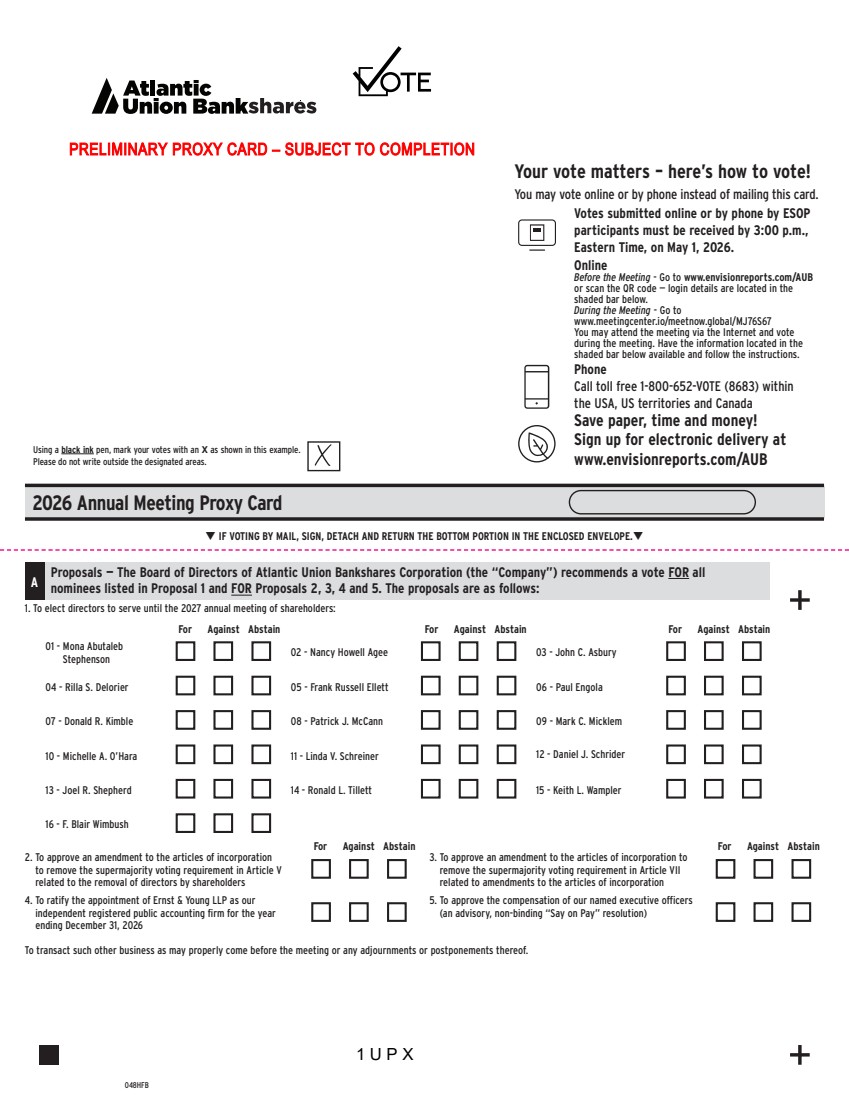
Authorizations of indemnification or payments under subsection (g) of this Article VI shall be made in the same manner as the determination that indemnification is proper, except that if the determination is made by special legal counsel, such authorizations of indemnification or payments under subsection (g) of this Article VI shall be made by those entitled under subsection (h)(ii) to select counsel.
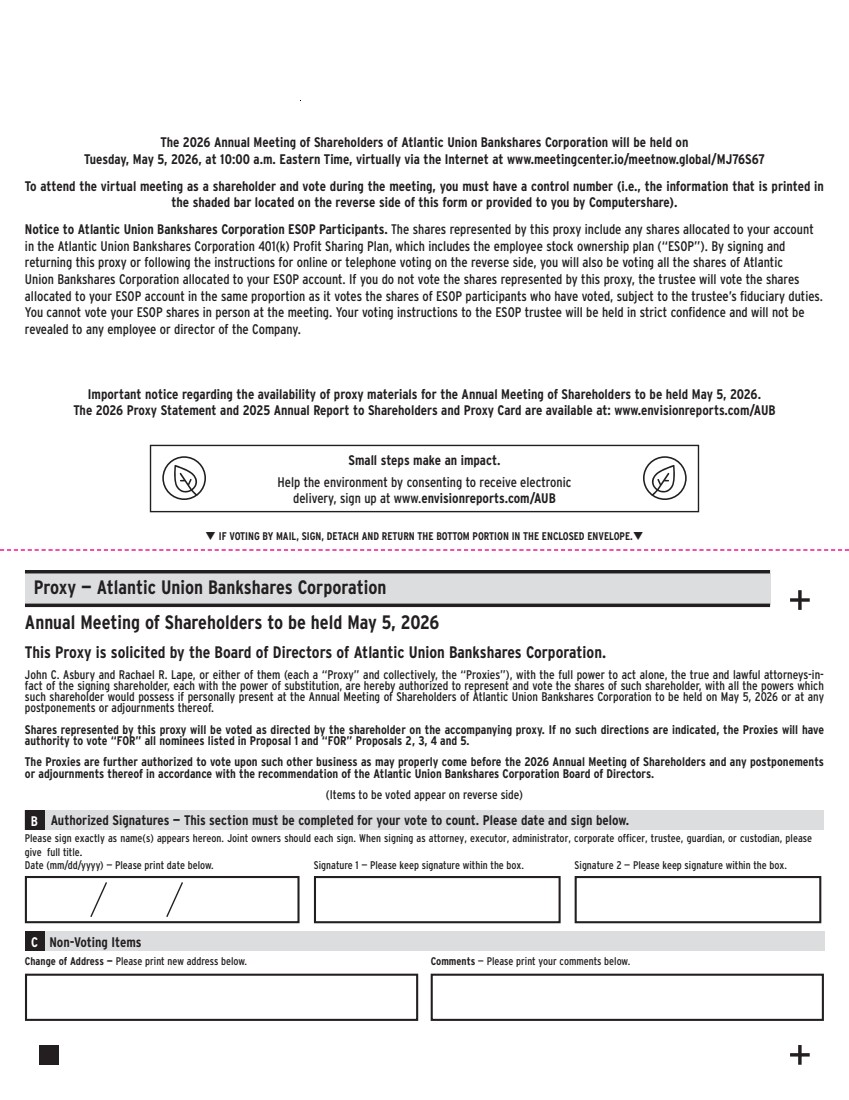
(i) The termination of any proceeding by judgment, order, settlement, conviction or upon a plea of nolo contendere or its equivalent, shall not of itself create a presumption that the applicant did not meet the standard of conduct described in subsection (a) or (b) of this Article VI.
(j)The indemnification provided by this Article VI and provided hereafter pursuant to the power conferred by this Article VI on the Board of Directors shall not be exclusive of any other rights to which any person may be entitled, including any right under policies of insurance that may be purchased and maintained by the Corporation or others, with respect to claims, issues or matters in relation to which the Corporation would not have the power to indemnify such person under the provisions of this Article VI. Such rights shall not prevent or restrict the power of the Corporation to make or provide for any further indemnity, or provisions for determining entitlement to indemnity, pursuant to one or more indemnification agreements, bylaws, or other arrangements (including, without limitation, creation of trust funds or security interests funded by letters of credit or other means) approved by the Board of
C-10
Directors (whether or not any of the Directors of the Corporation shall be a party to or beneficiary of any such agreements, bylaws or arrangements); provided, however, that any provision of such agreements, bylaws or other arrangements shall not be effective if and to the extent that it is determined to be contrary to this Article VI or applicable laws of the Commonwealth of Virginia. Each provision of this Article VI shall be severable, and an adverse determination as to any such provision of this Article VI shall in no way affect the validity of any other provision of this Article VI.
VII. Shareholder Approval of Certain Transactions
An amendment of the Corporation’s Articles of Incorporation, aA plan of merger or share exchange, a transaction involving the sale of all or substantially all the Corporation’s assets other than in the regular course of business and a plan of dissolution shall be approved by the vote of a majority of all the votes entitled to be cast on such transactions by each voting group entitled to vote on the transaction at a meeting at which a quorum of the voting group is present, provided that the transaction has been approved and recommended by at least two-thirds of the Directors in office at the time of such approval and recommendation. If the transaction is not so approved and recommended, then the transaction shall be approved by the vote of eighty percent (80%) or more of all the votes entitled to be cast on such transactions by each voting group entitled to vote on the transaction.
VIII. Amendments
Adoption of any amendment to the Articles of Incorporation that requires approval of shareholders by law shall be approved by the vote of a majority of all the votes entitled to be cast on such amendment by each voting group entitled to vote on such amendment at a meeting at which a quorum of the voting group exists.
C-11
| 01 - Mona Abutaleb Stephenson 04 - Rilla S. Delorier 07 - Donald R. Kimble 10 - Michelle A. O’Hara 13 - Joel R. Shepherd 16 - F. Blair Wimbush 02 - Nancy Howell Agee 05 - Frank Russell Ellett 08 - Patrick J. McCann 11 - Linda V. Schreiner 14 - Ronald L. Tillett 03 - John C. Asbury 06 - Paul Engola 09 - Mark C. Micklem 15 - Keith L. Wampler For Against Abstain For Against Abstain For Against Abstain For Against Abstain For Against Abstain 12 - Daniel J. Schrider Proposals — The Board of Directors of Atlantic Union Bankshares Corporation (the “Company”) recommends a vote FOR all nominees listed in Proposal 1 and FOR Proposals 2, 3, 4 and 5. The proposals are as follows: A 048HFB 1. To elect directors to serve until the 2027 annual meeting of shareholders: 2. To approve an amendment to the articles of incorporation to remove the supermajority voting requirement in Article V related to the removal of directors by shareholders 4. To ratify the appointment of Ernst & Young LLP as our independent registered public accounting firm for the year ending December 31, 2026 To transact such other business as may properly come before the meeting or any adjournments or postponements thereof. 3. To approve an amendment to the articles of incorporation to remove the supermajority voting requirement in Article VII related to amendments to the articles of incorporation 2026 Annual Meeting Proxy Card Using a black ink pen, mark your votes with an X as shown in this example. Please do not write outside the designated areas. q IF VOTING BY MAIL, SIGN, DETACH AND RETURN THE BOTTOM PORTION IN THE ENCLOSED ENVELOPE.q 5. To approve the compensation of our named executive officers (an advisory, non-binding “Say on Pay” resolution) 1 U P X If no electronic voting, delete QR code and control # 2024 You may vote online or by phone instead of mailing this card. Online Before the Meeting - Go to www.envisionreports.com/AUB or scan the QR code — login details are located in the shaded bar below. During the Meeting - Go to www.meetingcenter.io/meetnow.global/MJ76S67 You may attend the meeting via the Internet and vote during the meeting. Have the information located in the shaded bar below available and follow the instructions. Your vote matters – here’s how to vote! Votes submitted online or by phone by ESOP participants must be received by 3:00 p.m., Eastern Time, on May 1, 2026. Save paper, time and money! Sign up for electronic delivery at www.envisionreports.com/AUB Phone Call toll free 1-800-652-VOTE (8683) within the USA, US territories and Canada PRELIMINARY PROXY CARD – SUBJECT TO COMPLETION |
| Small steps make an impact. Help the environment by consenting to receive electronic delivery, sign up at www.envisionreports.com/AUB Annual Meeting of Shareholders to be held May 5, 2026 This Proxy is solicited by the Board of Directors of Atlantic Union Bankshares Corporation. John C. Asbury and Rachael R. Lape, or either of them (each a “Proxy” and collectively, the “Proxies”), with the full power to act alone, the true and lawful attorneys-in-fact of the signing shareholder, each with the power of substitution, are hereby authorized to represent and vote the shares of such shareholder, with all the powers which such shareholder would possess if personally present at the Annual Meeting of Shareholders of Atlantic Union Bankshares Corporation to be held on May 5, 2026 or at any postponements or adjournments thereof. Shares represented by this proxy will be voted as directed by the shareholder on the accompanying proxy. If no such directions are indicated, the Proxies will have authority to vote “FOR” all nominees listed in Proposal 1 and “FOR” Proposals 2, 3, 4 and 5. The Proxies are further authorized to vote upon such other business as may properly come before the 2026 Annual Meeting of Shareholders and any postponements or adjournments thereof in accordance with the recommendation of the Atlantic Union Bankshares Corporation Board of Directors. (Items to be voted appear on reverse side) Proxy — Atlantic Union Bankshares Corporation C Non-Voting Items q IF VOTING BY MAIL, SIGN, DETACH AND RETURN THE BOTTOM PORTION IN THE ENCLOSED ENVELOPE.q Change of Address — Please print new address below. Comments — Please print your comments below. Please sign exactly as name(s) appears hereon. Joint owners should each sign. When signing as attorney, executor, administrator, corporate officer, trustee, guardian, or custodian, please give full title. Date (mm/dd/yyyy) — Please print date below. Signature 1 — Please keep signature within the box. Signature 2 — Please keep signature within the box. B Authorized Signatures — This section must be completed for your vote to count. Please date and sign below. Important notice regarding the availability of proxy materials for the Annual Meeting of Shareholders to be held May 5, 2026. The 2026 Proxy Statement and 2025 Annual Report to Shareholders and Proxy Card are available at: www.envisionreports.com/AUB The 2026 Annual Meeting of Shareholders of Atlantic Union Bankshares Corporation will be held on Tuesday, May 5, 2026, at 10:00 a.m. Eastern Time, virtually via the Internet at www.meetingcenter.io/meetnow.global/MJ76S67 To attend the virtual meeting as a shareholder and vote during the meeting, you must have a control number (i.e., the information that is printed in the shaded bar located on the reverse side of this form or provided to you by Computershare). Notice to Atlantic Union Bankshares Corporation ESOP Participants. The shares represented by this proxy include any shares allocated to your account in the Atlantic Union Bankshares Corporation 401(k) Profit Sharing Plan, which includes the employee stock ownership plan (“ESOP”). By signing and returning this proxy or following the instructions for online or telephone voting on the reverse side, you will also be voting all the shares of Atlantic Union Bankshares Corporation allocated to your ESOP account. If you do not vote the shares represented by this proxy, the trustee will vote the shares allocated to your ESOP account in the same proportion as it votes the shares of ESOP participants who have voted, subject to the trustee’s fiduciary duties. You cannot vote your ESOP shares in person at the meeting. Your voting instructions to the ESOP trustee will be held in strict confidence and will not be revealed to any employee or director of the Company. |